
What’s the Best Tankless Water Heater for Your Large Household?
By Brian on January 14, 2026
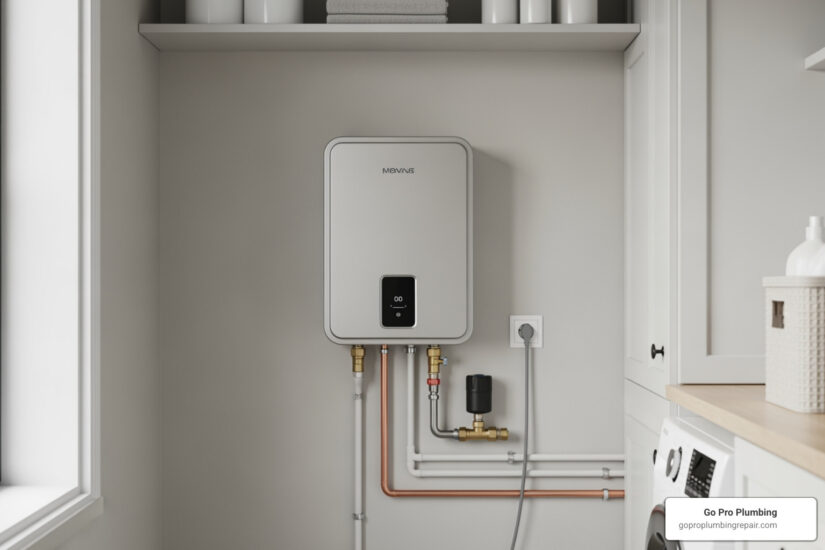
Why Large Homes Struggle with Traditional Water Heaters
The best tankless water heater for large home applications can deliver 8-11 gallons per minute (GPM) to handle multiple showers, appliances, and faucets running simultaneously. Here are the top models for 2025:
Top Tankless Water Heaters for Large Homes:
- Rinnai RU199iN – Best Overall (11 GPM, 0.95 UEF)
- Navien NPE-240A – Best Premium (condensing tech, built-in recirculation)
- Rheem RTGH-95DVLN – Best Gas Option (9.5 GPM, 4-bathroom capacity)
- Stiebel Eltron Tempra 36 – Best Electric (36kW, 99.5% efficiency)
- EcoSmart ECO 36 – Best Value (6 GPM, lifetime warranty)
Ever had three people showering at once while the dishwasher’s running, and suddenly – ice cold water hits? It’s a common nightmare in large homes.
Traditional water heaters store a limited supply of hot water in a tank, typically 40-50 gallons. But a family of four can easily use 100+ gallons during peak morning hours. When that tank runs dry, everyone suffers through cold showers until it refills and reheats – which can take 30-60 minutes.
Tankless water heaters solve this problem by heating water on demand as it flows through the unit. No storage tank means no running out of hot water, no matter how many fixtures are in use. For large households with 3+ bathrooms, multiple appliances, and high simultaneous demand, this technology is a game-changer.
These systems are also more efficient than traditional tanks. They only heat water when you need it, which can cut your water heating costs by 15-50%. Plus, they take up minimal wall space compared to bulky 50-gallon tanks – a huge benefit if your utility closet is cramped.
The key is choosing the right model with enough flow rate (GPM) to handle your household’s peak demand, plus the right energy efficiency rating to keep your bills low for years to come.

Related content about best tankless water heater for large home:
- how big are tankless water heaters
- are tankless water heaters more efficient
- Water heater energy savings
How to Choose a Tankless Water Heater for a Large Home
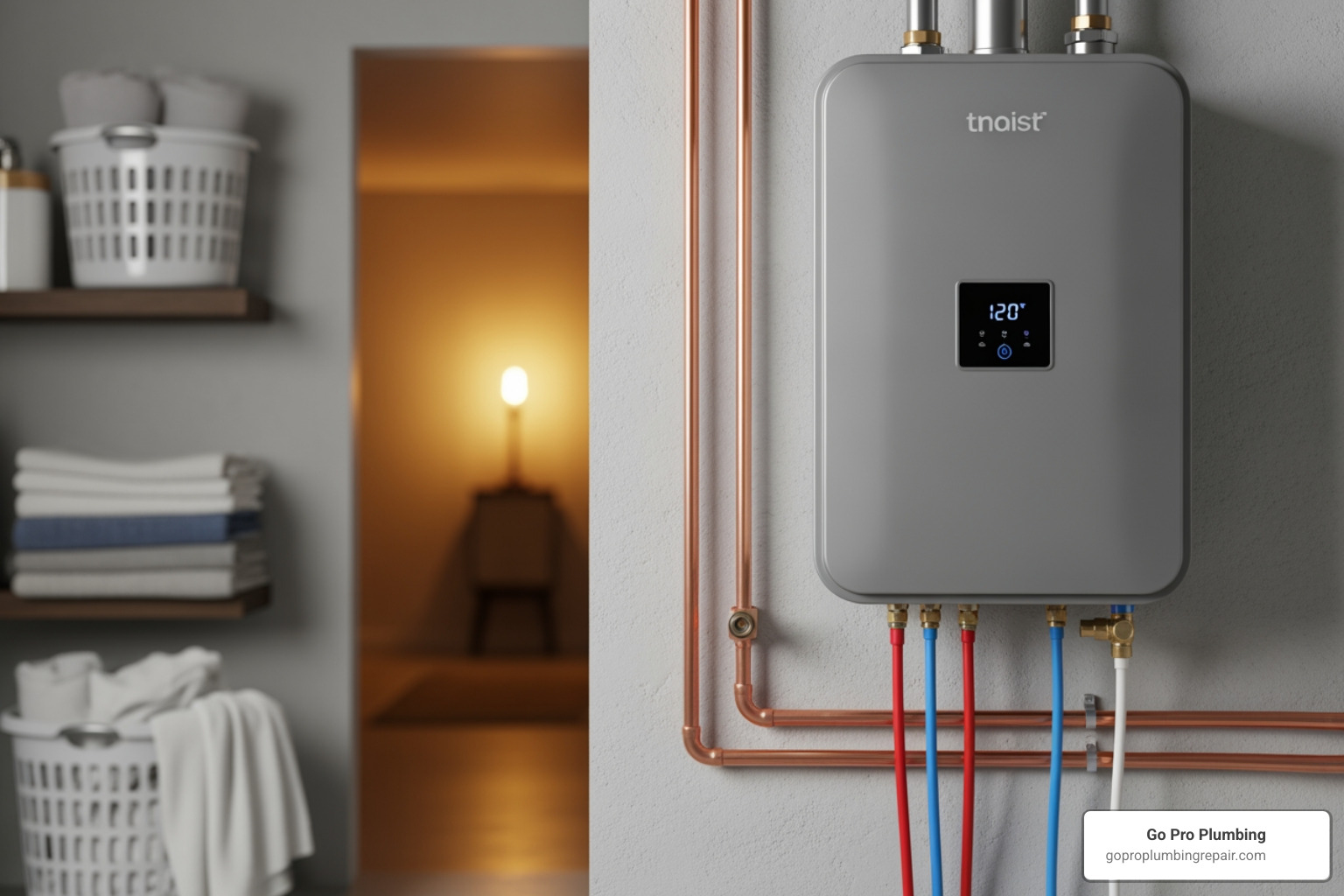
Selecting the ideal tankless water heater for a large home isn’t just about picking the biggest or most expensive model. It’s about a careful calculation of your household’s specific needs, energy considerations, and even your home’s existing infrastructure. We’ll walk you through the key features and factors to consider to ensure you never run out of hot water again.
At the heart of it, you need a unit that can deliver hot water consistently and efficiently. This means diving into metrics like Flow Rate (GPM), understanding Energy Efficiency (UEF), and weighing the pros and cons of gas versus electric models. We’ll also explore advanced technologies like condensing units, smart features, and recirculation pumps that can lift your hot water experience. Don’t worry, we’ll break it down into simple, understandable terms.
Key Sizing Factor: Flow Rate (GPM)
When it comes to tankless water heaters, Gallons Per Minute (GPM) is king. This number tells you how much hot water the unit can deliver at a specific temperature rise. For a large home, especially one with multiple bathrooms and appliances, simultaneous use is the name of the game. That’s why we need to calculate your peak demand.
Think about your busiest hot water moments. Is it mornings when everyone is showering, the dishwasher is running, and someone needs hot water for shaving? A typical shower uses about 2.0 gallons per minute. A dishwasher might pull 1.5 GPM, and a washing machine around 2.0 GPM. If you have two showers running (4 GPM total) and the dishwasher (1.5 GPM) at the same time, you’re looking at a peak demand of at least 5.5 GPM. This is a basic example, and real-world usage can be higher.
For large households with 3 or more bathrooms, we generally recommend aiming for a tankless water heater with a flow rate between 8 and 11 GPM to be on the safe side. This higher GPM ensures that everyone gets a comfortable hot shower, even when other hot water demands are active. You can find detailed calculators and guidance on sizing a new water heater to precisely match your needs.
It’s also crucial to consider your climate. In colder regions, incoming water is much colder, requiring the tankless unit to work harder to achieve your desired hot water temperature. This “temperature rise” impacts the effective GPM. A unit rated for 10 GPM in a warm climate might only deliver 6-7 GPM in a cold Northern California winter, so always factor this in!
Understanding Energy Efficiency (UEF)
After GPM, the next big number to look for is the Uniform Energy Factor (UEF). This rating measures a water heater’s overall energy efficiency, taking into account standby losses and heating efficiency. Simply put, a higher UEF means a more efficient unit, which translates to lower operating costs and more water heater energy savings for your large home.
For tankless water heaters, UEF ratings typically range from around 0.8 to over 0.98. Models with a UEF of 0.90 or higher are considered very efficient. We always recommend looking for ENERGY STAR certified models, as these units meet strict energy efficiency guidelines set by the EPA and can qualify for federal tax credits and local rebates. For example, some condensing tankless water heaters can achieve impressive UEF ratings of 0.93 or higher, maximizing every BTU of energy. Over the lifespan of the unit, these savings can really add up, making the initial investment even more worthwhile.
Gas vs. Electric: What’s Right for Your Home?
This is a fundamental choice with significant implications for performance and installation.
Gas Tankless Water Heaters: These are generally the go-to choice for large homes, especially here in Northern California, for a few compelling reasons:
- Higher GPM: Gas units, whether natural gas or propane, typically offer much higher flow rates (GPM) than electric models, making them better suited to meet the simultaneous demands of a large household.
- Cost-Effective Operation: Natural gas is often a more cost-effective fuel source than electricity for heating water, leading to lower monthly utility bills.
- Reliability: Gas tankless water heaters will continue to work during a power outage, unlike most electric models, ensuring you still have hot water when the lights go out.
Electric Tankless Water Heaters: While they offer advantages like compact size and no need for venting, electric tankless heaters present a significant challenge for large homes:
- Massive Electrical Requirements: To achieve even moderately high GPM for a large home, electric tankless units require an immense amount of electricity. We’re talking about needing a dedicated 200-300 amp electrical service, often requiring multiple high-amperage circuit breakers. For many existing homes in Sacramento or Rancho Cordova, this means expensive electrical panel upgrades and new wiring, which can easily double or triple your installation costs.
- Lower GPM Output: Even the most powerful electric models struggle to match the GPM output of their gas counterparts, especially in colder climates.
For these reasons, gas tankless water heaters are usually the more practical and powerful choice for high-demand large homes. However, if your home is all-electric and an upgrade is feasible, or if you only need hot water for a single, low-demand fixture, an electric unit might be considered. If you’re considering a sacramento electric tankless water heater install, we can help you assess your home’s electrical capacity.
Condensing vs. Non-Condensing Technology:
This distinction applies primarily to gas tankless water heaters and impacts efficiency.
- Non-Condensing: These are the traditional tankless units. They vent hot exhaust gases directly outside. While efficient, some heat is lost in these exhaust gases.
- Condensing: These advanced units capture additional heat from the exhaust gases by running them through a secondary heat exchanger. This process condenses the water vapor in the exhaust, recovering latent heat and significantly boosting efficiency (UEF of 0.93-0.98). The downside is a slightly higher upfront cost and the need for a condensate drain. For large homes seeking maximum energy savings, condensing models are almost always the superior choice.
Smart Features and Recirculation Pumps:
Modern tankless water heaters come with a host of features designed to improve comfort and efficiency:
- Wi-Fi Connectivity: Many models now offer Wi-Fi, allowing you to monitor and control your water heater from your smartphone. You can adjust temperatures, view energy usage, and even receive maintenance alerts.
- Built-in Recirculation Pumps: The “cold water sandwich” effect (a brief burst of cold water before the hot arrives) can be annoying. Built-in hot water recirculation for tankless system pumps or external systems can virtually eliminate this by keeping hot water close to your fixtures. Some even “learn” your usage patterns to optimize recirculation, saving energy while ensuring instant hot water. This is a fantastic feature for large homes where hot water has to travel long distances.
Our Top 7 Picks: The Best Tankless Water Heater for a Large Home in 2025
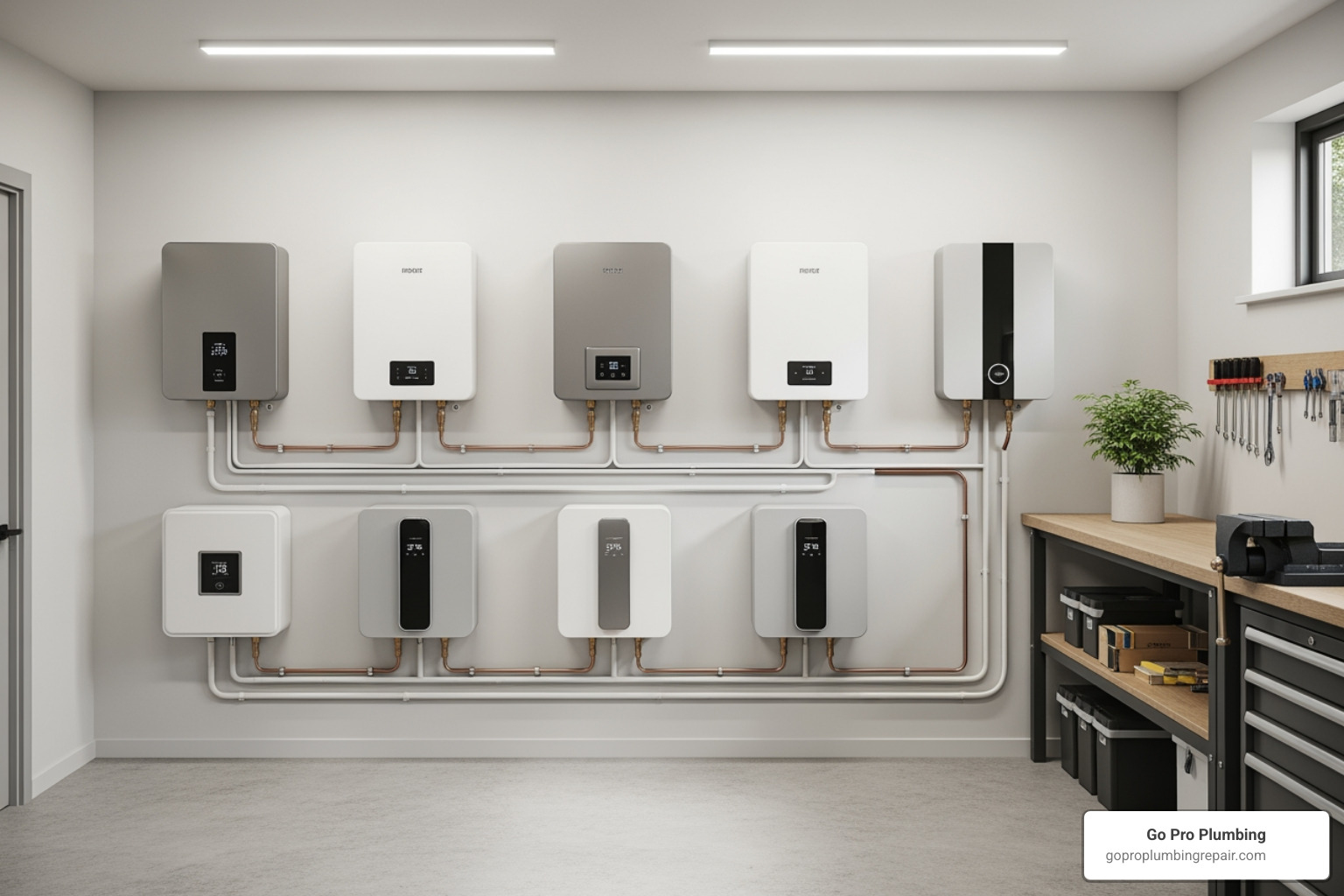
After careful consideration of flow rate, energy efficiency, advanced features, and overall reliability, we’ve compiled our top recommendations for the best tankless water heater for large home applications in 2025. These are the units that plumbers, like us, trust to deliver consistent, endless hot water even during the busiest household demands. We’ve factored in GPM, efficiency, smart features, and warranty to bring you the cream of the crop.
Best Overall: Rinnai RU199iN
The Rinnai RU199iN often tops the charts for a reason. With an impressive 11 GPM flow rate, this unit can handle up to 7 fixtures simultaneously – perfect for those busy mornings when everyone needs hot water at once. It boasts a remarkable 0.95 UEF, making it incredibly energy-efficient, and a powerful 199,000 BTU output. As a leading brand, Rinnai also offers advanced features like Smart-Circ intelligent recirculation technology, which learns your hot water usage patterns to provide hot water exactly when and where you need it, minimizing wait times and maximizing comfort. It’s a workhorse that consistently performs. You can learn about Rinnai models and if you’re in the area, we often recommend a rinnai tankless water heater sacramento installation.
Best Premium: Navien NPE-240A2
The Navien NPE-240A2 showcases what advanced engineering can achieve. This premium model features cutting-edge condensing technology, contributing to its excellent 0.95 UEF. What truly sets it apart for large homes is its built-in recirculation pump and ComfortFlow buffer tank. This innovative design practically eliminates the dreaded “cold water sandwich” effect, providing instant hot water from the moment you turn on the tap. As plumbers who’ve installed countless units, we can tell you this model’s sophisticated features make it worth every penny for large homes seeking the ultimate in comfort and efficiency. Explore Navien’s advanced features to see why it’s a top choice.
Best Gas Option: Rheem RTGH-95DVLN
For those prioritizing a robust gas-powered solution, the Rheem RTGH-95DVLN is a stellar choice. Its modulating gas valve operates between 11,000 to 199,000 BTU/h, precisely adjusting to your hot water demand. With a remarkable 0.93 UEF, it’s one of the most efficient gas tankless heaters out there. It delivers an impressive 9.5 GPM, making it suitable for homes with up to 4 bathrooms. The RTGH-95DVLN also features Ultra-Low NOx emissions, making it an environmentally conscious choice for Northern California homeowners. We’ve installed many of these, and their performance is consistently strong. See Rheem’s condensing line for more details.
Best Electric Option: Stiebel Eltron Tempra 36 Plus
If gas isn’t an option and you have the electrical capacity, the Stiebel Eltron Tempra 36 Plus is arguably the best tankless water heater for large home applications that run on electricity. With German engineering at its core, this powerhouse delivers remarkable efficiency with up to 99.5% energy conversion. Operating at 36kW, its self-modulating technology continuously monitors water flow and temperature, ensuring optimal power usage. You could see 15-20% savings on your energy bills compared to conventional electric tanks. However, be prepared: this unit requires substantial electrical service, often needing a 300-amp service with multiple circuit breakers, which can be a significant installation consideration. View the Tempra 36 specifications to understand its electrical demands.
Best Value: EcoSmart ECO 36
For homeowners looking for an efficient electric tankless water heater that won’t break the bank, the EcoSmart ECO 36 offers exceptional value. At 99.8% energy efficiency, this unit stands among the most efficient tankless heaters available. Its advanced self-modulating technology adjusts power consumption based on demand, potentially saving homeowners up to 50% on water heating costs according to Department of Energy data. While its 6 GPM flow rate might be slightly lower than the top gas models in very cold climates, it’s still robust enough for many large homes, especially in our moderate Northern California climate. Plus, EcoSmart offers a lifetime parts warranty, providing excellent peace of mind. Check out the EcoSmart ECO 36 for a budget-friendly, high-efficiency choice.
Best Compact Design: Takagi T-H3-DV-N
Space is often at a premium, even in large homes. The Takagi T-H3-DV-N proves that you don’t need a bulky unit to get powerful performance. At just 22.50″ x 17.75″ x 10.75″, this unit takes up minimal wall space while delivering a robust 10 GPM flow rate. It boasts a 0.95 Energy Factor and features a commercial-grade heat exchanger, ensuring durability and efficiency. Its space-saving design makes it perfect for utility closets or garage installations, freeing up valuable square footage. If you’re wondering how big are tankless water heaters and need a compact solution without compromising power, this Takagi model is a fantastic option. Find more on the Takagi T-H3.
Best Warranty: Noritz NR981-DVC-NG
A solid warranty is a testament to a manufacturer’s confidence in their product. The Noritz NR981-DVC-NG offers one of the best warranty packages in the industry, providing long-term peace of mind. It includes a 12-year warranty on the heat exchanger, 5 years on parts, and 1 year on labor. What truly sets this warranty apart is its transferability to new homeowners, protecting your investment even if you decide to sell your property down the line. Beyond the warranty, this is a reliable unit designed for consistent performance in large homes. Review Noritz warranty details for full coverage information.
Installation, Lifespan, and Long-Term Value
Choosing the best tankless water heater for large home applications is a significant investment, and understanding its installation, expected lifespan, and ongoing maintenance is crucial for maximizing its long-term value. Unlike traditional tank heaters, tankless systems offer distinct advantages in longevity and efficiency, but they also come with specific requirements. We believe that informed homeowners make the best decisions, so let’s dive into what you can expect after your purchase. For a comprehensive overview, check out our revamp your home with a tankless water heater installation guide.
Installation Considerations
While tankless water heaters are compact, their installation can be more complex than a simple tank replacement, especially for a large home. This is why professional installation is not just recommended, but often crucial for safety, performance, and warranty validation.
Here are the key considerations:
- Gas Line Upgrades: For gas tankless units, you might need a larger gas line (often 3/4 inch) to meet the higher BTU demands. If your existing line is too small, an upgrade will be necessary.
- Electrical Panel Upgrades: As discussed, electric tankless heaters for large homes require massive electrical capacity. This almost always necessitates an electrical panel upgrade and dedicated high-amperage circuits. Even gas models need a standard electrical outlet for their electronic controls.
- Venting Requirements: Gas tankless water heaters produce exhaust that must be safely vented outside. Modern high-efficiency condensing models often use PVC piping for venting, which can be more flexible and cost-effective than the stainless steel required for non-condensing units. Proper venting ensures no harmful gases enter your home.
- Water Line Connections: Your home’s water lines might need adjustments to accommodate the new unit, including the addition of service valves for future maintenance.
Given these complexities, hire a qualified plumber for your sacramento tankless water heater installation. Our team in Northern California has extensive experience ensuring these systems are installed correctly and safely, adhering to all local codes.
Lifespan and Maintenance
One of the most compelling advantages of tankless water heaters is their impressive lifespan. While traditional tank heaters typically last 10-12 years, a well-maintained tankless unit can easily last 20 years or more. This longer lifespan, combined with significant energy savings, contributes to a much lower total cost of ownership over time.
However, “well-maintained” is the operative phrase here. Tankless water heaters require regular maintenance, primarily annual flushing, to remove mineral buildup (scale) from the heat exchanger. This is especially important in areas with hard water, like parts of Northern California. If not flushed, mineral deposits can reduce efficiency, restrict water flow, and eventually damage the unit. Some units have built-in self-cleaning features, but manual flushing is still recommended.
We offer comprehensive water heater flush service sacramento ca to keep your tankless unit running efficiently for decades. This simple service protects your investment and ensures you continue to enjoy endless hot water.
Frequently Asked Questions about Tankless Water Heaters for Large Homes
We know you might have more questions about making the switch to a tankless water heater for your large home. Here are some of the most common inquiries we receive:
How many GPM do I really need for the best tankless water heater for a large home?
This is perhaps the most critical question. As we discussed earlier, it all comes down to your household’s peak simultaneous hot water demand. Let’s do a quick recap:
- A typical shower uses about 2 GPM.
- A dishwasher uses around 1.5 GPM.
- A washing machine uses roughly 2 GPM.
So, if you envision two showers running, plus the dishwasher, that’s 2 + 2 + 1.5 = 5.5 GPM. If someone also needs a hot water faucet for shaving (0.5 GPM), you’re at 6 GPM. For a truly large home with 3+ bathrooms, potentially a large soaking tub (which can draw 4-6 GPM on its own), and multiple appliances, aiming for a unit with 8-11 GPM is a safe bet. This higher GPM rating ensures that even during your busiest moments, your family won’t experience cold showers. Colder incoming water temperatures (common in winter) will reduce a unit’s effective GPM output, so always factor that into your calculations.
Are electric tankless heaters a good choice for a large home?
For most large homes, especially those with high simultaneous hot water demands, electric tankless heaters are generally not the best choice. While they are efficient and compact, their power requirements are extreme. To achieve a GPM suitable for a large household, an electric unit would often require a dedicated 300-amp electrical service and multiple large circuit breakers. For many existing homes in Northern California, this would necessitate expensive electrical panel and wiring upgrades, making the installation cost prohibitive.
Gas tankless models, whether natural gas or propane, are almost always more practical and powerful for high-demand households. They offer significantly higher GPM outputs without the massive electrical infrastructure demands. We encourage you to review our detailed guide to comparing tankless water heater options to understand why gas often wins for larger residences.
What is the typical installation cost for the best tankless water heater for a large home?
The installation cost for a best tankless water heater for large home can vary widely, typically ranging from $3,000 to $8,000+, depending on several factors unique to your home in Northern California.
- Unit Cost: The tankless unit itself can range from $1,000 to $3,000+.
- Retrofitting Needs: If you’re replacing a traditional tank, you might need significant plumbing modifications.
- Gas Line Upgrades: A common expense for gas models is upgrading your gas line to a larger diameter (e.g., 3/4 inch) to meet the unit’s BTU demands.
- Electrical Work: Even gas units need a standard electrical outlet. Electric models, as discussed, can require extensive and costly electrical panel and wiring upgrades.
- Venting Complexity: The routing and type of venting material (PVC vs. stainless steel) can impact costs.
- Labor: Professional installation by licensed plumbers ensures safety and compliance with local codes.
While the upfront cost can be higher than a traditional tank heater, remember the long-term savings on energy bills and the extended lifespan of a tankless unit. Plus, you might be able to find a tankless water heater rebate sacramento or explore tankless water heater financing options to make the investment more manageable. We’re here to provide transparent quotes and help you understand all potential costs.
Conclusion: Upgrade Your Large Home to Endless Hot Water
Say goodbye to the “cold shower nightmare” and hello to endless hot water. Choosing the best tankless water heater for large home applications is a smart investment in your family’s comfort and your home’s energy efficiency. By focusing on key factors like flow rate (GPM) to meet your peak demand and Uniform Energy Factor (UEF) for long-term savings, you can select a unit that perfectly suits your household’s needs. A tankless water heater is a long-term investment in comfort and efficiency, designed to last for two decades or more with proper maintenance.
For expert advice, professional assessment of your home’s needs, and seamless installation of a tankless water heater in Northern California, including Sacramento and Rancho Cordova, trust the experienced team at Go Pro Plumbing. We’re committed to outstanding customer service and ensuring your home enjoys the benefits of unlimited hot water. Don’t hesitate to Contact us for professional tankless water heater services today.