
Don’t Dismantle! Replacing Your Pedestal Sink Faucet Made Easy
By Brian on January 1, 2026
Why Changing a Faucet on a Pedestal Sink is Different
Change faucet on pedestal sink projects come with unique challenges that turn what seems like a simple swap into a frustrating ordeal for many homeowners. The tight space behind the pedestal makes accessing connections difficult, and as one DIY blogger called it, the biggest “rookie mistake” is trying to work around the sink instead of removing it.
Quick Answer: Steps to Change a Faucet on a Pedestal Sink
- Turn off water at shutoff valves under the sink
- Remove the sink basin from the wall (highly recommended for access)
- Disconnect old faucet – supply lines, mounting nuts, and drain assembly
- Install new faucet – secure with mounting nuts, apply plumber’s putty to drain
- Remount basin and reconnect all plumbing connections
- Test for leaks and check drain function
The primary challenge isn’t the complexity of the work itself—it’s the cramped workspace behind the pedestal. While you can technically replace a faucet without removing the basin, most DIYers find this approach saves time and eliminates scraped knuckles. Even professional plumbers consider pedestal sink work “one of my least favorite jobs” due to the tight access.
Time: 2-4 hours for most DIYers
Cost: Around $150 for parts, plus $10-11 for a basin wrench if you don’t own one
Difficulty: Moderate—manageable with the right approach
This guide will walk you through the entire process, from understanding your faucet type to making that final leak check. We’ll show you why removing the basin transforms this from a frustrating project into a manageable one.
Gearing Up: Preparation and Understanding Your Sink
Before we dive in, let’s get organized. A little preparation goes a long way in turning a potentially messy project into a smooth success. For most DIYers, replacing a faucet on a pedestal sink is a 2 to 4-hour project. If this is your first time tackling a plumbing project of this nature, especially with a pedestal sink, we recommend budgeting for the higher end of that range. Rushing a plumbing task is never a good idea, so set aside a half-day to do it right.
In terms of cost, expect to spend around $150 for parts, which typically covers a new faucet kit and possibly new supply lines. You might also need to factor in the cost of a specialized tool like a basin wrench, which runs about $10-$11. It’s a worthwhile investment, as we’ll explain shortly!
When preparing your workspace, the first step is to clear everything from under and around the sink. Remove any cleaning supplies, toiletries, or decorative items. This isn’t just about tidiness; it’s about safety and giving yourself enough room to work without knocking things over. Next, protect your floor from inevitable drips and spills by laying down old towels or a tarp. Keep a bucket and plenty of rags handy for catching water and wiping up messes.
Here’s a list of essential tools and materials we recommend having on hand:
- Basin wrench: This is your best friend for reaching those impossibly tight spots behind the basin. Its long shaft and swiveling head are specifically designed to grip the mounting nuts that hold the faucet in place, which are otherwise nearly impossible to reach with a standard wrench. It’s a small investment that can save you a world of frustration and scraped knuckles.
- Adjustable wrenches (a set of two is ideal)
- Pliers (channel-lock pliers are particularly useful for P-trap nuts)
- Utility knife
- Putty knife (for scraping old caulk/putty)
- Plumber’s putty: Essential for creating watertight seals around the new faucet and drain. We prefer grey putty as it often matches hardware better than beige!
- Silicone caulk and caulk gun (for resealing the sink to the wall and floor)
- New faucet kit (make sure it’s compatible with your sink’s hole configuration)
- Stainless steel braided hoses (new supply lines are often a good idea, especially if your old ones are stiff or corroded)
- Safety glasses
- Headlamp or flashlight
- Penetrating oil (for stubborn, corroded nuts)
Understanding Faucet and Drain Types
Before you even think about removing your old faucet, it’s crucial to understand the different types of faucet configurations and how they relate to your sink. This will help you choose a new faucet that’s compatible with your existing sink setup. Take a moment to look at your current sink. How many holes does it have for the faucet? What is the distance between them? This is the most critical information you’ll need when shopping.
| Faucet Configuration | Hole Spacing | Description – |
|---|---|---|
| Centerset | 4 inches | The most common type for bathroom sinks. The handles and spout are combined on a single base unit. – |
| Widespread | 8 to 16 inches | Features separate hot and cold handles that are not connected to the spout above the sink. This offers a more customizable and often more luxurious look. – |
| Single-Hole | One hole | A single handle controls both temperature and flow. Some single-hole faucets come with an optional deck plate to cover existing 3-hole setups. – |
| Drain Type | Mechanism | Description – |
| Pop-up Drain | Lever/Rod Operated | A rod, usually located behind the faucet, is lifted or pushed to open and close the drain stopper. This is the most traditional type. – |
| Click-Clack/Push-Pop | Spring-Loaded | A simple push on the drain stopper itself causes it to pop up or click closed. This type is becoming increasingly popular for its sleek, modern look and ease of installation, as it doesn’t require a connecting rod. |
The Great Debate: To Remove the Sink Basin or Not?
This is the single most important decision you’ll make for this project. The primary challenge isn’t the complexity of the plumbing itself—it’s the severely limited workspace. The pedestal, while neat, creates a narrow, awkward cavern between the sink basin and the wall. Trying to work in this space is like performing surgery in a shoebox. You’ll be on your back, contorting your body, and trying to turn a wrench with only your fingertips.
While it’s technically possible to replace a faucet without removing the basin, most DIYers and even seasoned professionals find this approach leads to immense frustration, scraped knuckles, and a much longer project time. As one DIY blogger aptly put it, it’s the biggest ‘rookie mistake’ you can make. Even professional plumbers often admit that pedestal sink work is ‘one of my least favorite jobs’ precisely because of this tight access. The time you think you’re saving by not removing the sink is often lost tenfold in the struggle to loosen and tighten nuts in a space where your hands barely fit.
How to Safely Remove the Sink Basin
Convinced? Good. Removing the basin is a straightforward process that will make the rest of the job a breeze.
- Score the Caulk: Use a utility knife to carefully cut the caulk seal where the sink meets the wall. This will prevent you from damaging the paint or drywall when you pull the sink away.
- Loosen the Mounting Bolts: Look underneath the sink, on either side, for the lag bolts or nuts that secure the basin to the wall. Loosen them with a wrench, but don’t remove them completely just yet. They will hold the sink in place while you disconnect the plumbing.
- Disconnect Everything: Follow the steps in the next section to disconnect the water supply lines and the P-trap from the wall pipes.
- Lift and Remove: With the plumbing disconnected, fully remove the mounting nuts. The basin is now free. It can be heavy and awkward, so it’s a good idea to have a helper. Lift the basin straight up and off the pedestal. Place it upside down on a soft, protected surface like a thick towel or a piece of cardboard to prevent scratching the porcelain.
Step-by-Step Guide to Change Faucet on Pedestal Sink
This section provides a detailed walkthrough for both removing the old hardware and installing the new, ensuring a professional result. We’ll assume you’ve made the wise choice to remove the sink basin first, giving you open and easy access to all the connections.
Step 1: Removing the Old Faucet and Drain Assembly
With your basin safely placed upside down on a protected surface, you have a clear view of all the plumbing. Now, let’s get that old faucet out.
- Disconnect Water Supply Lines: If you haven’t already, place a bucket underneath the shutoff valves. Use an adjustable wrench to loosen the nuts connecting the hot and cold water supply lines to the valves. A second wrench can be used to hold the valve steady to prevent it from twisting or damaging the pipe. Once loose, some residual water will drain out. Now, disconnect the other end of the supply lines from the faucet’s threaded shanks.
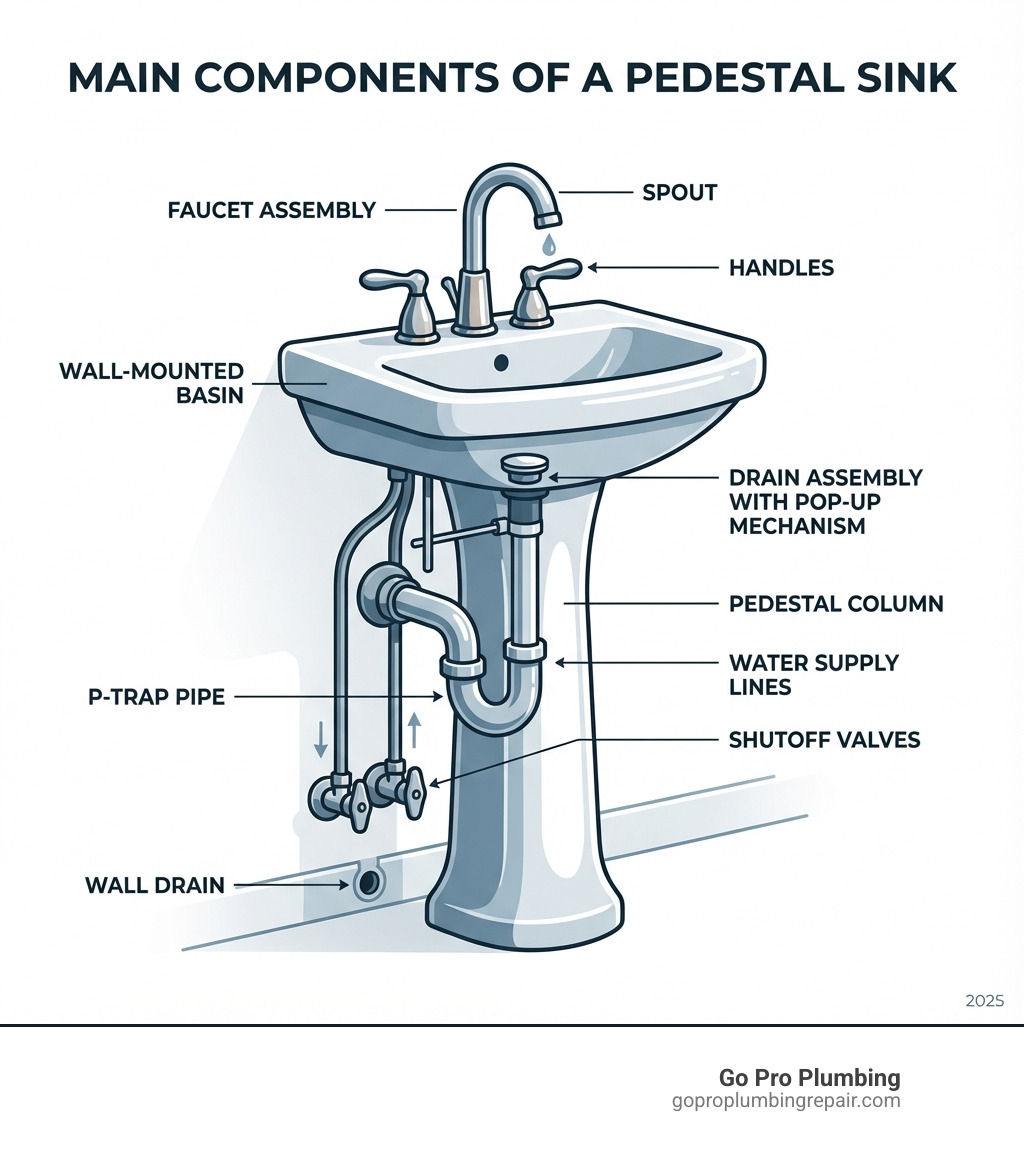
- Disconnect the P-Trap: The P-trap is the U-shaped pipe under the sink. It holds a small amount of water to block sewer gases. Position your bucket directly underneath it. The large slip nuts holding it in place are often just hand-tight, but you can use channel-lock pliers if they’re stuck. Unscrew both ends and carefully lower the P-trap, emptying its contents into the bucket.
- Disconnect the Pop-Up Drain Linkage: If you have a pop-up drain, you’ll see a horizontal rod connected to a vertical strap. This is the linkage. It’s usually held in place by a small spring clip. Squeeze the clip to release the rod. Then, unscrew the pivot nut that holds the rod in the drain tailpiece and pull the rod out.
- Loosen Faucet Mounting Nuts: This is where your basin wrench becomes invaluable. From underneath the sink, locate the large nuts (usually plastic or brass) that hold the faucet to the sink deck. If they are corroded, a shot of penetrating oil can help loosen them. Fit the basin wrench’s jaw around a nut and use the T-handle to turn it. It might take some effort, but it’s far easier than trying to fit a standard wrench in that tight space.
- Remove the Old Faucet and Drain: Once the mounting nuts are off, you can lift the old faucet assembly straight up and out of the sink. Then, from underneath, unscrew the large nut holding the drain flange in place. Push the drain body down and out, and then lift the flange from the top of the sink.
- Clean the Sink Surface: Use a putty knife to carefully scrape away any old plumber’s putty or sealant from around the faucet and drain holes. Clean the area thoroughly with a rag and some rubbing alcohol to ensure a clean, dry surface for the new installation. This is a critical step for ensuring a good seal with the new components.
Step 2: Installing the New Faucet and Drain
With the old hardware gone and the surface prepped, you’re ready for the new installation. Always follow the manufacturer’s instructions included with your new faucet, but these general steps will guide you.
- Install the New Drain Assembly: Take your plumber’s putty and roll it into a thin, snake-like rope about the thickness of a pencil. Place this rope around the underside of the new drain flange. From the top of the sink, press the flange firmly into the drain hole. From underneath, slide the rubber gasket onto the drain body and then screw on the large mounting nut. Tighten it by hand first, then give it another quarter-turn with channel-lock pliers. Don’t overtighten, as this can crack the porcelain. Wipe away any excess putty that squeezes out from the top.
- Install the New Faucet: Carefully guide the new faucet’s tailpieces and any attached supply lines through the mounting holes in the sink. If your faucet came with a base gasket, ensure it’s properly seated against the porcelain.
- Secure the Faucet: From underneath, slide the provided washers and mounting nuts onto the faucet’s threaded shanks. Hand-tighten them first, ensuring the faucet is straight and centered from above. Then, use your basin wrench to give them a final tightening. Again, be firm but avoid over-tightening to prevent cracking the sink.
- Connect Supply Lines and Pop-Up Drain: If your new faucet didn’t come with integrated supply lines, now is the time to attach your new stainless steel braided hoses to the faucet’s tailpieces. Then, re-install the pop-up drain linkage according to the manufacturer’s instructions. This usually involves inserting the pivot rod and securing it with its clip. Test the pop-up mechanism to ensure it opens and closes smoothly before moving on.
Step 3: Reassembling the Pedestal Sink
Now it’s time to put everything back together. This step is much easier with a helper to assist in lifting and aligning the heavy sink basin.
- Position the Basin: Carefully lift the sink basin, now with the new faucet attached, and place it back onto the pedestal. Align the mounting holes on the back of the sink with the bolts or brackets on the wall.
- Secure the Basin: Thread the nuts and washers onto the mounting bolts and tighten them, alternating between each side to ensure even pressure. The goal is to make the sink snug and stable, but be very careful not to overtighten, as this can crack the porcelain. Check for any wobbling and adjust as needed.
- Reconnect Plumbing: Re-attach the P-trap to the new drain tailpiece and the wall pipe. Hand-tighten the slip nuts, then give them a slight turn with pliers if needed. Connect the new hot and cold water supply lines to the corresponding shutoff valves. Use two wrenches again to prevent straining the pipes.
- Seal the Gaps: Apply a thin, even bead of silicone caulk along the seam where the back of the sink meets the wall. If your pedestal was previously caulked to the floor, apply a new bead there as well. This prevents water from splashing behind the sink and provides a clean, finished look. Smooth the bead with a wet finger or a caulk finishing tool for a professional appearance.