
The Rancho Cordova Gas Leak: Understanding Past Tragedies to Prevent Future Ones
By Brian on December 8, 2025

Why Understanding Gas Leak History Matters for Your Safety
Rancho Cordova gas leak incidents have shaped the community’s awareness of natural gas safety over the past two decades. If you’re searching for information about gas leaks in this Sacramento County city, here’s what you need to know:
Key Facts About Rancho Cordova Gas Leaks:
- 2008 Christmas Eve Explosion: One person killed, five injured, home destroyed due to PG&E negligence – resulting in a $38 million fine
- Recent Folsom Boulevard Incident: 12-15 homes evacuated after contractor struck unmarked gas line, no injuries reported
- Primary Causes: Faulty repairs, contractor accidents, and delayed emergency response
- Warning Signs: Rotten egg smell, hissing sounds, dead vegetation, physical symptoms like dizziness
Gas leaks aren’t just statistics. They’re real events that have forever changed families in our community. On Christmas Eve 2008, a 72-year-old man lost his life when natural gas accumulated in his Paiute Way home and exploded. Five others were injured. The tragedy could have been prevented.
This wasn’t an isolated incident. More recently, a private contractor’s equipment struck an unmarked gas line on Folsom Boulevard, forcing families from their homes and buckling the asphalt as gas escaped underground.
These incidents share common threads: preventable causes, warning signs that were missed or ignored, and critical lessons about emergency response. Understanding what happened helps protect your family today.
Whether you’re a homeowner worried about aging pipes, a renter who smelled something strange, or a contractor working near utility lines, knowing the history and warning signs of gas leaks can save lives.
Reviewing Major Rancho Cordova Gas Leak Incidents
Gas leak safety isn’t just theory; it’s lessons from real tragedies. Rancho Cordova has experienced incidents that changed lives and shaped our approach to natural gas safety.
These incidents remind us to stay vigilant, follow procedures, and act on any warning sign.
The Tragic 2008 Christmas Eve Explosion
Christmas Eve should be filled with joy and anticipation. But for families on Paiute Way in 2008, December 24th became a day of unimaginable loss.
At 1:35 p.m., a massive natural gas explosion tore through 10708 Paiute Way. The blast was so powerful it completely destroyed one home, severely damaged two others, and could be felt throughout the neighborhood. A 72-year-old man lost his life. Five other people were injured, some critically.
This tragedy was heartbreakingly preventable.
The National Transportation Safety Board investigation uncovered a chain of failures that led to this devastating Rancho Cordova gas leak and explosion. Back in 2006, PG&E had made a repair to the gas line. They inserted a 1¼-inch polyethylene pipe into an older 2-inch pipeline from 1977. Sounds technical, but here’s what matters: they used the wrong type of pipe. It was unmarked, out-of-specification, and had walls that were too thin. At the mechanical coupling, gas slowly began to escape.
But the problems didn’t stop there. Residents had been smelling gas in the area. On the morning of the explosion, a neighbor at 10716 Paiute Way called to report a gas odor at 9:16 a.m. A PG&E technician arrived, but a properly trained crew with the right equipment didn’t show up for another 2 hours and 47 minutes. The technician on scene didn’t even have barrier tape to warn residents of the danger.
The explosion happened at 1:35 p.m., just as a leak investigator finally arrived. The likely spark? A 17-year-old granddaughter flicking a cigarette lighter inside the home, having no idea that invisible natural gas had filled the space around her.
The California Public Utilities Commission hit PG&E with a $38 million fine—the highest safety-related penalty they’d ever issued at that time. PG&E was forced to replace underground pipes throughout the area and overhaul their emergency response procedures.
Ten years later, neighbors told reporters that the heartbreak never really goes away. Some said Christmas has never felt the same. You can read their reflections in this CBS News report about the tragedy.
The More Recent Folsom Boulevard Gas Leak
The 2008 explosion taught us hard lessons about utility company negligence. But a more recent incident along Folsom Boulevard near Mira del Rio Drive reminded us that private contractors also play a critical role in gas line safety.

During underground trenching work, a private contractor struck an unmarked gas line. Not once, but three times. The damage was immediately obvious—gas shot out of the ground with such force that it buckled the asphalt above it.
Thankfully, this Rancho Cordova gas leak had a very different outcome than the 2008 tragedy. Emergency services responded quickly. Metro Fire of Sacramento and the Sacramento Office of Emergency Services evacuated 12 to 15 homes as a precaution. No one was injured. No one lost their life.
Residents were allowed back home around 2:15 p.m., though Folsom Boulevard stayed closed for another hour or two while crews secured the area and started repairs.
This incident highlights something crucial: calling 811 before you dig isn’t optional—it’s essential. That simple phone call gets utility lines marked before any excavation begins. It’s the difference between a normal workday and a neighborhood evacuation.
Both of these incidents—separated by years but connected by preventable causes—show us that gas leak safety isn’t just about old pipes or corporate negligence. It’s about everyone doing their part: utilities maintaining their lines properly, contractors following safety protocols, and residents knowing the warning signs and acting immediately when something seems wrong.
Recognizing the Warning Signs of a Gas Leak
Recognizing a gas leak early can make all the difference between a close call and a tragedy. Here’s how to know if there’s a leak in your home.
Natural gas companies actually do us a huge favor. Since natural gas is naturally odorless, colorless, and tasteless—basically invisible to all our senses—they add a chemical called mercaptan to give it that distinctive smell. You know the one. It’s not pleasant, but that’s the point.
What to Look, Listen, and Smell For
Your senses are your best early warning system for a Rancho Cordova gas leak. Let’s talk about what to pay attention to.
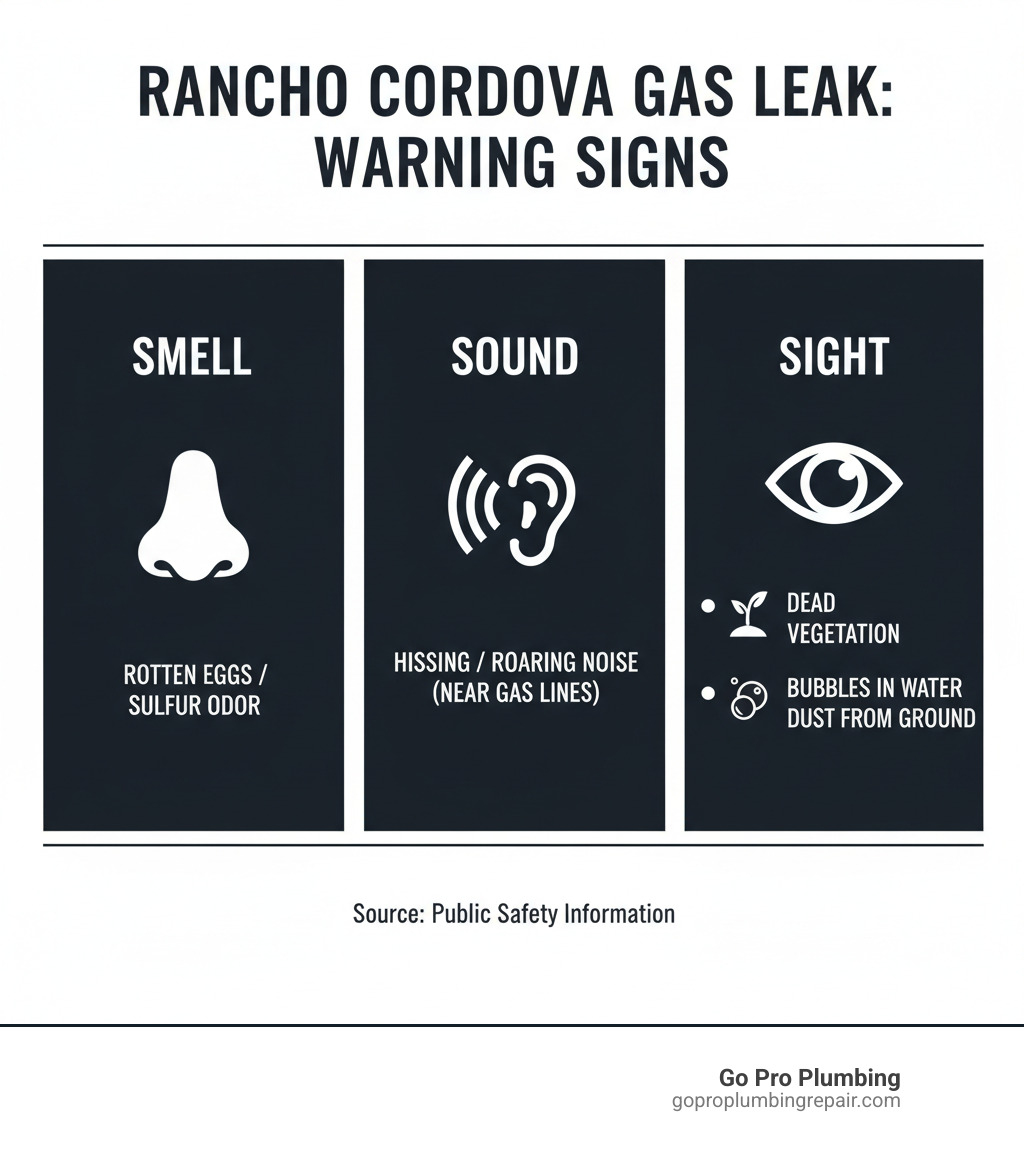
The smell is usually what people notice first. If you catch a whiff of something that reminds you of rotten eggs or sulfur, trust your nose. That distinctive odor is mercaptan doing its job. Some people describe it as smelling like a skunk or decaying vegetables. Whatever comparison works for you, the key is this: don’t second-guess yourself or assume it’s something else.
Listen carefully for unusual sounds around your gas appliances or outside near gas lines. A hissing or roaring sound means gas is escaping under pressure. You might hear it near your stove, water heater, furnace, or even coming from the ground in your yard. This sound isn’t normal, and it demands immediate attention.
Visual clues can be just as important, though they’re often overlooked. Take a walk around your property occasionally and look for these signs:
Dead or dying vegetation in isolated patches, especially near where you know gas lines run, can signal an underground leak. If one spot in your lawn is brown and dying while everything around it looks healthy, gas might be depriving the roots of oxygen. Bubbles in standing water—whether it’s a puddle after rain, a pond, or even muddy areas—can indicate gas escaping from below. You might also see dust or dirt blowing up from the ground where gas is pushing through soil under pressure.
Don’t forget to check your appliances. Damaged connections on your stove, water heater, or furnace are obvious red flags. Sometimes you’ll notice a white cloud or mist near a gas line, or even unexplained condensation on your windows.
If you see, hear, or smell any of these warning signs, it’s time to act—not investigate further.
Physical Symptoms and Health Risks of a Rancho Cordova Gas Leak
Here’s something that catches people off guard: a gas leak can make you feel sick before you even realize there’s a problem.
While natural gas isn’t toxic like carbon monoxide, it creates danger by displacing oxygen in enclosed spaces. When there’s less oxygen available, your body starts sending distress signals. You might experience dizziness or lightheadedness, almost like you stood up too quickly. Nausea often follows, sometimes with vomiting. Headaches are extremely common—the kind that seem to come out of nowhere.
Many people also report feeling unusually fatigued or drowsy, even after a full night’s sleep. Some experience irregular breathing or find themselves short of breath without exertion.
Here’s the tricky part: these symptoms can easily be mistaken for the flu, food poisoning, or just being run down. But if you or your family members are experiencing these issues without an obvious cause—especially if multiple people in the household feel sick at the same time—consider a gas leak as a real possibility.
The danger increases with prolonged exposure. In high concentrations, or when oxygen levels drop significantly, natural gas can be life-threatening. This is why getting to fresh air immediately is so critical.
If you suspect a gas leak is making you or your loved ones ill, don’t try to tough it out. Get everyone outside into fresh air right away. If symptoms persist or are severe—particularly difficulty breathing, chest pain, or loss of consciousness—call 911 or seek emergency medical care immediately.
Your health and safety aren’t worth gambling on. When in doubt, get out.
Your Immediate Action Plan for a Suspected Gas Leak
When you suspect a Rancho Cordova gas leak, your mind might race with questions: Should I investigate? Should I grab important belongings? The answer is simpler than you think: get out now, ask questions later.
Every second matters when gas is involved. The difference between a close call and a tragedy often comes down to how quickly and calmly you respond. We’ve seen what can happen when gas accumulates in homes—the 2008 Christmas Eve explosion is a heartbreaking reminder. That’s why we want you to have a crystal-clear action plan memorized before you ever need it.

Your first and most important step is to evacuate immediately. Don’t pause to investigate the source. Don’t stop to grab your laptop or jewelry. Just get yourself, your family, and your pets out of the building as quickly and calmly as possible. If you’re outside when you notice signs of a leak, move far away from the area—at least several hundred feet if possible.
Here’s what makes gas leaks so dangerous: a single spark can ignite the accumulated gas. That’s why the next rule is absolutely critical: do not use any electronics or touch any electrical switches. This means no light switches, no cell phones while inside, no appliances, no garage door openers—nothing. Even the tiniest spark from flipping a switch or unplugging a device could trigger an explosion.
Leave light switches exactly as they are. If a light is on, leave it on. If it’s off, don’t turn it on. The same goes for your thermostat, doorbell, or anything else electrical. Resist the urge to turn things off as you leave.
If you can safely leave doors and windows open as you exit, do so—but don’t delay your evacuation for this step. Opening windows helps ventilate the area, but your safety comes first. If it takes more than a few seconds, skip it and keep moving.
Once you’re at a safe distance from the building—ideally across the street or at a neighbor’s home—call 911 immediately. Use a neighbor’s phone or your cell phone from this safe location. Emergency services need to know about the situation right away. The fire department and trained responders will handle the situation with the proper equipment and expertise.
After calling 911, contact PG&E to report the gas leak. You can find their emergency number on your utility bill, or call 1-800-743-5000. Give them your exact address and describe what you’ve noticed—the smell, any sounds, visible signs, or symptoms anyone experienced.
Finally, and this is crucial: do not re-enter your home or building until emergency services or the utility company explicitly tells you it’s safe. We know it’s hard to stay away from your home, but gas can linger in pockets and concentrations that aren’t immediately obvious. Only trained professionals with proper detection equipment can confirm that all gas has been cleared and the source has been secured.
Your safety isn’t worth the risk of going back for anything. Trust us—we’ve been called to homes after gas incidents, and the families who followed these steps are the ones who walked away unharmed. Material possessions can be replaced. You cannot.
Prevention and Accountability: Lessons from Past Incidents
The tragedies and close calls we’ve experienced in Rancho Cordova have taught us invaluable lessons. But lessons only matter if they lead to real change. When we look at both the devastating 2008 explosion and the more recent contractor-caused incident on Folsom Boulevard, we see clear patterns—and clear opportunities to prevent future Rancho Cordova gas leak events.
Prevention isn’t just about better technology or stricter rules. It’s about every person involved in our community’s gas infrastructure taking responsibility seriously. That includes the contractors digging in our neighborhoods, the utility companies maintaining the lines, and the regulatory agencies holding everyone accountable.
The Critical Role of Private Contractors
The Folsom Boulevard incident could have been a tragedy. Instead, it was a wake-up call about something that happens far too often: contractors accidentally striking gas lines during excavation work. In that case, a private contractor’s equipment hit an unmarked gas line during underground trenching, breaking the pipe in three places and forcing families from their homes.
Here’s the thing—these accidents are almost entirely preventable.
Before anyone digs anywhere in California, there’s a simple, free step that can save lives: calling 811. When you dial 811, you’re connected to your local call center, which notifies utility companies to come out and mark the approximate location of underground lines with paint or flags. This includes gas pipes, electrical lines, water pipes, and communication cables.
Whether you’re a large construction company excavating for a new building or a homeowner planning to plant a tree in your backyard, calling 811 should be your mandatory first step. It’s not just good practice—it’s the law in most situations, and it’s common sense.
When contractors skip this step or ignore the markings, they’re gambling with public safety. The potential consequences extend far beyond the immediate danger of the leak itself. Contractor liability for striking unmarked (or worse, marked) gas lines can be severe, including financial responsibility for emergency response costs, repairs, evacuations, and any resulting damages or injuries.
We’ve seen how quickly a routine excavation project can turn into an emergency situation. That’s why at Go Pro Plumbing, we never start any work that involves digging without first ensuring all utilities are properly marked. It’s a small step that makes a massive difference.
Regulatory Oversight and Future Safety Measures
Utility companies and the agencies that oversee them carry an enormous responsibility for keeping our gas infrastructure safe. The 2008 Christmas Eve explosion revealed serious gaps in that system—gaps that cost a man his life and forever changed his family and neighbors.
The California Public Utilities Commission (CPUC) serves as the state’s watchdog over privately owned utilities, including gas companies like PG&E. Their job is to make sure these companies follow strict safety standards to protect the public. When utilities fall short, the CPUC has the authority to issue substantial fines—and they’ve used it. The $38 million safety fine levied against PG&E after the 2008 explosion was the highest safety-related penalty the CPUC had ever issued at that time. You can learn more about the CPUC’s ongoing work at the California Public Utilities Commission website.
But fines alone don’t bring anyone back or undo the damage. What matters is the changes that follow.
The NTSB investigation into the 2008 explosion identified critical problems with PG&E’s emergency response. Technicians arrived without proper equipment like barrier tape. There was confusion about who should respond and how. Most troubling was the nearly three-hour delay between the first gas odor report and the arrival of a properly trained crew—a delay that ended with an explosion.
In response, PG&E has implemented improved response protocols designed to get qualified personnel on-site faster and better equipped. They’ve also undertaken pipe replacement programs in Rancho Cordova and other affected areas, targeting aging infrastructure that poses the greatest risk. Additionally, operator qualification programs now ensure that technicians responding to gas emergencies have the training and tools they need to act quickly and safely.
These improvements matter, but they only work if they’re maintained consistently and updated as new challenges emerge.
At Go Pro Plumbing, we stay current on all regulations and safety standards set by the CPUC and local building codes. When we install or repair gas lines, we’re not just following these requirements because we have to—we do it because we know the stakes. Our community’s safety depends on every professional taking their responsibility seriously, whether they’re responding to an emergency or installing a new water heater.
The lessons from past incidents are clear: prevention requires vigilance from everyone involved, and accountability means not just punishing failures but actively working to prevent them in the first place.
Frequently Asked Questions about Gas Leaks in Rancho Cordova
Over the years, we’ve heard countless questions from concerned homeowners in our community. When it comes to Rancho Cordova gas leak incidents, people naturally want to understand what happened, how to protect their families, and who’s responsible when something goes wrong. Let’s address the questions we hear most often.
What was the primary cause of the deadly 2008 Rancho Cordova gas explosion?
The National Transportation Safety Board’s investigation revealed that the tragic 2008 Christmas Eve explosion stemmed from a faulty repair PG&E completed two years earlier, in 2006. During that repair, technicians inserted a 1¼-inch diameter polyethylene pipe into an older 2-inch gas pipeline that had been in the ground since 1977.
Here’s where things went terribly wrong: the pipe they used was unmarked and didn’t meet proper specifications. It had inadequate wall thickness at the mechanical coupling point. Over time, this substandard repair failed, allowing natural gas to seep from the underground line and accumulate inside the home at 10708 Paiute Way.
The accumulated gas eventually reached an explosive concentration. When a 17-year-old granddaughter flicked a cigarette lighter inside the home—completely unaware of the danger—the spark ignited the gas. The resulting explosion killed her 72-year-old grandfather and injured five others. It was a preventable tragedy that underscored the critical importance of using proper materials and following safety protocols during repairs.
How can I tell if a smell in my house is a gas leak?
This is one of the most important questions you can ask. Natural gas in its pure state has no smell whatsoever—it’s completely odorless. But utility companies know that’s dangerous, so they add a chemical called mercaptan to give it a distinctive odor that’s hard to miss.
Most people describe the smell as being like rotten eggs or sulfur. Some say it reminds them of a skunk’s spray. It’s a pungent, unpleasant odor that immediately gets your attention. That’s exactly the point—the smell is designed to alert you to danger.
If you detect this distinctive odor anywhere in or around your home, don’t second-guess yourself or spend time investigating. Assume it’s a gas leak and act immediately. Evacuate your home, avoid creating any sparks or flames, and call 911 from a safe distance. It’s always better to be cautious and have professionals determine the source than to risk your safety.
Who is responsible for repairing a gas line?
Understanding who’s responsible for which parts of your gas system can save you time and frustration when you need repairs. The responsibility is typically divided at your gas meter.
The utility company—PG&E in our area—owns and maintains everything from the main gas line in the street up to and including your meter. This includes the service line that connects the main to your property and the meter itself. If there’s a problem with any of these components, the utility company handles the repairs at no cost to you.
However, everything beyond the meter is your responsibility as the homeowner. This includes all the gas pipes running from the meter into your house and throughout your home—the lines that feed your water heater, furnace, stove, and any other gas appliances. If you need repairs, replacements, or new installations on your side of the meter, that’s when you’ll want to call a licensed professional.
At Go Pro Plumbing, we handle all gas line work on the homeowner’s side of the meter, from routine inspections to complete replacements. If you’re ever unsure whether an issue is your responsibility or the utility company’s, give us a call. We’re happy to help you figure out who needs to address the problem, even if it turns out to be on the utility company’s side.
Conclusion
Looking back at the Rancho Cordova gas leak history—from the heartbreaking 2008 Christmas Eve explosion that claimed a life to the more recent Folsom Boulevard incident that sent families from their homes—one truth becomes clear: natural gas safety demands our constant attention and respect.
These aren’t just stories from the past. They’re lessons written in real experiences that continue to shape how we protect our community today. The 2008 tragedy taught us about the consequences of faulty repairs and delayed responses. The Folsom Boulevard incident reminded us that even with improved protocols, vigilance remains essential every single day.
As residents of Rancho Cordova and the greater Sacramento area, we all play a part in keeping our community safe. That means recognizing the warning signs—the rotten egg smell, the hissing sound, the dead patches in your lawn—and knowing exactly what to do when something doesn’t seem right. It means never hesitating to evacuate if you suspect a leak, and always calling 911 from a safe distance.
If you’re a contractor, it means dialing 811 before every dig, no matter how small the project. If you’re a homeowner, it means scheduling professional inspections of your gas lines, especially if your home was built decades ago. These simple steps can prevent the next tragedy.
At Go Pro Plumbing, we’ve served Northern California families for years, and we take gas line safety personally. We’ve seen what happens when gas lines aren’t properly maintained or when warning signs go unnoticed. That’s why we’re committed to providing thorough inspections, expert repairs, and professional installations that meet every safety standard.
We believe every home in Rancho Cordova deserves the peace of mind that comes from knowing their gas lines are safe and properly maintained. Our team stays current with all CPUC regulations and local codes, and we bring that expertise to every job—whether it’s a routine inspection or an emergency repair.
Your family’s safety isn’t something to put off until tomorrow. If you have concerns about your gas lines, if you’ve noticed any warning signs, or if your home simply hasn’t had a professional inspection in years, we’re here to help. For professional gas line inspection and replacement, learn more about our services.
Together, we can honor the lessons learned from past incidents by building a safer future for Rancho Cordova.