
The Ultimate Guide to Solar Hot Water Recirculating Pumps for Eco-Friendly Homes
By Brian on June 26, 2026

Why Every Eco-Friendly Home Should Know About Solar Hot Water Recirculating Pumps
A solar hot water recirculating pump is one of the smartest upgrades you can make to a solar water heating system — and if you’re a homeowner in Northern California, it can mean instant hot water, lower energy bills, and less water waste every single day.
Quick answer: A solar hot water recirculating pump is a small electric pump that keeps hot water continuously moving through your home’s pipes. Instead of waiting 2–3 minutes for hot water to arrive at your faucet, the pump circulates water from your solar storage tank through the pipes and back again — so hot water is ready the moment you turn on the tap.
Here’s what it does at a glance:
- Moves water between your solar collector and storage tank to maximize heat capture
- Keeps hot water ready at every faucet without long waits
- Reduces water waste by eliminating the cold water that runs down the drain while you wait
- Protects pipes from freezing in cold weather by keeping water moving
- Works with timers or smart controls so it only runs when you need it
Most households see hot water delivery drop from 2–3 minutes down to about 15 seconds after installing one of these pumps.
This guide covers everything — how these pumps work, which specs matter, how to compare brands, and what to watch out for when buying online.
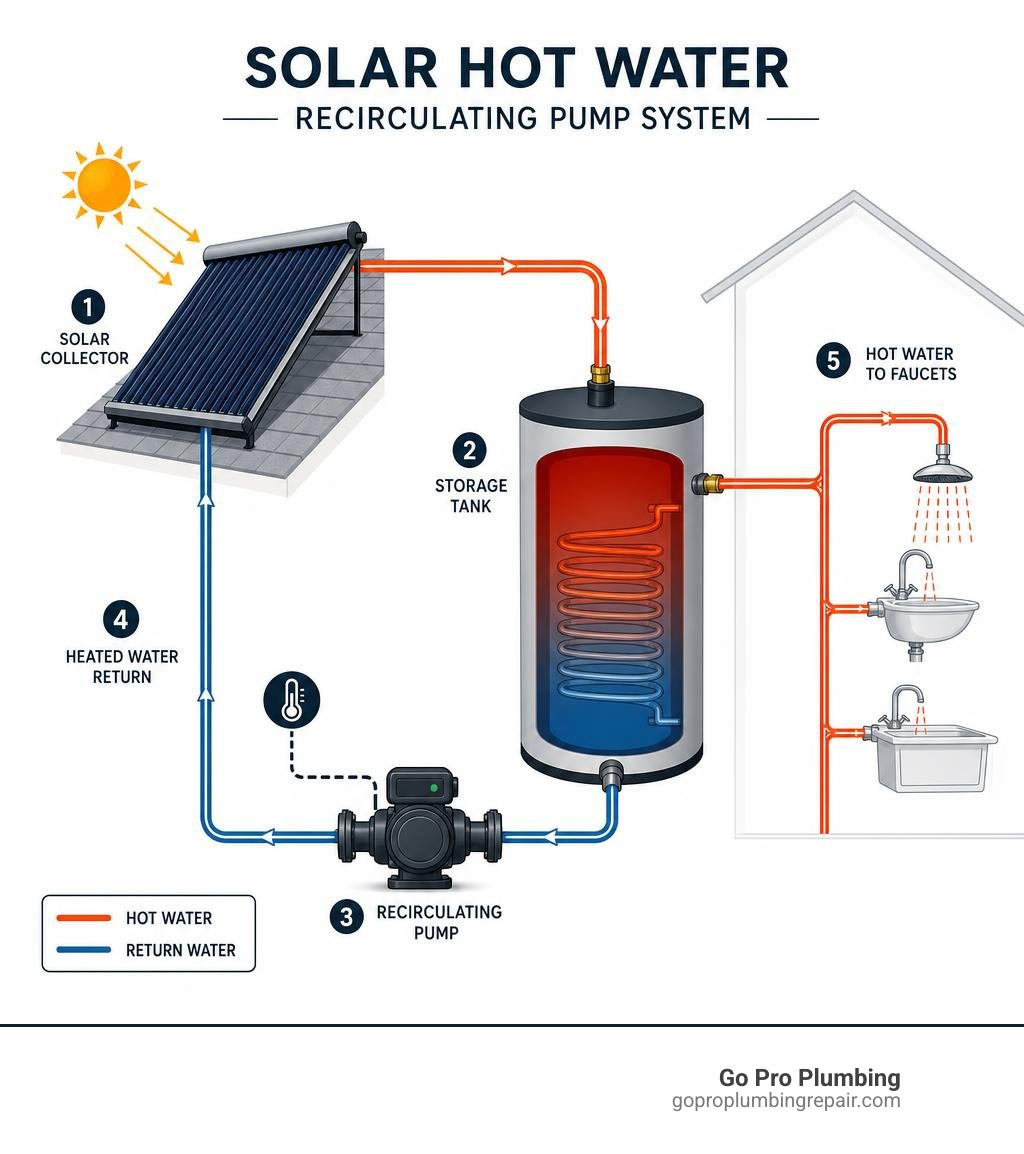
Explore more about solar hot water recirculating pump:
- hot water heater recirculation pump
- hot water recirculating pump installation diagram
- recirculation pump sizing
What Is a Solar Hot Water Recirculating Pump and How Does It Work?
To understand how this system keeps your showers steamy without wasting a drop, we have to look at how active solar water heating systems manage heat transfer.
In a standard passive solar setup, you rely entirely on gravity and natural heat rise to move water. But in an active solar system, a solar hot water recirculating pump acts as the mechanical heart of the system.
The pump is installed within the collector loop—the plumbing pathway that connects your rooftop solar thermal panels (the collectors) to your indoor water storage tank. When sensors detect that the solar collectors are hotter than the water in your tank, the pump kicks on. It pushes cold or lukewarm water up to the roof, where the sun’s energy heats it up, and then returns that freshly heated water back down to your storage tank.
But its job doesn’t stop at the tank. Many systems also use a secondary loop—the domestic hot water recirculation loop—to keep that hot water moving through your home’s plumbing branches. To see this process in action, you can read our breakdown of how does a hot water recirculating system work. By keeping a low-volume, steady stream of water flowing through your home’s pipes, the pump ensures that hot water is always sitting right behind your faucet valve, rather than cooling down in the walls.
Key Specifications of a Solar Hot Water Recirculating Pump
When shopping for a pump, you will run into a wall of technical specifications. Don’t let the jargon scare you! Here are the core specifications you need to understand:
- Flow Rate: Measured in Gallons Per Minute (GPM) or Liters Per Minute (LPM). This is the volume of water the pump can push through the system. For solar loops, you don’t need a fire hose; a low, steady flow is ideal to allow the water enough time to absorb heat from the collectors.
- Head Lift (or Max Head): This is the maximum height the pump can push water straight up. If your solar collectors are on a two-story roof, you need a pump with a head lift rating that comfortably exceeds that height.
- Power Consumption: Measured in Watts (W). Since we are building an eco-friendly home, we want a pump that doesn’t guzzle electricity. Many modern pumps feature multi-speed controls (e.g., 46W/67W/93W) so you can dial in the lowest power setting that still gets the job done.
- Materials: Because these pumps handle hot potable (drinking) water, the pump head must be made of corrosion-resistant materials like stainless steel or brass. Avoid cast iron heads for drinking water systems, as they will rust over time.
To help you visualize how some of the most popular options on the market stack up in 2026, we’ve put together a quick comparison table:
| Pump Model / Brand | Max Flow Rate | Max Head Lift | Rated Power | Key Materials |
|---|---|---|---|---|
| KOLERFLO RS15-6 | 9.5 / 7.66 / 5.28 GPM | 20 / 16 / 13 ft | 93 / 67 / 46 W | Stainless Steel / Composite |
| VEVOR 120W Pump | 8.0 GPM | 36 ft | 120 W | Stainless Steel Head, Brass Fittings |
| PH Solar Series | Custom (Up to 17 GPM) | Custom (Up to 20 ft) | 55 / 70 / 100 W | Stainless Steel & Cast Iron |
For larger, commercial-scale solar installations, the PH Solar Heating System Hot Water Circulation Pump relies on precise mathematical formulas to size the pump. For example, in a closed solar loop, the required flow rate is calculated as:
$$Q = 0.02 \times 3.6 \times A$$
(Where $Q$ is the flow rate and $A$ is the total solar collector area in square meters).
For open systems, the head lift formula accounts for the direct height difference:
$$H = 1.1 \times \Delta H$$
(Where $\Delta H$ is the elevation difference between the highest and lowest points of the plumbing).
Thermosiphon vs. Forced Circulation
If you are designing a solar thermal system, you will eventually have to choose between a passive “thermosiphon” system and an active “forced circulation” system.
A thermosiphon system is completely passive. It relies on the basic scientific principle that hot water rises while cold water sinks. By placing your storage tank above the rooftop solar collectors, the water naturally circulates without any electrical help. If you want to explore this hands-off approach, check out our guide on hot water recirculation without a pump.
While passive systems are incredibly reliable because they have zero moving parts, they have major limitations:
- Structural Weight: Water is heavy (about 8.34 lbs per gallon). Placing a massive 80-gallon storage tank on top of your roof requires serious structural reinforcement.
- Efficiency Loss: Passive circulation is slow. If the sun goes behind a cloud, the loop can stall or even reverse, losing precious heat back to the sky.
- Aesthetics: Let’s be honest—a giant metal tank sitting on your roof isn’t exactly a boost for your home’s curb appeal.
Active forced circulation systems, powered by a solar hot water recirculating pump, allow you to keep your heavy storage tank safely on the ground (or in the garage). The pump gives you complete control over when and how fast the water moves, resulting in up to 30% higher heat-transfer efficiency compared to passive setups.
Key Benefits of Solar Hot Water Recirculation
Why should you invest in a dedicated recirculating pump for your solar hot water system? The benefits go far beyond just avoiding a chilly surprise when you step into the shower.
- Unmatched Water Conservation: Did you know the average American home wastes up to 12,000 gallons of water per year just waiting for the tap to run hot? In Northern California, where drought conservation is a way of life, saving that water isn’t just eco-friendly—it’s a civic duty.
- Maximum Solar Efficiency: Solar panels only collect heat when the sun is shining. A recirculating pump ensures that as soon as the collectors reach their peak temperatures, that thermal energy is immediately transferred down to your insulated storage tank, rather than radiating away on your roof. You can read more about this in our article on are hot water recirculation systems efficient.
- Reliable Freeze Protection: Winters in Sacramento and Rancho Cordova can bring overnight temperatures below freezing. If water sits stagnant in your outdoor solar collectors, it can freeze, expand, and rupture the copper pipes. A smart recirculating pump can be programmed to run a tiny trickle of warm water through the collector loop when temperatures plummet, saving you thousands of dollars in winter repair bills.
How to Choose the Right Solar Hot Water Recirculating Pump
Choosing the wrong pump can lead to two frustrating problems: either your pump is too weak to push water to your roof, or it’s so overpowered that it wastes electricity and erodes your copper pipes through high-velocity friction.

To choose the perfect pump, consider these factors:
- System Height and Pipe Friction: Measure the vertical distance from your pump to the top of your solar collectors. This is your static head. Then, account for pipe friction (each elbow and foot of pipe adds resistance). If your roof is 20 feet high, look for a pump with a max head of at least 25 to 30 feet to ensure reliable flow.
- Potable Water Safety: Ensure the pump body is made of brass or stainless steel. The Grundfos 15-20 CIL 2 Solar Hot Water Circulating Pump is a legendary, contractor-grade choice designed specifically for solar loops, boasting a low-energy B-class rating and a highly durable composite/stainless construction.
- Speed Adjustability: Opt for a pump with multiple speed settings. The VEVOR Hot Water Recirculating Pump is a highly adaptable 120W unit that offers multi-speed controls, allowing you to fine-tune the flow rate to match your home’s exact layout.
Budget Brands vs. Established Manufacturers
When browsing online marketplaces in 2026, you will find a massive price gap. Premium European brands like Grundfos or Taco often cost $200 to $400, while budget brands like VEVOR, iMeshbean, or KOLERFLO can be found for $50 to $100.
Are these budget pumps actually reliable?
The short answer is yes, but with some caveats. Many homeowners and plumbers report that budget-friendly VEVOR and KOLERFLO pumps perform remarkably well, often running 24/7 for several years without a single hiccup. They are incredibly cost-effective options for retrofitting older solar systems. To get a sense of how these fit into your overall plumbing budget, take a look at our guide on hot water recirculation system cost.
However, premium brands still hold the crown when it comes to long-term engineering, whisper-quiet operation, and local warranty support. If a Grundfos pump fails, you can easily find replacement parts or get a warranty replacement through an authorized local dealer. If a no-name budget pump fails, you will likely end up throwing it away and buying a new one.
Installation and Maintenance Best Practices
While some manufacturers advertise these pumps as simple “DIY weekend projects,” proper plumbing and electrical integration are vital.
Here are our top installation best practices:
- Keep the Shaft Horizontal: No matter how you route your pipes, the motor shaft of the circulating pump must remain horizontal. If you mount the pump with the shaft pointing straight up or down, air pockets will get trapped inside the rotor housing, causing the bearings to overheat and burn out the motor.
- Flush the System First: Before installing your new pump, thoroughly flush your plumbing lines. Tiny flecks of solder, copper shavings, or hard water scale can easily lodge themselves in the pump’s delicate impeller, seizing the motor on day one.
- Banish the “Oil Taste”: Many brand-new pumps are assembled with a tiny amount of food-safe lubricating oil inside. To avoid a metallic or oily taste in your morning coffee, run your hot water taps fully 3 to 5 times to thoroughly flush out the pump housing before drinking the water.
If you want a step-by-step layout of the entire process, check out our comprehensive hot water recirculation installation guide.
Essential Accessories and Check Valves
A pump alone does not make a complete recirculation system. To prevent water from flowing backward or creating dangerous pressure spikes, you need a few essential accessories:
- Check Valves (Non-Return Valves): This is non-negotiable. Without a check valve, cold water can backflow into your hot water lines, leaving you with lukewarm showers. Some smart kits, like the VEVOR Digital Smart Instant Hot Water Recirculating Pump Kit, come with a built-in check valve, which simplifies installation under your farthest sink.
- Expansion Tanks: Because solar collectors can heat water to extreme temperatures (sometimes reaching boiling point if circulation stops), water volume will expand. An expansion tank gives this extra volume a safe place to go, protecting your pipes from bursting.
- Isolation Ball Valves: Install these on both sides of your pump. If you ever need to clean, service, or replace the pump, you can simply close these valves and swap the pump out without draining your entire home’s water system.
Noise Levels and Lifespan Maintenance
If your pump is installed right under your master bedroom or kitchen sink, the last thing you want is a loud hum keeping you awake at night.
Fortunately, modern wet-rotor circulator pumps are incredibly quiet. High-quality models operate at around 25 decibels (dB)—which is quieter than a soft whisper or a rustling leaf. If your pump is making a loud grinding or rattling noise, it usually means there is air trapped in the line (which requires purging) or the bearings are beginning to fail.
To maximize your pump’s lifespan (which is typically 8 to 15 years), follow these simple maintenance tips:
- Annual Visual Inspections: Check the pump casing and fittings for any signs of green corrosion or slow leaks.
- Listen Closely: Once a month, stand near the pump while it runs. Any change in pitch or vibration is an early warning sign of debris buildup.
- Clean the Inlet Filter: If your system has an inlet strainer, clean it annually to keep hard water sediment from choking the pump’s flow.
Ignoring these basic steps can lead to premature motor failure. For a deeper dive into troubleshooting, check out our guide on hot water recirculation system problems.
Frequently Asked Questions About Solar Recirculation Pumps
We get a lot of questions from eco-conscious homeowners in Northern California about how to optimize their solar hot water loops. Here are the answers to the most common queries.
Do solar hot water circulation systems run all the time?
Absolutely not! Running a pump 24/7 is incredibly inefficient. It wastes electricity, causes premature wear on the pump, and constantly radiates heat out of your pipes, cooling down your storage tank. To learn more about this, read our article: does a hot water recirculating pump run all the time.
Instead, you should control your pump using one of three methods:
- Mechanical Timers: Program the pump to run only during peak household hours (e.g., 6:00 AM to 9:00 AM and 6:00 PM to 10:00 PM).
- Thermostatic Control (Aquastats): The pump only runs when the water temperature in the return line drops below a set point (e.g., 105°F) and shuts off once it hits 115°F.
- Demand-Sensing Controls: Systems like the Smart Aquastat Control 32 are the gold standard. They detect when you briefly tap a hot water faucet, activate the pump to prime the line with hot water, and then shut down immediately. This saves the maximum amount of energy and water.
Can I install a recirculating pump on a tankless solar water heater?
Yes, but it requires careful planning. Tankless water heaters require a specific minimum flow rate (usually 0.5 to 1.0 GPM) to trigger the gas burners. If your recirculating pump is too small, it won’t activate the heater, leaving you with cold water.
Furthermore, tankless systems can suffer from the “cold water sandwich” effect during frequent on-off cycling. To prevent this, we recommend installing a small, insulated buffer tank (around 5 to 10 gallons) after the tankless heater to keep a steady reservoir of hot water ready for the pump to draw from. For a detailed layout, check out our guide on hot water recirculation for tankless system.
How do I verify if an online pump seller is legitimate?
With the rise of direct-to-consumer online storefronts in 2026, it’s easy to get lured in by rock-bottom prices. However, many buyer-beware stories exist, particularly with budget brands sold on independent websites.
Before clicking “buy,” take these steps to protect your wallet:
- Run a Scamadviser Check: Paste the seller’s domain name into Scamadviser to check their trust score and see where the website is actually hosted.
- Analyze the Terms and Conditions: Look closely at the “Governing Law” section. Many illegitimate or fly-by-night sellers leave this section blank or list obscure overseas jurisdictions, meaning they have no legal obligation to honor warranties or return policies.
- Watch Out for “Warehouse Tricks”: Some non-US companies use third-party US warehouses to make it look like they are a local business, but provide zero customer phone numbers or physical office addresses for support.
When in doubt, buy from established local plumbing distributors or hire a licensed professional who supplies and warrants the equipment themselves.
Conclusion
Upgrading your home with a solar hot water recirculating pump is a fantastic way to slash your utility bills, conserve precious water, and enjoy the modern luxury of instant hot water. Whether you choose a premium Grundfos pump or a budget-friendly VEVOR kit, getting the sizing and installation right is the key to long-term success.
At Go Pro Plumbing, we are proud to serve communities across Northern California, including Sacramento and Rancho Cordova. We are committed to outstanding customer service and offer same-day service to keep your home’s water running hot and your systems operating at peak efficiency.
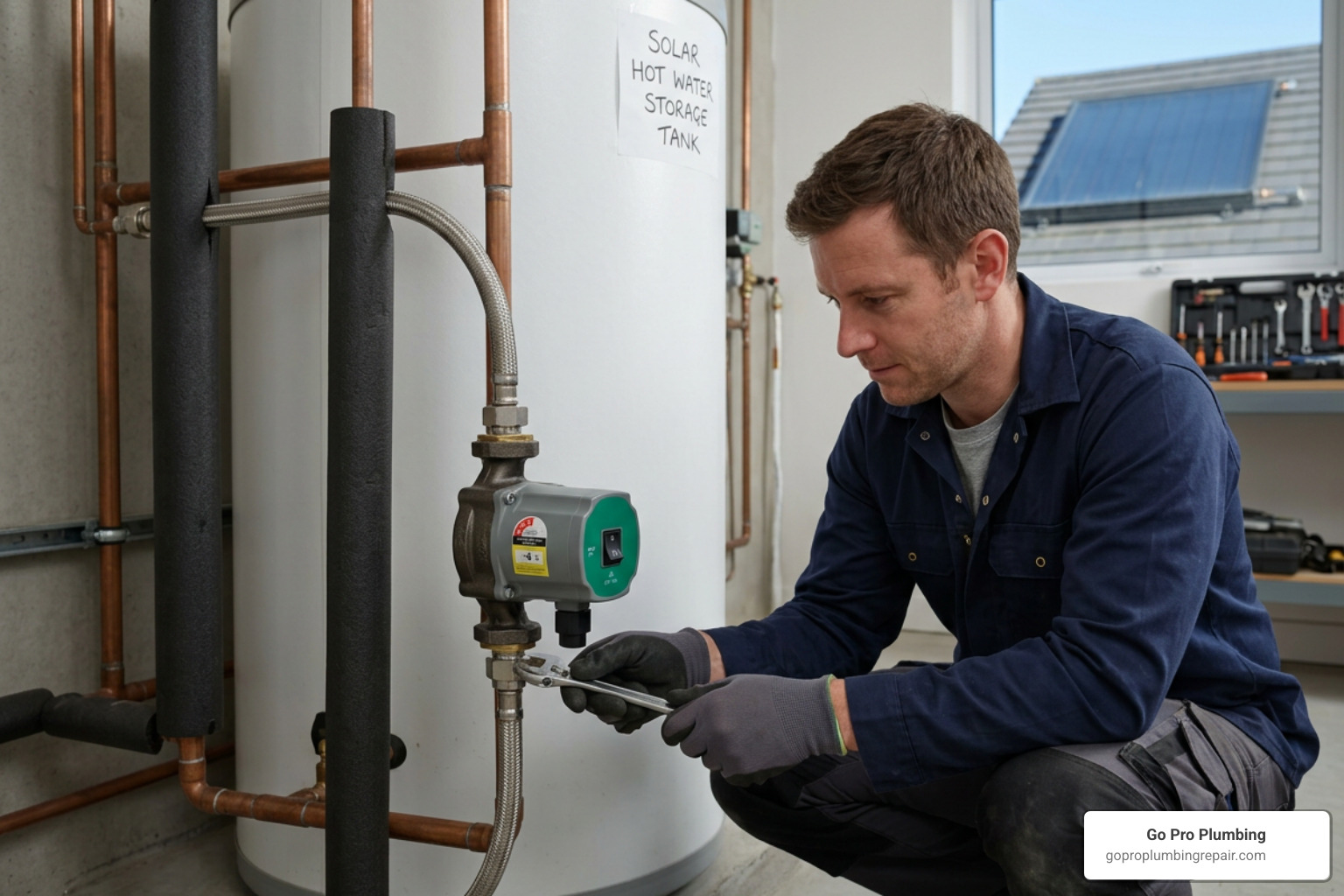
Ready to stop waiting for hot water and start saving? Our friendly, licensed plumbing experts are here to help you select, install, and maintain the perfect pump for your home.
For more information or to schedule an appointment, check out our more info about water recirculation services and let us help you go green today!