
Don’t Get Tapped Out: Your Guide to Commercial Faucet Replacement
By Brian on August 6, 2026

When a Dripping Faucet Becomes a Business Problem
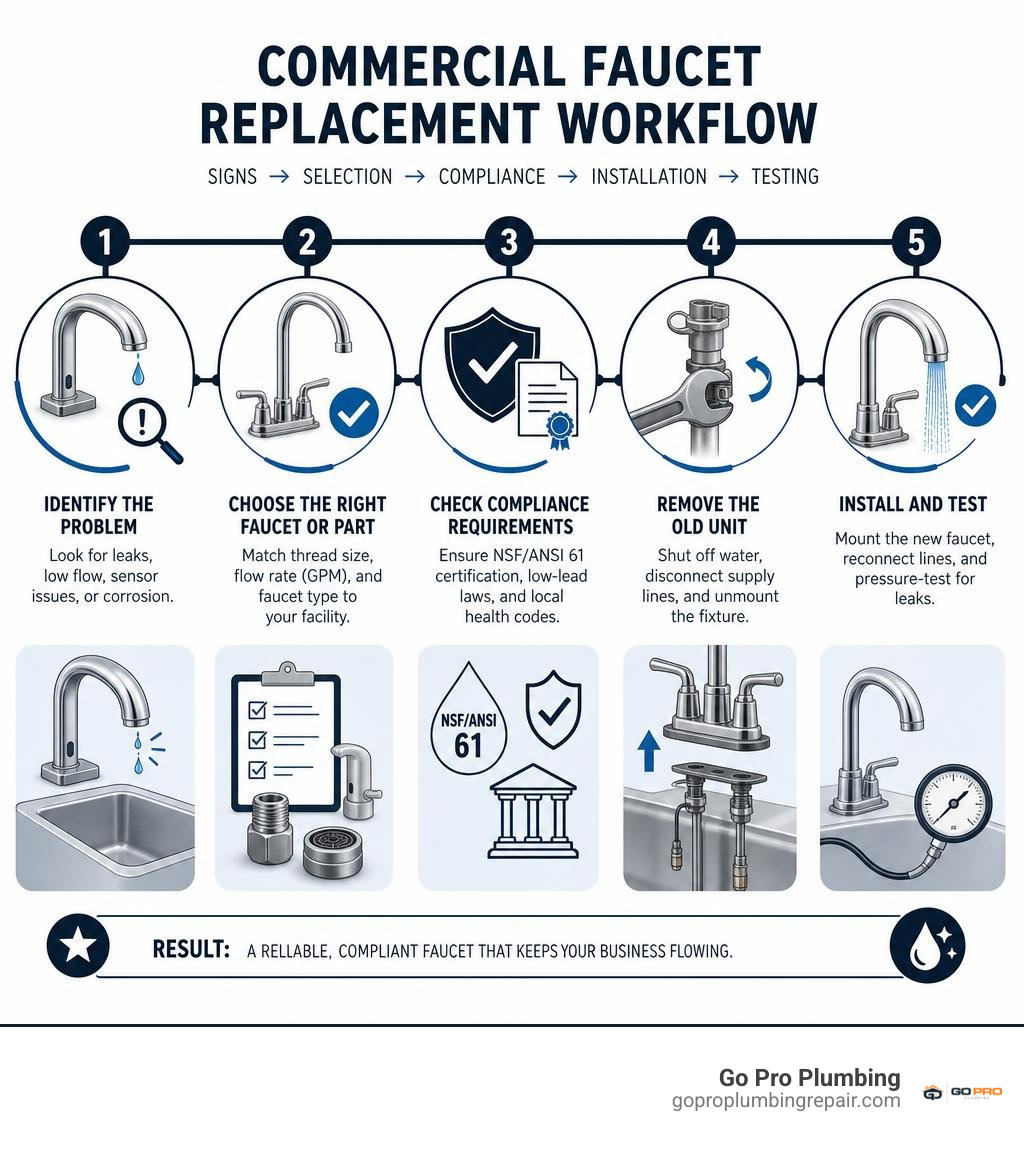
Commercial faucet replacement is the process of removing a worn, leaking, or non-compliant faucet from a business facility and installing a new commercial-grade unit — or swapping out key internal parts like cartridges, stems, or spouts to restore full function.
Here’s a quick overview of what the process involves:
- Identify the problem — persistent leak, low flow, sensor failure, or corrosion
- Choose the right faucet or part — match thread size, flow rate (GPM), and faucet type to your facility
- Check compliance requirements — NSF/ANSI 61 certification, low-lead laws, and local health codes
- Remove the old unit — shut off water, disconnect supply lines, and unmount the fixture
- Install and test — mount the new faucet, reconnect lines, and pressure-test for leaks
Walk into any busy commercial kitchen or office restroom and you’ll see faucets working hard — hot and cold, high pressure, dozens of times every day. That constant use takes a real toll.
Unlike a home faucet that might get turned on a few times a day, a commercial faucet in a restaurant or healthcare facility can cycle hundreds of times daily. When one fails, it’s not just an inconvenience. It can trigger health inspection violations, operational shutdowns, or insurance headaches.
The good news? Many commercial faucet problems don’t require a full replacement. A worn cartridge, a cracked spout, or a clogged aerator can often be fixed with an inexpensive repair kit. But knowing when to repair versus when to replace — and how to do it right — is what this guide is all about.
Basic commercial faucet replacement vocab:
Signs You Need a Commercial Faucet Replacement
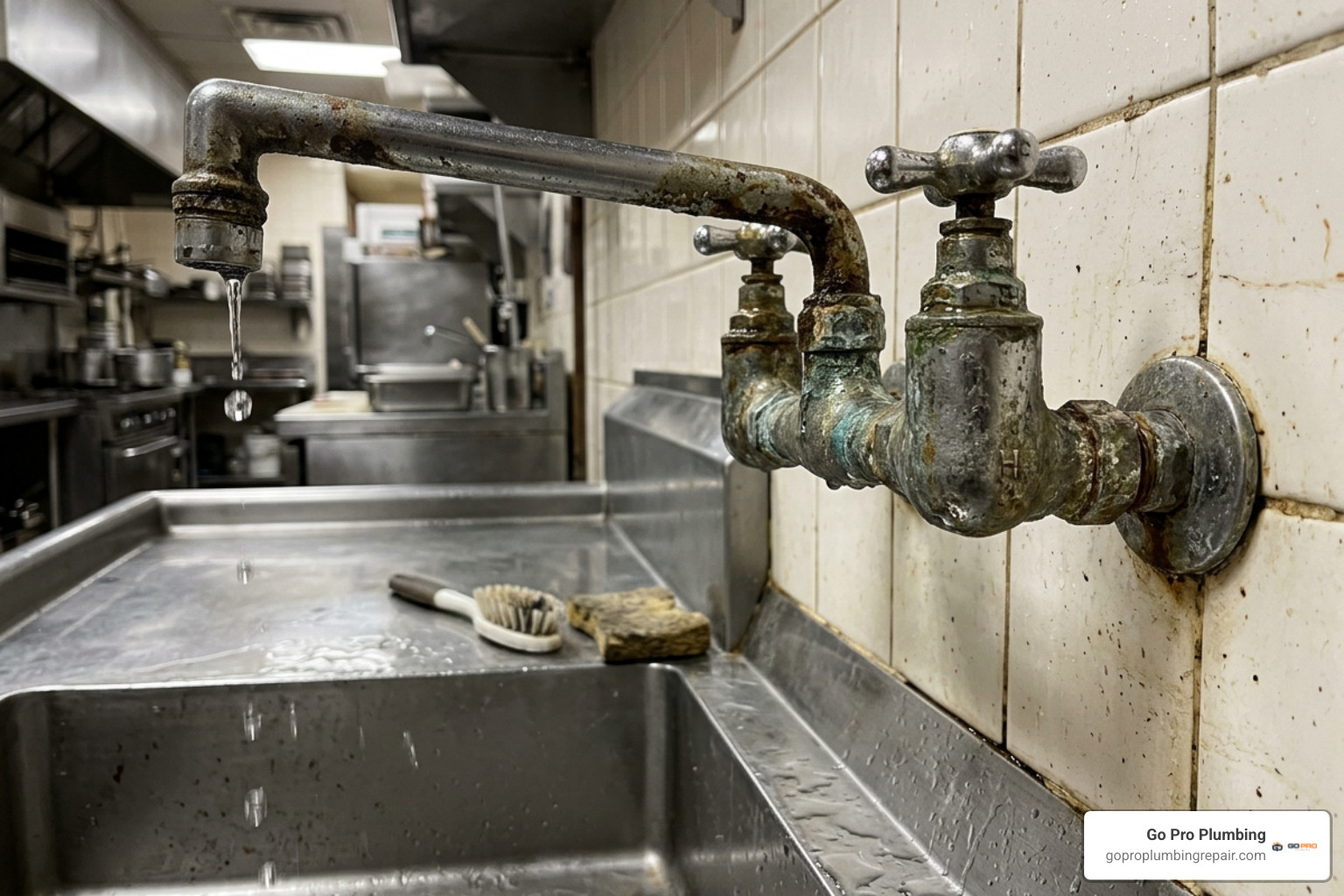
In a commercial environment, waiting until a faucet snaps off in someone’s hand is a recipe for an emergency shutoff and lost revenue. Recognizing early warning signs allows facility managers and kitchen crews to plan a replacement before an emergency strikes.
Here are the most common indicators that your business needs a commercial faucet replacement:
- Persistent Dripping and Valve Seat Wear: If a faucet continues to drip after you’ve already swapped out the stem washers or ceramic cartridges, the valve seat inside the heavy brass faucet body is likely pitted or cracked. Once the valve housing erodes, internal water bypass occurs, and no amount of tightening will stop the leak.
- Structural Corrosion and Metal Fatigue: Commercial kitchens use harsh chemical degreasers and sanitizers daily. Over time, chrome plating wears down, exposing underlying brass or zinc alloys to corrosion. Greenish copper oxide buildup or visible flaking on the faucet body indicates structural metal breakdown.
- Low Water Pressure and Internal Mineral Buildup: Calcium and lime buildup can restrict flow. If soaking the aerator in vinegar fails to restore full pressure, hard water scale has likely clogged the internal channels of the faucet assembly or spout neck.
- Erratic Sensor Malfunctions: Infrared sensor faucets in office restrooms or medical facilities feature solenoid valves controlled by driver circuit boards. If replacing the battery pack or cleaning the sensor window fails to fix erratic triggering, water locks, or total failure, the solenoid valve or electronic control box needs replacement.
- Aged Water Supply Lines: In high-pressure commercial plumbing setups, supply lines older than 8 to 10 years are subject to high cycle fatigue. Replacing aged braided stainless steel or copper supply lines during faucet upgrades prevents catastrophic line bursts.
- Failure to Meet Sanitation or Temperature Codes: Health inspectors check water delivery speed and temperature for handwashing and sanitizing. If a commercial faucet cannot reliably hold hot water delivery or lacks anti-scald protection, code compliance is at risk.
Before deciding between a quick component fix or replacing the entire fixture, you can review our guide on How to Compare Faucet and Sink Replacement Costs Steps and check our breakdown of Faucet and Sink Repair options.
Choosing the Right Commercial Faucet and Replacement Parts
Selecting commercial plumbing hardware is very different from picking out a residential kitchen faucet. Commercial fixtures are engineered around heavy-duty brass construction, high cycle rates, specific thread dimensions, and strict health codes.
First, determine whether you need a full replacement unit or specific modular components. Many leading brands offer standalone replacement components, such as an 8 in. Commercial Faucet Swivel Spout Replacement in Polished Chrome with G3/4 Internal Thread featuring built-in water seal gaskets, or a 12 in. Commercial Faucet Swivel Spout Replacement in Polished Chrome with 1.8 & 2.2 GPM Aerator and G3/4 Internal Thread – Aleashafaucet .
When replacing modular spouts, thread specification is critical. Commercial spouts commonly use G3/4 female internal threads, but some specialized setups require precise metric connections like M25*1.25mm connector threads, as seen on the 12 Inch Swivel Spout Replacement Kit for Commercial Kitchen Sink Fauce – iprokitchenware . Always verify thread specs before ordering.
For detailed hardware selection steps, consult our Sink Faucet Replacement Guide.
Here is how common commercial faucet styles compare across applications:
| Commercial Faucet Type | Primary Application | Mounting Type | Key Characteristics | Flow Rate Range (GPM) |
|---|---|---|---|---|
| Pre-Rinse Sprayer | Commercial dish pits, dishwashing stations | Wall-Mount or Deck-Mount | Overhead flexible spring hose, high-pressure spray valve | 1.15 GPM to 2.2+ GPM |
| Swivel Swing Spout | 2-Compartment & 3-Compartment sinks | Wall-Mount (4″ or 8″ centers) | Heavy brass swivel arm (6″, 8″, 12″, 14″), dual levers | 1.8 GPM to 2.2 GPM |
| Touchless Sensor | Public restrooms, healthcare, food prep | Single-hole or Deck-Plate | Hands-free infrared, solenoid valve control, battery/transformer | 0.35 GPM to 1.5 GPM |
| Wrist-Blade / Metering | Surgical scrub sinks, handicap wash stations | Deck-Mount or Wall-Mount | 3″ or 4″ ergonomic lever handles, timed auto shut-off | 0.35 GPM to 1.0 GPM |
Modern touchless upgrades, like the 320342555 , offer hands-free operation to limit cross-contamination while reducing water waste in high-traffic commercial environments.
Step-by-Step Commercial Faucet Replacement Process

Replacing a commercial faucet requires careful preparation, the right tools, and systematic execution. Follow these procedures to perform a clean, leak-free installation.
Preparing for Your Commercial Faucet Replacement
Before unboxing your new hardware, prepare the work space and water delivery system:
- Isolate Water Lines: Locate the dedicated shutoff valves under the sink basin or shut off the main facility isolation valve for that plumbing branch.
- Verify Pressure Drops: Open the existing faucet hot and cold levers completely to bleed off line pressure and verify that the shutoffs hold tight.
- Inspect Supply Piping: Examine existing supply connections. If braided stainless lines or copper risers show signs of kinking, green oxidation, or age beyond 8 to 10 years, replace them during this installation.
- Flush Supply Lines: Once the old unit is removed, place a bucket beneath the shutoff valves and purge the lines for 60 seconds to clear rust, sediment, or scale deposits before connecting new solenoid valves or ceramic cartridges.
For a deeper dive into plumbing connections, review The Ultimate Guide to Kitchen Sink Faucet Connections and Hardware and Your Guide to a Leak-Free Faucet Installation.
Step-by-Step DIY Commercial Faucet Replacement
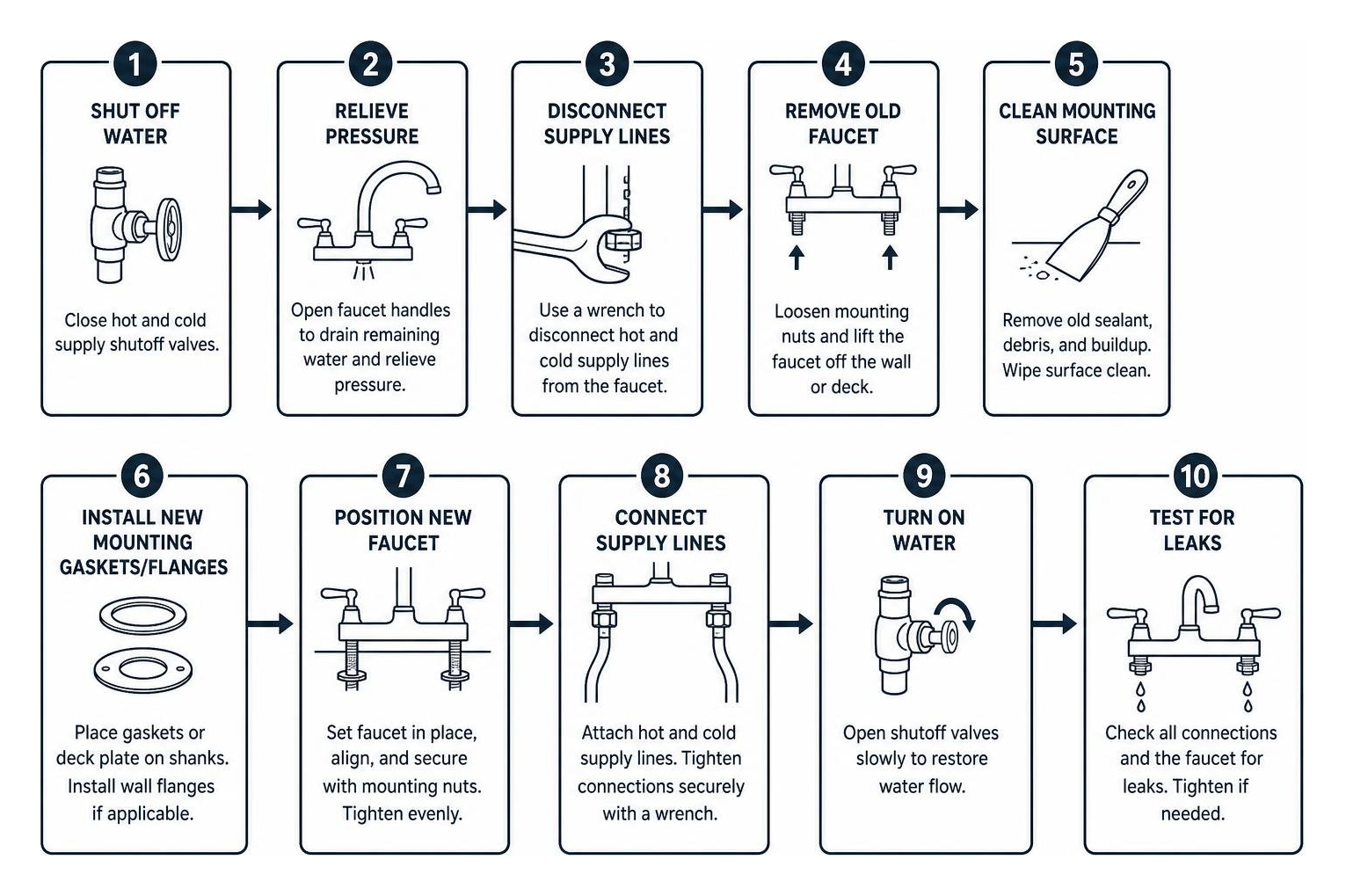
Here is the step-by-step process for replacing a standard commercial faucet unit:
- Remove Old Fixture: Use a basin wrench or open-end wrench to loosen the supply line nuts attached to the faucet inlet shanks. Unscrew the brass mounting locknuts securing the faucet body to the wall or deck flange, and lift the fixture free.
- Clean Mounting Deck: Scrape away calcified mineral crust, old plumber’s putty, or deteriorated rubber gaskets from the stainless steel sink surface using a putty knife. Wipe clean with a sanitizing cleaner.
- Position Deck Gaskets and Flanges: Place the new rubber mounting gaskets or deck seal plate onto the shanks. For wall-mount units, thread eccentric wall flanges onto the exposed 1/2″ MPT wall nipples, using thread sealant tape on the male pipe threads.
- Mount and Secure the Faucet Body: Insert the faucet shanks through the sink mounting holes (or align with eccentric wall flanges). From beneath the deck, thread on the mounting washers and brass locknuts. Tighten evenly by hand, then snug down using a wrench. Ensure the faucet body remains level.
- Connect Water Supply Lines: Connect hot and cold supply lines to the 1/2″ MPT inlet shanks. Tighten connection nuts with two wrenches — one holding the faucet shank stationary to prevent twisting internal solder joints, and the second tightening the supply hose nut.
- Flush and Test: Remove the spray head or aerator nozzle. Slowly open shutoff valves to reintroduce water pressure. Run hot and cold water for two minutes to clear trapped air and construction debris. Inspect all threaded joints for moisture. Finally, reinstall the aerator.
For step-by-step guidance tailored to food service applications, check out Installing Faucet in Kitchen Sink and 3-Compartment Sink Faucet Installation.
Commercial Plumbing Codes, Water Pressure, and Compliance
Commercial plumbing environments operate under strict legal and physical standards. Ignoring code requirements can lead to failed health inspections, voided property insurance, or building permit rejections.
Key technical and regulatory requirements include:
- Static Water Pressure Operating Ranges: Commercial water lines operate under higher dynamic pressure than residential systems. Commercial faucets require operating static pressure between 20 and 80 PSI for optimum performance, with absolute maximum limits reaching 125 PSI static. System pressure exceeding 80 PSI requires a pressure-reducing valve (PRV) to prevent water hammer and seal rupture.
- NSF/ANSI 61 and Low-Lead Mandates: All drinking water and food preparation faucets installed in California must carry NSF/ANSI 61 certification and satisfy low-lead laws. Replacement valves, stems, and repair kits must maintain low-lead compliance to remain legal for food service setups.
- Backflow Prevention and Air Gaps: Pre-rinse spray units and sink faucets equipped with hose attachments must feature integrated check valves or vacuum breakers to prevent contaminated sink water from siphoning back into municipal water supplies.
- Thermostatic Mixing Valves (TMV) and Scald Safety: Restrooms and public facilities require ASSE 1070-compliant thermostatic mixing valves to cap maximum water delivery temperatures at 110°F to 120°F, protecting users from scalding.
- High-Temperature Thermal Disinfection Standards: Specialized medical control boxes are built to handle continuous elevated line temperatures up to 171°F (77°C) for thermal disinfection flushes designed to eliminate waterborne pathogens like Legionella, as detailed in technical specifications like 212181 RevA (1500T3 series – English) .pdf.pdf).
To learn more about local regulatory guidelines in Northern California, explore our Commercial Plumbing Services Sacramento Guide and our overview of Commercial Plumbing Repair.
Frequently Asked Questions About Commercial Faucet Upgrades
How does commercial faucet installation differ from residential installation?
Commercial installations differ significantly from residential jobs across five main areas:
- Operating Pressure: Commercial supply lines operate under higher static and dynamic line pressure, requiring heavier brass construction and heavy-duty ceramic disc valves.
- Code Compliance: Commercial units must comply with strict health department regulations, backflow prevention rules, and NSF/ANSI 61 low-lead mandates.
- Rough-In Configurations: Commercial setups frequently use wall-mounted rough-in plumbing with 8-inch adjustable eccentric centers rather than standard 4-inch or single-hole residential deck mounts.
- Cycle Durability: Commercial faucets use thick chrome finishes, vandal-resistant aerators, and replaceable internal valve cartridges built to endure hundreds of daily cycles.
- Flow Rates: Commercial splash-mount spouts deliver higher water flow (up to 2.2 GPM or higher) for rapid bucket fills and dish pit washing, compared to residential water-conserving fixtures.
For more comparison insights, see our Complete Kitchen Sink Faucet Guide.
What troubleshooting steps should I take before replacing a commercial faucet?
Before purchasing a full replacement fixture, run through these troubleshooting steps:
- Low Flow Rate: Unscrew the aerator or spray valve and clear debris or lime buildup. Soak the aerator in a descaling solution.
- Handle Leakage: Tighten the packing nut beneath the handle lever or replace the internal bonnet O-rings and ceramic disc stem cartridges.
- Spout Base Drips: Replace the internal quad-rings or built-in water seal gaskets at the swivel spout connection joint.
- Sensor Faucet Inaction: Test battery health on the electronic module. If battery voltage is normal, hold the diagnostic toggle button on the driver board to read system error codes (such as E01 through E07), flush the solenoid inlet filter screen, and recalibrate detection ranges (typically 3 to 15 inches).
If troubleshooting uncovers a major leak, refer to our guide on handling Commercial Plumbing Emergencies.
When should I hire a licensed plumber for commercial faucet replacement?
While simple component swaps like aerators or swivel spouts can be handled in-house, you should hire a licensed commercial plumber when:
- High line pressure requires installing or adjusting pressure-reducing valves.
- Replacing wall-mounted fixtures requires modifying wall blocking or soldering concealed rough-in copper piping.
- Installing specialized commercial equipment where improper work could jeopardize health department permits, business licenses, or property insurance coverage.
- Integrating mandatory backflow preventers, thermostatic mixing valves, or hardwired 24VAC electronic control transformers.
For local professional assistance across Northern California, learn about our services at Commercial Plumbing Sacramento CA.
Conclusion
Keeping your facility’s plumbing in top shape doesn’t have to be a headache. Whether you run a busy restaurant kitchen in Sacramento, manage a commercial building in Rancho Cordova, or oversee operations anywhere across Northern California, tackling commercial faucet replacement proactively keeps your business running smoothly, protects your water supply, and keeps health inspectors happy.
When a quick repair kit isn’t enough, or when high line pressures and wall rough-ins demand professional expertise, our team at Go Pro Plumbing is here to help. We deliver code-compliant commercial plumbing solutions backed by our commitment to outstanding customer service and fast, same-day service.
Don’t let a dripping faucet tap out your business operations. Visit our Services – Faucets & Sinks page or contact us today to schedule your commercial faucet service!