
How to Master Your Water Efficiency Management Plan Without Breaking a Sweat
By Brian on June 12, 2026
Why a Water Efficiency Management Plan Is Essential for Every Organization
A water efficiency management plan is one of the most practical tools an organization can use to track water consumption, cut costs, and stay ahead of regulations — all at the same time.
Here’s a quick summary of what a WEMP is and what it does:
- What it is: A structured framework for monitoring how and where your organization uses water
- Who needs one: Businesses, utilities, and municipalities — especially large water users (in some regions, any facility using 60,000 m³ or more per year is required to submit one)
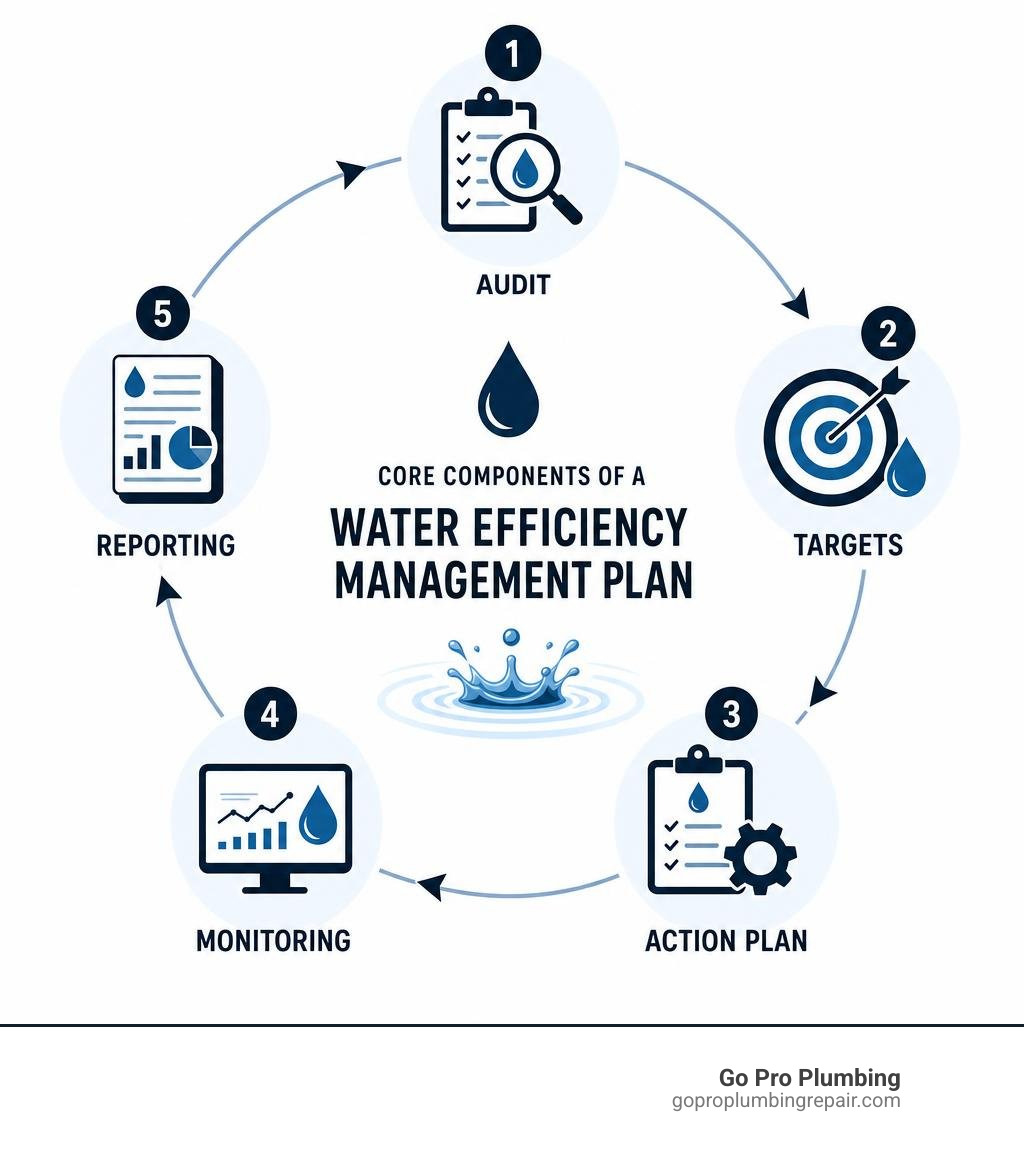
- What it covers: Water use audits, savings targets, action plans, and ongoing performance tracking
- Key benefits: Lower water bills, regulatory compliance, reduced environmental impact, and stronger community reputation
- How to start: Document current water use, identify waste, set targets, and review progress annually
Water scarcity is a growing pressure for cities and businesses alike. Calgary’s water efficiency program — built around its two small supply rivers, the Bow and the Elbow — cut per-capita water use by 30% between 2005 and 2016, even as the city kept growing. That kind of result doesn’t happen by accident. It comes from deliberate planning.
Whether you’re a facility manager in Northern California, a business owner watching your utility bills climb, or a municipality planning for the next drought, a water efficiency management plan gives you a clear roadmap.
This guide walks you through everything — what a WEMP includes, who needs one, how to build one, and how to measure success.
Water efficiency management plan terminology:
What is a Water Efficiency Management Plan and Why Does Your Organization Need One?
At its core, a water efficiency management plan (WEMP) is a strategic roadmap designed to help organizations understand exactly how much water they use, where they are wasting it, and how they can optimize their consumption. It is both a tracking mechanism and a continuous improvement framework. Instead of treating water as a fixed utility cost, a WEMP treats water as a manageable resource that can be optimized to protect your bottom line.
For commercial facilities, public institutions, and multi-family residential complexes, implementing a WEMP is the single most effective way to transition from reactive maintenance to proactive management. It allows you to align your facility operations with broader environmental goals, such as Domestic Water Conservation, while simultaneously cutting utility bills.
If your facility is located in our service area, such as Rancho Cordova or Sacramento, local municipal guidelines actively encourage these conservation steps. In fact, reviewing the Water Conservation Tips | City of Rancho Cordova shows just how much local water districts value proactive demand management. By establishing a WEMP, you ensure your business is doing its part to protect Northern California’s shared water resources while protecting your property from costly water waste.

Global Frameworks: Mandatory vs. Voluntary Regional Plans
Depending on where a business operates, a WEMP might be a smart voluntary choice or a strict legal requirement. Looking at global and regional frameworks helps us understand how different governments approach water security:
- Singapore (PUB): Singapore’s National Water Agency enforces some of the strictest mandatory water management laws in the world. Any large non-domestic water user with a net consumption of 60,000 m³ or more in the preceding year must submit an annual WEMP for at least three consecutive years. They are also required to appoint a certified Water Efficiency Manager, install private water meters at key usage areas, and comply with strict industrial recycling mandates.
- Australia’s Waterwise Business Program: Similar to Singapore’s framework, certain commercial and industrial customers consuming more than 20,000 kL of water annually must participate in mandatory reporting and water auditing programs.
- Calgary’s Water Efficiency Plan: On the voluntary and municipal side, Calgary uses a collaborative, incentive-driven model. Rather than forcing strict limits on every business, they established a goal to reduce per-capita water demand by 20% by 2040, using education, advanced metering, and structured landscape watering schedules to manage seasonal peak demands.
- York Region (Canada): York Region has utilized a long-term water conservation strategy spanning over a decade, outlining a 40-year vision for sustainable growth and water efficiency infrastructure.
Aligning with Urban Water Management Plans (UWMPs)
For organizations operating in California, individual facility plans do not exist in a vacuum. They are designed to align with broader municipal strategies known as Urban Water Management Plans (UWMPs).
Under the California Water Code, every urban water supplier that delivers more than 3,000 acre-feet of water per year (or serves more than 3,000 connections) must update and submit a comprehensive UWMP every five years. These plans project water demand, evaluate supply reliability over a 25-year horizon, and outline water shortage contingency stages to survive severe droughts.
For instance, the 2025 URBAN WATER MANAGEMENT PLAN drafted by Riverside Public Utilities (RPU) manages a service area of 75 square miles and over 68,000 connections, projecting growth up to 315,865 residents by 2050. Similarly, right in our backyard, the Urban Water Management Plan – Sacramento Suburban Water District outlines how local water resources are managed to ensure reliability for Sacramento residents.
When your business designs a custom water efficiency management plan, you are directly supporting these regional goals. Understanding how regional wholesalers and retailers plan for future supply constraints—such as the regional strategies highlighted in How We Plan – MWD —helps local businesses design smarter, more resilient facilities.
Designing and Executing Your Water Conservation Strategy
An effective water efficiency strategy requires transitioning from guesswork to data-backed execution. You cannot manage what you do not measure. This begins with a comprehensive water audit to map out every drop of water entering and leaving your property.

To see how mandatory frameworks compare to target-driven municipal strategies, look at the table below:
| Feature/Metric | Singapore PUB (Mandatory Framework) | Calgary Water Efficiency Plan (Target-Driven) |
|---|---|---|
| Primary Driver | Strict regulatory compliance & water security | Drought resilience & infrastructure optimization |
| Applicability Threshold | Large users consuming $\ge$ 60,000 m³/year | City-wide (residential, commercial, municipal) |
| Key Requirements | Appoint Water Efficiency Manager; annual WEMP | Transition to advanced metering; voluntary schedules |
| Recycling Mandates | Up to 50% recycling rate for wafer fab plants | Focus on landscape design & greywater education |
| Long-Term Target | Continuous efficiency improvements | 20% reduction in per-capita demand by 2040 |
Step-by-Step Guide to Creating Your Water Efficiency Management Plan
Building your custom plan does not have to be overwhelming. By breaking the process down into clear, structured steps, we can help you build a plan that delivers measurable results:
- Document and Analyze Recent Water Use Patterns: Gather your utility bills from the past 12 to 24 months. Establish a baseline of your typical water consumption. Note any seasonal spikes, such as increased irrigation demand during hot Northern California summers.
- Develop a Water Balance Chart: Map out exactly where your water goes. Your water balance chart should account for indoor domestic use, commercial processes, cooling towers, and outdoor landscaping.
- Identify and Quantify Savings Opportunities: Look for the low-hanging fruit first. Are there older toilets, faucets, or showerheads that can be retrofitted with low-flow alternatives? Next, look at your thermal systems. For example, understanding How Does a Hot Water Recirculating System Work? can help you eliminate the gallons of water wasted down the drain while waiting for hot water to reach distant fixtures.
- Address Landscape Irrigation: Outdoor water use is a massive source of waste. In California, all public and commercial properties must comply with the Model Water Efficient Landscape Ordinance , which sets strict limits on water budgets for new and retrofitted landscapes.
- Establish an Action Plan with Timelines: Assign responsibilities, set realistic budgets, and define clear deadlines for each efficiency upgrade. For guidance on state-level commercial water targets, you can refer to the [PDF] Sustainability Roadmap 2021 FinalIIICDT – Green California .
- Partner with Local Water Agencies: Take advantage of local rebates and resources. The Sacramento County Water Agency – Water Efficiency program offers excellent support, toolkits, and potential commercial rebates to offset the cost of your efficiency upgrades.
The Role of Technology in a Modern Water Efficiency Management Plan
Modern plumbing technology has evolved far beyond simple low-flow aerators. Today, a truly advanced WEMP relies on smart technology and real-time data to prevent waste:
- Advanced Metering Infrastructure (AMI): Smart water meters track water flow in real-time, allowing facility managers to view consumption patterns hourly rather than waiting for the monthly utility bill.
- Automated Leak Detection: Acoustic and flow-based sensors can identify tiny, hidden leaks behind walls or underground long before they cause catastrophic structural damage.
- High-Efficiency Hot Water Delivery: Traditional water heaters waste massive amounts of water and energy. By upgrading to an Energy Efficient Water Heater or installing a hot water recirculation pump, you ensure hot water is delivered instantly.
- Recirculation Systems: If you are wondering, “Are Hot Water Recirculation Systems Efficient?“, the answer is a resounding yes. They keep hot water primed in your pipes, saving thousands of gallons of clean water from being wasted down the drain every single year.
Frequently Asked Questions about Water Efficiency Management Plans
Who is required to submit a Water Efficiency Management Plan?
Requirement thresholds depend entirely on your jurisdiction. Globally, large commercial and industrial consumers are the primary targets. Under Singapore’s PUB regulations, any non-domestic facility consuming 60,000 m³ or more annually must submit a WEMP. In other regions, like Australia, businesses using more than 20,000 kL per year fall under the mandatory Waterwise Business Program.
In Northern California, while individual business WEMPs are often voluntary or tied to green building certifications (like LEED), municipal water suppliers themselves are legally mandated to submit comprehensive Urban Water Management Plans to the state.
How do water efficiency plans help cities manage drought and climate risks?
Cities like Calgary demonstrate how proactive planning mitigates climate risks. By setting clear 2040 targets and introducing structured lawn and landscape watering schedules, municipalities can flatten peak summer water demands, which can otherwise spike up to 40% higher than winter baselines. This prevents water treatment plants from being overwhelmed and ensures sufficient water remains in local rivers and reservoirs to support both human populations and local ecosystems during dry spells.
What are the primary benefits of a WEMP beyond direct cost savings?
While cutting your monthly water bill is a fantastic motivator, a WEMP delivers several other major advantages:
- Regulatory Compliance: It keeps your business ahead of evolving state and local environmental laws, preventing unexpected fines.
- Brand Reputation: Demonstrating a concrete, data-backed commitment to sustainability resonates strongly with modern eco-conscious consumers and partners.
- Infrastructure Longevity: Reducing overall demand on your boilers, cooling towers, and commercial piping networks reduces wear and tear, extending the lifespan of your mechanical systems.
- Risk Mitigation: Identifying and resolving leaks early prevents structural water damage, mold growth, and costly emergency operational shutdowns.
Conclusion
Implementing a robust water efficiency management plan does not have to be a stressful, overwhelming process. By taking a systematic approach—analyzing your current baseline, identifying waste, and upgrading to modern, water-saving plumbing technologies—you can significantly lower your operating costs while protecting California’s vital water resources.
Whether you need a comprehensive water audit, a high-efficiency commercial water heater upgrade, or smart leak detection solutions, we are here to help. At Go Pro Plumbing, we provide premier residential and commercial plumbing services across Sacramento, Rancho Cordova, and the surrounding Northern California communities. Our team is dedicated to outstanding customer service, and we pride ourselves on offering reliable, same-day service to keep your facility running smoothly.
Ready to optimize your facility’s water usage and start saving? Contact us today to schedule your consultation and learn more about our Water Conservation Services!