
Why You Are Waiting for Hot Water and How Recirculators Fix It
By Brian on June 22, 2026

Why You’re Waiting for Hot Water — and What Recirculators Actually Do About It
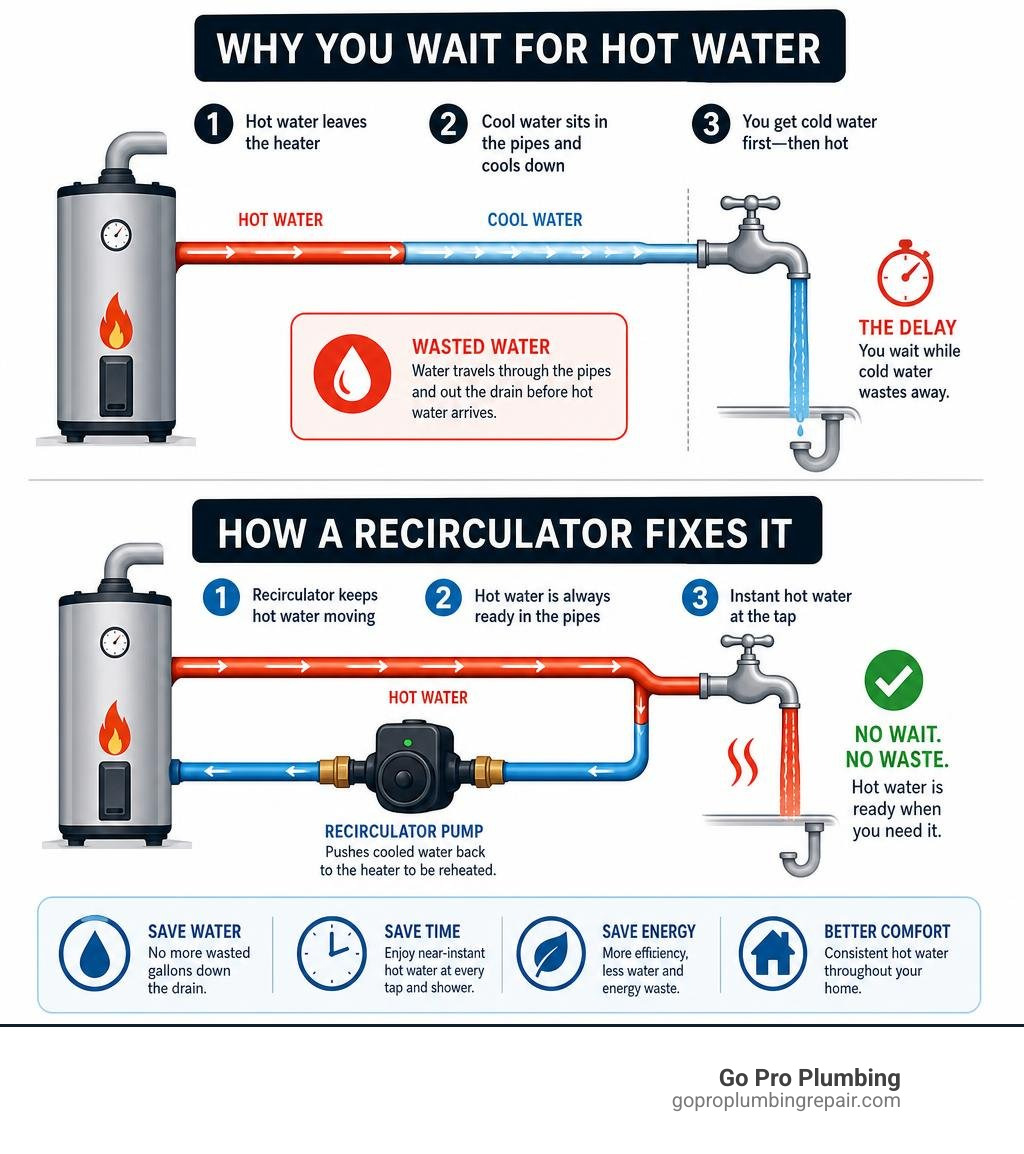
Hot water recirculators are pump-based systems that keep hot water moving through your pipes so it arrives at the tap almost instantly — no more running the faucet for 30, 60, or even 90 seconds waiting for it to warm up.
Here’s the quick answer:
- A recirculating pump sits near your water heater and continuously (or on demand) moves hot water through your plumbing loop
- Cool water that sits in the pipes gets pushed back to the heater to be reheated — instead of being wasted down the drain
- The result: near-instant hot water at every faucet and shower in your home
If you’ve ever stood at your kitchen sink watching cold water run down the drain while waiting for it to warm up, you’re not alone. The average home wastes 26 hours per year just waiting for hot water to arrive at the tap. Across the country, that adds up to between 400 billion and 1.3 trillion gallons of water wasted annually — simply from the delay between turning on the tap and getting usable hot water.
For homeowners in Northern California, where water conservation is a real concern, that waste adds up fast — both in water bills and environmental impact.
A hot water recirculation system is one of the most practical fixes for this problem. But there are several types, and they don’t all work the same way. This guide breaks down exactly how they work, which type fits your home, and what to expect from installation and maintenance.
Hot water recirculators word guide:
- hot water recirculation
- hot water heater return line
- does a hot water recirculating pump run all the time
Understanding Hot Water Recirculators and How They Work
To understand why you have to wait for hot water, you first need to understand “thermal lag.” When you turn off a hot water faucet, the water remaining in the pipe doesn’t stay hot forever. It slowly cools down to room temperature.
The next time you turn on the hot water tap, you have to flush out all of that standing, cooled water before fresh hot water can travel from the water heater to your faucet. The further your sink or shower is from the water heater, the longer the wait.
A hot water recirculator solves this by keeping hot water in a continuous loop. Instead of letting that cooled water sit in the pipes or go down the drain, a recirculation system redirects it back to the water heater.

How Does a Hot Water Recirculating System Work?
The fundamental mechanics of a hot water recirculating pump rely on water pressure and temperature differentials.
When the system is active, a small pump creates a pressure differential that draws water through the hot water line and pushes the cooled water back to the heater. In a standard thermal bypass system, a specialized sensor valve is installed under the sink furthest from the water heater. This valve contains a thermal element that stays open when the water temperature is below 98°F.
As long as the water is cool, the pump pushes it through the valve and back to the water heater. Once the water temperature reaching the valve hits approximately 98°F, the thermal valve closes. This stops the loop, ensuring that hot water is immediately available at that fixture without bleeding hot water into your cold water lines. For a visual representation of how these lines connect, you can check out our recirculating hot water system diagram.
To dive deeper into the physics of how this loop operates, read our guide on how does a hot water recirculating system work.
The Role of Dedicated Return Lines
A dedicated return line is the gold standard for hot water recirculation. In this setup, your plumbing system is designed as a complete loop. Hot water travels from the heater to your fixtures, and a separate, dedicated pipe runs from the furthest fixture back to the water heater.
This loop design ensures that hot water is always close to every tap without ever interacting with your cold water pipes. However, many older homes in Sacramento and Rancho Cordova were not built with a dedicated return line. Retrofitting one can be costly because it requires running new copper or PEX pipes through existing walls.
For homes without this pre-existing loop, plumbing manufacturers have developed “integrated” or “bypass” systems that utilize your existing cold water line as a temporary return pathway. You can learn more about how these dedicated lines are structured in our hot water heater return line guide.
Main Types of Hot Water Recirculation Systems
When choosing a hot water recirculation system, you will generally compare two primary plumbing architectures (dedicated vs. integrated loops) and two operational styles (demand-controlled vs. continuous).
| System Feature | Dedicated Loop System | Integrated (Bypass) Loop System |
|---|---|---|
| Return Pathway | Dedicated return pipe | Existing cold water pipe |
| Installation Cost | Higher (especially for retrofits) | Lower (ideal for existing homes) |
| Cold Water Impact | None | Temporary lukewarm cold water |
| Best Suited For | New construction or major remodels | Retrofitting existing homes |
| Pump Location | At the water heater | At the water heater or under the sink |
Dedicated Loop vs. Integrated Loop Systems
If you are building a new home or undergoing a major remodel in Northern California, installing a hot water recirculating system with dedicated return line is highly recommended. It keeps your hot and cold systems entirely separate, preventing any lukewarm water from bleeding into your cold water taps.
For retrofits, an integrated loop system is the go-to option. These systems use a bypass valve installed under the sink furthest from the water heater. The pump (which can be mounted at the water heater or under the sink) pushes the lukewarm water back through the cold water line.
While highly convenient and affordable, the minor drawback of an integrated system is that your cold water line may briefly run warm for a few seconds when you first turn on the cold tap.
Demand-Controlled vs. Continuous Hot Water Recirculators
How often should your pump run?
- Continuous Systems: These pumps run 24/7. While they ensure hot water is always ready instantly, they waste a significant amount of electricity and lead to high “standby heat loss” from your pipes.
- Timer-Based Systems: These systems use a mechanical or digital timer (like the one found on the VEVOR Hot Water Recirculating Pump with Timer) to run only during peak hours, such as mornings and evenings.
- Demand-Controlled Systems: These are the most energy-efficient options. They only activate when you trigger them via a button, motion sensor, or smart flow sensor. For example, the Smart Aquastat Control 32 – Leridian Dynamics senses when hot water is drawn anywhere in the house and runs the pump only until the loop reaches the programmed temperature. This reduces pump runtime by over 90% compared to continuous systems.
Key Benefits of Installing a Recirculation System
Installing a recirculator isn’t just about avoiding a cold shiver when you step into the shower; it has measurable financial and environmental benefits.
Water and Financial Savings
The average household wastes thousands of gallons of clean municipal water every year while waiting for the tap to warm up. Depending on the size of your home and your family’s habits, a hot water recirculation system can save between 12,000 and 15,000 gallons of water per year.
In Northern California, where water rates continue to rise, these savings directly lower your monthly utility bills. When evaluating the overall hot water recirculation system cost, including the recirculation pump installation cost, many homeowners find that the system pays for itself over time through reduced water waste.
Energy Efficiency of Modern Hot Water Recirculators
A common concern is whether the energy required to run the pump offsets the water savings. According to the Department of Energy (DOE), between 800 and 1,600 kilowatt-hours (kWh) per year are used nationally to treat and pump water to households that is ultimately wasted down the drain.
However, running a standard recirculating pump continuously can consume 400 to 800 kWh per year just in electricity, plus the extra energy your water heater uses to keep replacing the heat lost through uninsulated pipes.
This is why modern, smart controls are so critical. By using demand-sensing systems or smart timers, you can keep pump energy use to a fraction of that amount. To understand how to maximize these savings, read our analysis: are hot water recirculation systems efficient.
Installation Requirements and System Design Considerations
Before purchasing a pump, you must ensure it matches your home’s plumbing layout and water heating system.
Sizing and Plumbing Setup Compatibility
A pump that is too small won’t deliver hot water quickly enough, while an oversized pump can cause noisy pipes and premature pipe erosion. Sizing depends on your home’s total pipe length, pipe diameter, and the “head lift” (the vertical distance the pump must push water).
For detailed calculations, refer to our recirculation pump sizing complete guide.
Furthermore, system compatibility is vital. Standard recirculating pumps are designed for traditional tank water heaters and should not be used on tankless systems unless specifically rated for them. Tankless water heaters require a higher flow rate to activate the burner.
If you have a tankless system, you will need a specialized controller or a tankless-compatible pump. Read our hot water recirculation for tankless system guide to learn about options like the Rinnai Smart Circ or specialized electric water heater recirculation pump guide setups.
Retrofitting Without a Dedicated Return Line
If your home does not have a dedicated return line, you can easily retrofit using a thermal bypass system.
An excellent example of this technology is the Astro Express 2 Hot Water Recirculation System | Armstrong Fluid Technology. This system combines a stainless steel pump installed at your water heater with a lead-free bronze bypass valve installed under your furthest sink. It redirects the cooled water into the cold supply line, providing instant hot water without requiring any drywall damage or new pipe runs.
Another advanced retrofit option is the Smart Thermostatic Control 32 Complete Maxx-Flow System – Leridian Dynamics, which uses a high-flow crossover valve that provides twice the flow rate of standard plastic bypass valves, ensuring incredibly rapid hot water delivery.
Potential Drawbacks and Maintenance Requirements
While hot water recirculators are fantastic convenience-boosters, they are not entirely “set-it-and-forget-it” appliances.
Common Hot Water Recirculation System Problems
Over time, continuous water circulation can lead to specific plumbing issues:
- Pipe Erosion: Constant high-velocity water flow, especially in copper pipes, can wear down the pipe walls over several years, leading to pinhole leaks. This is why we recommend choosing a high-quality pump—often discussed as the bronze standard unpacking recirculation and secondary circulation pumps—which utilizes corrosion-resistant materials.
- Calcium and Mineral Buildup: In areas with hard water, scale can accumulate inside the pump and the under-sink bypass valves, causing them to stick open or closed.
- Lukewarm Cold Water: If your bypass valve fails or gets stuck due to mineral buildup, hot water will continuously bleed into your cold water lines, resulting in lukewarm water when you turn on the cold tap.
Regular plumbing maintenance, including flushing your water heater and checking the check valves, can prevent these issues. For troubleshooting tips, read our guide on hot water recirculation system problems.
Frequently Asked Questions About Hot Water Recirculation
Does a Hot Water Recirculating Pump Run All the Time?
No, it doesn’t have to. While some basic models run continuously, doing so wastes electricity and accelerates wear on your plumbing. Most modern systems utilize mechanical timers, aquastats (which shut the pump off when the water reaches a certain temperature), or smart smartphone-app controls to run only when needed.
For a complete breakdown of runtimes, check out does a hot water recirculating pump run all the time.
Can You Have Hot Water Recirculation Without a Pump?
Yes, in very specific multi-story homes, you can design a gravity-fed or “thermosiphon” system. Because hot water naturally rises and cold water sinks, a properly designed plumbing loop can circulate water naturally without an electric pump.
However, this requires precise pipe sloping and is generally only possible during initial home construction. Learn more about this method in our guide on hot water recirculation without a pump.
Are There Rebates or Incentives for Installing Recirculators?
Yes! Because hot water recirculators conserve massive amounts of water, many municipal water districts offer rebates. For example, some cities offer rebates ranging from $100 to $200 for installing demand-controlled recirculation pumps.
Additionally, in California, on-demand recirculation systems help homeowners comply with strict energy codes, including California Title 24. You can find more details on code compliance and incentives in the industry resource what you need to know about hot-water recirculation.
Conclusion
Waiting for hot water to arrive at your tap is a daily frustration that wastes thousands of gallons of water and adds unnecessary costs to your utility bills. Whether you choose a dedicated return loop for a remodel or a convenient under-sink retrofit bypass system, installing a hot water recirculator is one of the best upgrades you can make for your home.
Because proper system design, sizing, and water heater compatibility are critical to preventing pipe damage and maximizing energy efficiency, it is always best to consult a professional.
At Go Pro Plumbing, we specialize in helping homeowners throughout Sacramento, Rancho Cordova, and Northern California find the perfect energy-efficient plumbing solutions. From demand-controlled smart pumps to complete loop retrofits, our commitment to outstanding customer service and same-day service ensures your home gets hot water exactly when you need it.
Ready to stop wasting water and start enjoying instant hot showers? Schedule Water Recirculation Pump Services with us today!