
A Complete Guide to Domestic Hot Water Return Valves
By Brian on August 21, 2026
Why a Balancing Valve for Hot Water Return Matters
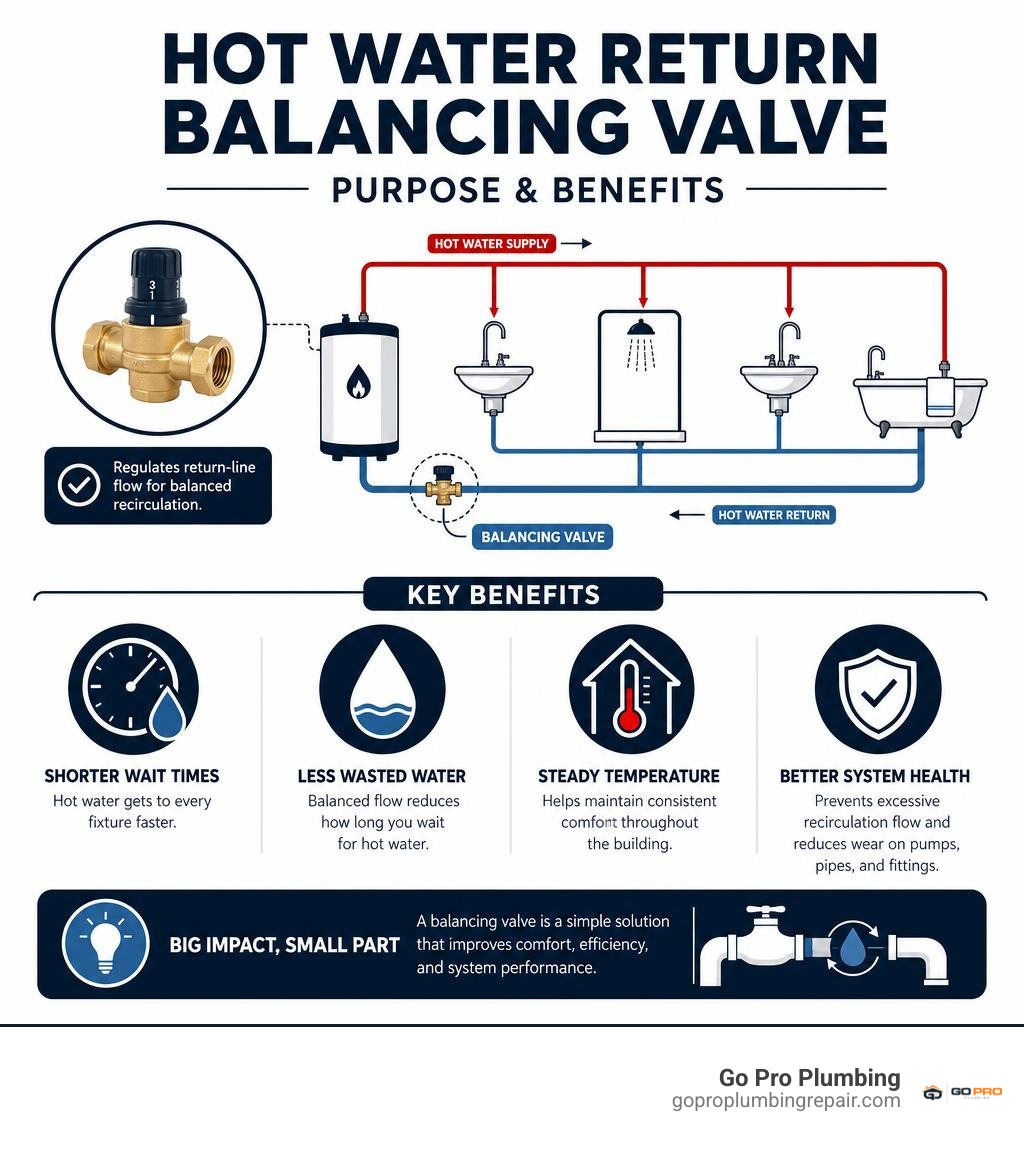
A balancing valve for hot water return controls how recirculated hot water moves through a plumbing system, helping each branch or riser receive enough flow to stay warm.
Without proper balancing, water follows the easiest path. Nearby lines may get too much hot water while distant bathrooms, apartments, or upper floors wait longer for it. That can waste water, increase energy use, and create uneven temperatures across the building.
| Quick answer | What it means |
|---|---|
| What it does | Regulates return-line flow so hot water is distributed more evenly. |
| Where it goes | Usually on the hot water return line, after the last fixture on a branch or riser. |
| Why it matters | It can shorten hot-water wait times, reduce wasted water, and support steady recirculation temperatures. |
| Common types | Manual, pressure-independent automatic, and thermostatic balancing valves. |
For a home, apartment building, hotel, or commercial property, a return valve is a small part with a big impact on comfort and system performance. The right valve also helps prevent excessive recirculation flow, which can add wear to pumps, pipes, and fittings.
Key balancing valve for hot water return vocabulary:
System Dynamics and the Purpose of a Balancing Valve for Hot Water Return
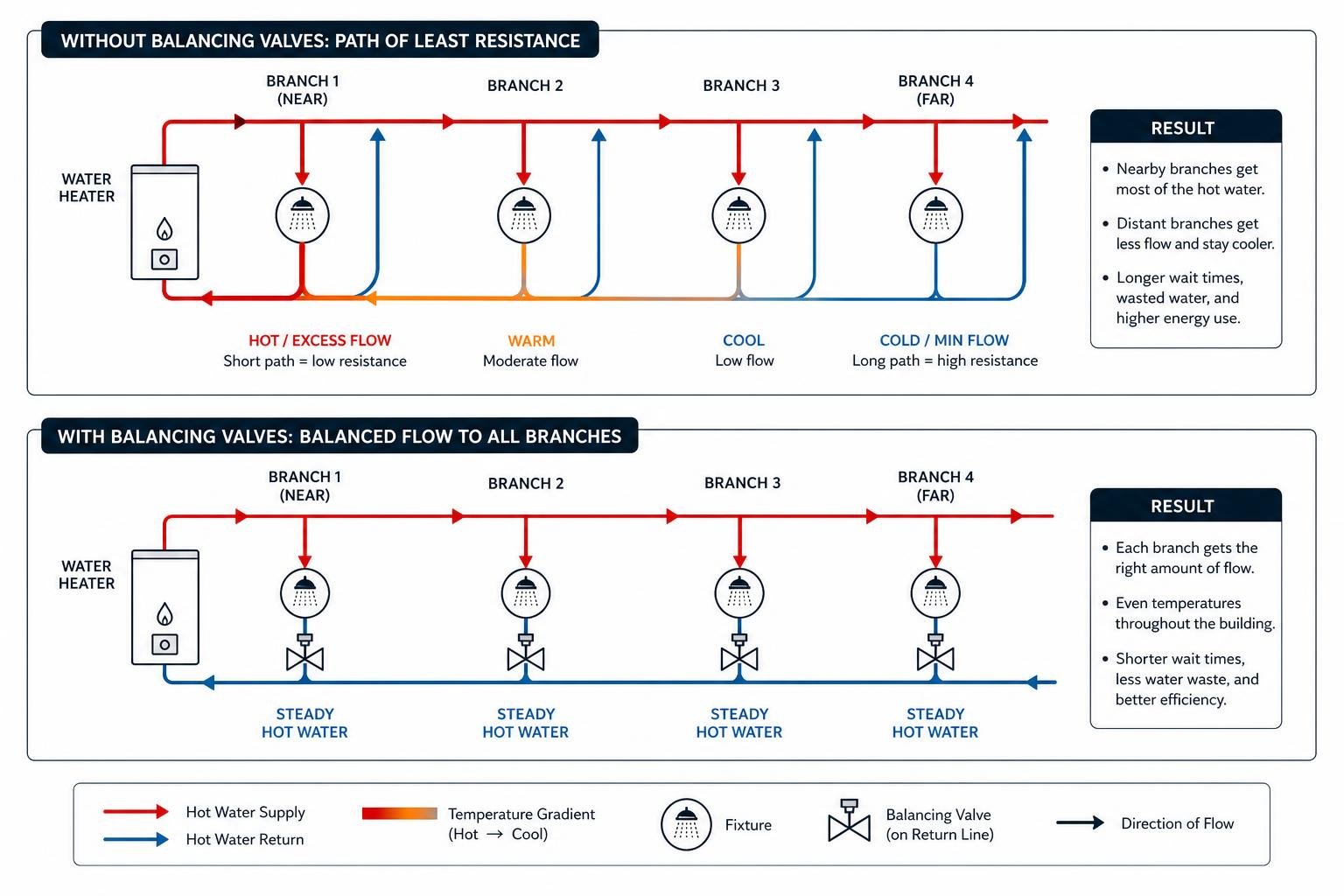
To understand why a balancing valve for hot water return is critical, we first need to look at how water behaves inside a building’s piping network. When water is heated and pushed into a supply line, it naturally seeks out the easiest route back to the water heater or boiler.
In any multi-branch or multi-floor plumbing setup, water will flow through short loops close to the heat source while avoiding long loops that lead to distant fixtures. This phenomenon creates severe flow imbalances across the building, leaving far-away taps lukewarm while nearby lines overheat.
The Mechanics of Domestic Hot Water Recirculation Lines
In a standard domestic plumbing setup without continuous circulation, water sitting in the supply pipes cools down between uses. When someone turns on a tap, all that cooled water must be dumped down the drain before hot water arrives. To stop this water waste, modern buildings utilize a hot water recirculation system with dedicated return line.
Here is how the continuous flow mechanism operates:
- Supply Main: Hot water leaves the central heating source and enters main supply risers.
- Branch Takeoffs: Hot water feeds individual groups of fixtures across various floors or wings.
- Dedicated Return Loop: At the last fixture on each branch, a return line picks up unused hot water.
- Circulation Pump: A pump draws water from these return lines and directs it back to the water heater.
Understanding how does a hot water recirculating system work helps us see that as hot water travels through these long piping runs, it constantly loses thermal energy to the surrounding air. In multi-riser piping layouts, each individual branch experiences a different rate of thermal drop based on distance, pipe insulation quality, and local ambient temperatures.
How Thermal Loss and Hydraulic Path of Least Resistance Affect Flow
Fluid mechanics dictate that water always takes the hydraulic path of least resistance. Without a flow-control mechanism on each loop:
- Short-circuiting occurs: Hot water rapidly circulates through the shortest, closest branch near the pump, returning to the heater instantly.
- Distant fixtures starve: The longest, most remote branches receive almost no flow because the water pressure drops off over long distances.
- Excessive hot water wait times: Building occupants on upper floors or end-of-line units wait anywhere from 5 to 7 minutes for hot water to arrive at the tap.
- Massive energy waste: Water heaters work overtime trying to maintain overall loop temperatures, while gallons of potable water are flushed down drains daily waiting for hot water.
By placing a calibrated balancing valve for hot water return at the tail end of each branch or riser prior to joining the main return header, we introduce controlled resistance. This forces hot water to distribute evenly throughout every branch across the entire facility.
Manual, Automatic, and Thermostatic Balancing Technologies Compared
Over the past few decades, plumbing technology has evolved significantly in how we manage return line balancing. Choosing the correct technology determines not only how comfortable building occupants will be, but also how much labor you spend maintaining the system.
| Feature | Manual Circuit Setters | Automatic Flow Limiting Valves | Thermostatic Balancing Valves (TBVs) |
|---|---|---|---|
| Balancing Parameter | Static flow coefficient (fixed orifice) | Fixed maximum flow (GPM) | Dynamic temperature (°F) |
| Adjustment Need | Labor-intensive manual setting | Factory pre-set cartridge | Self-actuating automatic regulation |
| Response to Thermal Changes | None (Static) | None (Static flow only) | Dynamic (Modulates as temperature changes) |
| System Startup Time | 2 to 3 days (Multiple plumbers) | Instantaneous upon startup | Fast automatic balance (Under 3 hours) |
| Energy Waste | High (Continuous high flow) | Moderate (Constant flow) | Lowest (Restricts flow when warm) |
| Risk of Over-Pumping | High | Low | Extremely Low |
Limitations of Traditional Manual Circuit Setters
Traditional manual balancing relies on calibrated circuit setters—essentially adjustable globe or ball valves equipped with pressure readout ports. While manual circuit setters were the U.S. industry standard for decades, they suffer from fundamental design flaws in domestic hot water applications:
- Labor-Intensive Balancing Procedures: Commissioning a multi-riser commercial building requires Testing, Adjusting, and Balancing (TAB) teams. It typically takes 2 to 3 plumbers 2 to 3 full days to iteratively measure differential pressure across every valve and adjust flow rates manually.
- Cascading Adjustments: Adjusting one manual valve changes the pressure dynamics across all other branches in the system. Installers must repeatedly check and re-check every riser until an acceptable balance is achieved.
- Static Solutions to Dynamic Problems: Domestic hot water demand is constantly changing. Manual valves set flow for a static, zero-demand state. When people open faucets, branch pressures shift instantly, rendering static manual valve settings completely ineffective.
- Frequent Customer Callbacks: Building managers frequently experience cold spots during peak morning usage, resulting in costly contractor callbacks to tweak manual settings.
Selecting a Fixed vs Adjustable Balancing Valve for Hot Water Return
To overcome manual valve drawbacks, modern engineers turn to dynamic self-actuating thermostatic balancing valves (TBVs). Unlike manual valves that react to pressure drop, TBVs monitor line temperature and adjust flow automatically. When specifying thermostatic valves, you must choose between fixed-setpoint and field-adjustable models.
According to research published on What’s the Hype with Thermostatic Balancing Valves? – ASPE Pipeline, the choice between fixed and adjustable thermal valves comes down to control span, field calibration flexibility, and system pressure drops:
- Fixed Thermostatic Valves: Factory calibrated to operate over a tight 10°F temperature span (fully open to fully closed within 10°F of target return setpoint). Because their internal flow paths are streamlined, fixed valves exhibit negligible pressure drops under normal operation. They are tamper-proof, eliminating unauthorized field adjustments.
- Adjustable Thermostatic Valves: Offer a wide field-adjustment range (typically covering a 50°F span, such as 104°F to 149°F). While this allows engineers to tweak settings post-installation, adjustable internal mechanisms can increase pressure drops by more than 4:1 compared to fixed models when operating 5°F below target temperature.
How Thermostatic Valves Protect Systems and Lower Labor Costs
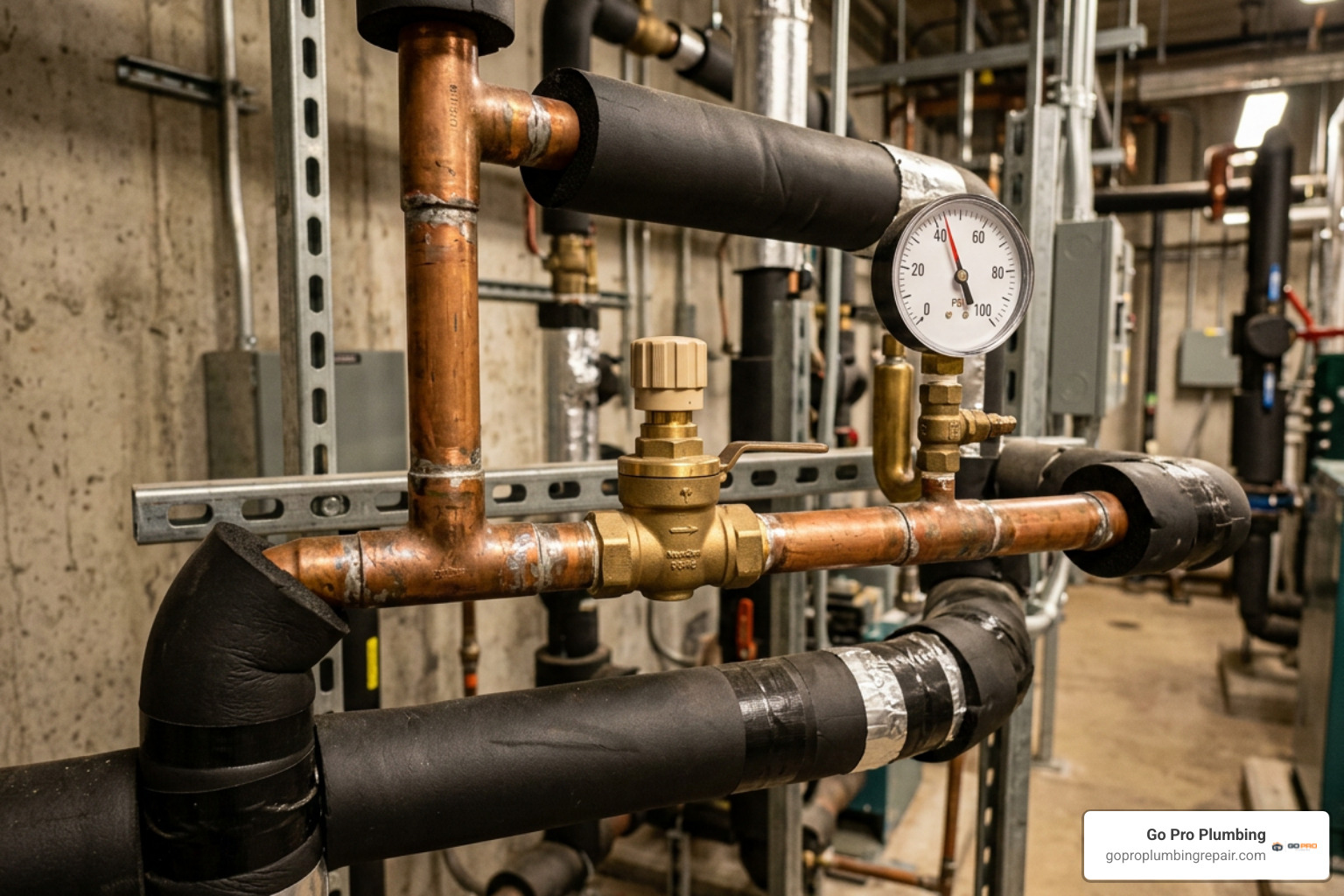
Thermostatic balancing valves represent a direct “temperature solution to a temperature problem.” Instead of trying to calculate complex fluid dynamics and static friction losses, a thermostatic valve simply asks one question: Is this return line hot enough?
Thermal Wax Actuators and Minimum Bypass Protection
At the core of every high-performance thermostatic balancing valve lies a self-actuating thermal element filled with a specialized blended paraffin wax compound.
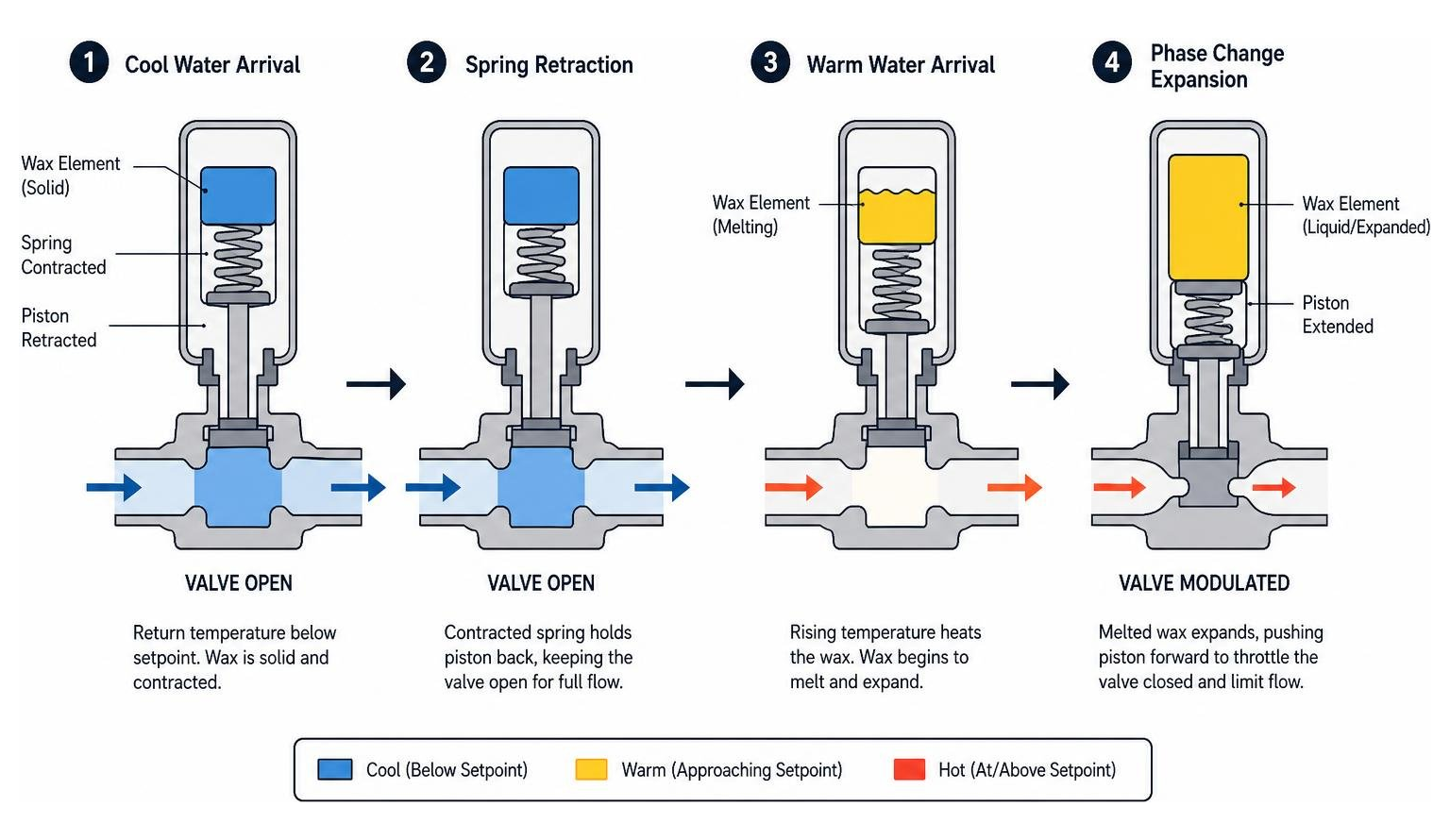
The internal mechanics function through a precise physical process:
- Cool Water Arrival: When return line temperature drops below the valve’s setpoint, the internal paraffin wax solidifies and contracts.
- Spring Retraction: An internal stainless-steel spring contracts the wax element piston, opening the main valve orifice to allow full recirculation flow.
- Warm Water Arrival: As fresh, hot water reaches the valve from the main heating source, heat transfers directly into the wax chamber.
- Phase Change Expansion: The paraffin wax melts and expands rapidly from solid to liquid, pushing the piston forward to throttle the valve orifice closed.
- Minimum Bypass Protection: A thermostatic valve is engineered so that it never fully shuts off. It retains a small, calculated minimum flow bypass (typically maintaining a minimum coefficient of flow, Cv, around 0.2).
This minimum continuous flow bypass is vital. It guarantees that the hot water recirculation pump is never dead-headed (pumping against a completely blocked pipe), protecting motor windings from overheating while maintaining continuous temperature sensing at the valve seat.
Installing a Thermostatic Balancing Valve for Hot Water Return Lines
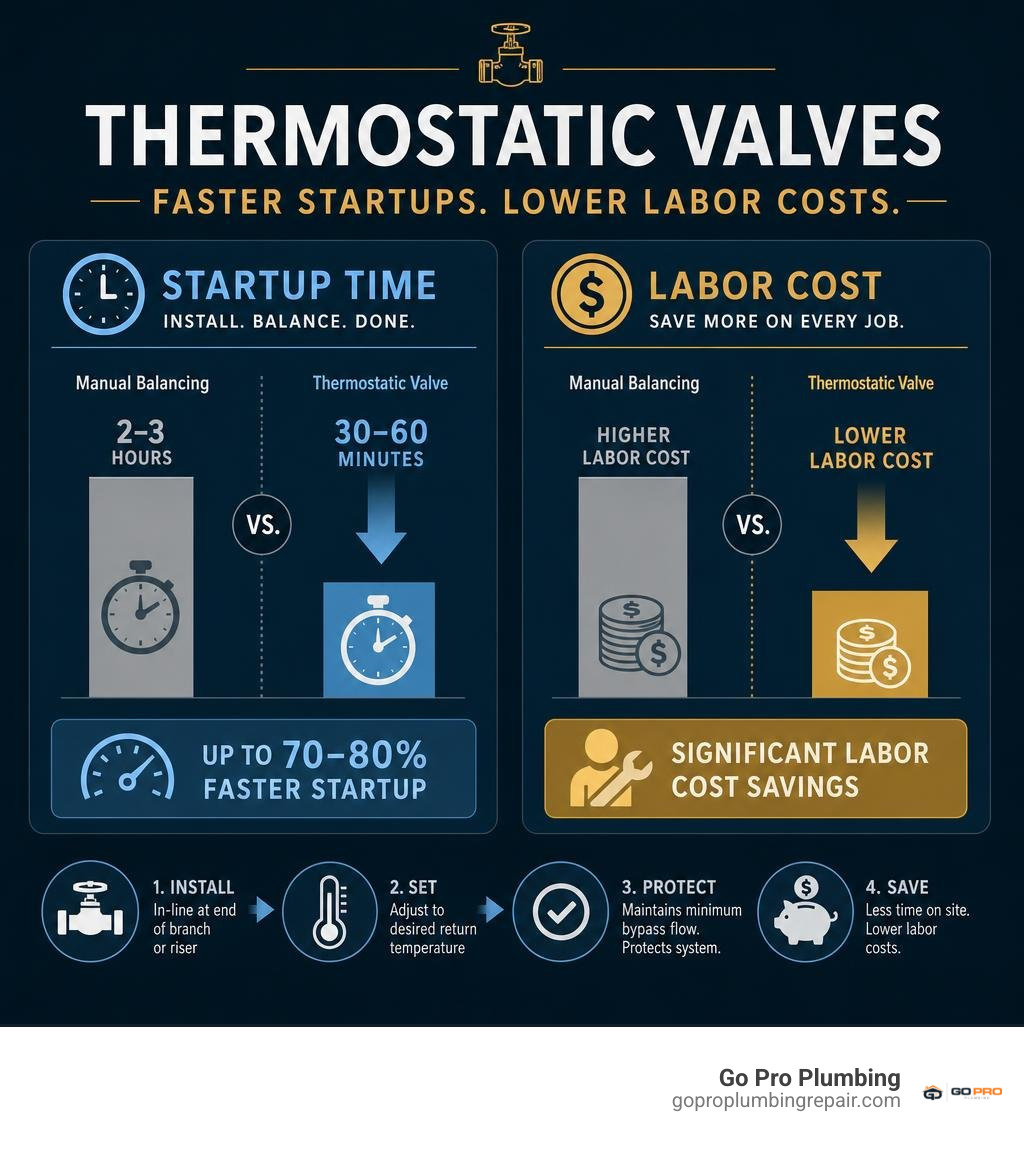
Installing thermostatic return valves dramatically slashes mechanical contractor startup times. Following general manufacturer Installation Instructions, valves should be installed in-line at the end of each hot water supply branch or riser, immediately after the last fixture connection and before joining the main return loop header.
When selecting thermostatic balancing valves for potable drinking water systems in Northern California cities like Sacramento and Rancho Cordova, verify the following material specifications:
- Lead-Free Compliance: Must carry NSF/ANSI/CAN 61 and NSF 372 certifications to comply with strict drinking water regulations.
- Corrosion-Resistant Housing: Opt for 300-series stainless steel or lead-free brass construction to withstand aggressive recirculating hot water.
- High-Grade Elastomer Seals: Look for peroxide-cured EPDM O-rings rather than standard sulfur-cured seals. Peroxide curing provides superior chemical resistance against local water disinfectants like chlorine, chloramines, and chlorine dioxide.
- Generous Manufacturer Warranty: Industry-leading thermostatic valves back their wax actuators with 10-year warranties.
Contractors report that systems utilizing self-actuating thermostatic valves balance automatically upon startup in under 3 hours without requiring a single manual valve adjustment. This eliminates days of tedious balancing labor and guarantees zero post-occupancy callbacks.
Code Compliance, Pipe Longevity, and Smart Recirculation Pump Integration
Beyond delivering instant hot water, implementing dynamic balancing valves protects overall plumbing infrastructure and keeps commercial properties fully compliant with modern building energy codes.
Preventing Pipe Erosion, Velocity Damage, and Legionella Growth
When recirculation pumps are oversized or static balancing valves are choked down tightly, water velocity inside return lines can spike dramatically. High-velocity hot water creates serious plumbing failures over time:
- Copper Erosion-Corrosion: Continuous recirculating water speeds exceeding 2 feet per second (fps) cause mechanical erosion of the protective oxide layer inside copper pipes. Combined with elevated water temperatures (above 140°F), this leads to localized turbulence, premature pipe thinning, and disastrous copper pinhole leaks.
- PEX Tubing Splitting: Excessive flow velocities combined with hot, chlorinated municipal water can accelerate micro-cracking and wall degradation in PEX piping.
- Legionella Bacterial Proliferation: Legionella bacteria thrive in stagnant water between 68°F and 122°F. Dead-legs and unbalanced return branches that drop into this temperature zone pose severe health risks to building occupants.
To combat bacterial growth, modern thermostatic balancing valves offer optional thermal disinfection features, such as those detailed in the Thermal Balancing Valve with Thermal Disinfection By-Pass – Intatec specification. When the water heater raises system temperatures above 158°F–160°F during periodic sanitation cycles, an internal secondary bypass opens wide. This allows high-temperature water to surge through every return loop, thoroughly sanitizing the entire pipe network before automatically returning to standard thermal balancing mode. Preventing these flow and bacterial issues helps eliminate common hot water recirculation system problems.
Energy Standards and Smart Recirculation Pump Integration
Updating building codes across the West Coast are rapidly shifting thermostatic return valves from an optional upgrade to a mandatory design standard:
- Washington State Energy Code (WSEC C404.7.1.2): Explicitly mandates self-actuating thermostatic balancing valves on variable flow multi-riser hot water recirculation loops.
- California Energy Code (Title 24 / Title 20): Grants significant compliance credit for hot water distribution designs incorporating thermostatic return valves set at or below 120°F.
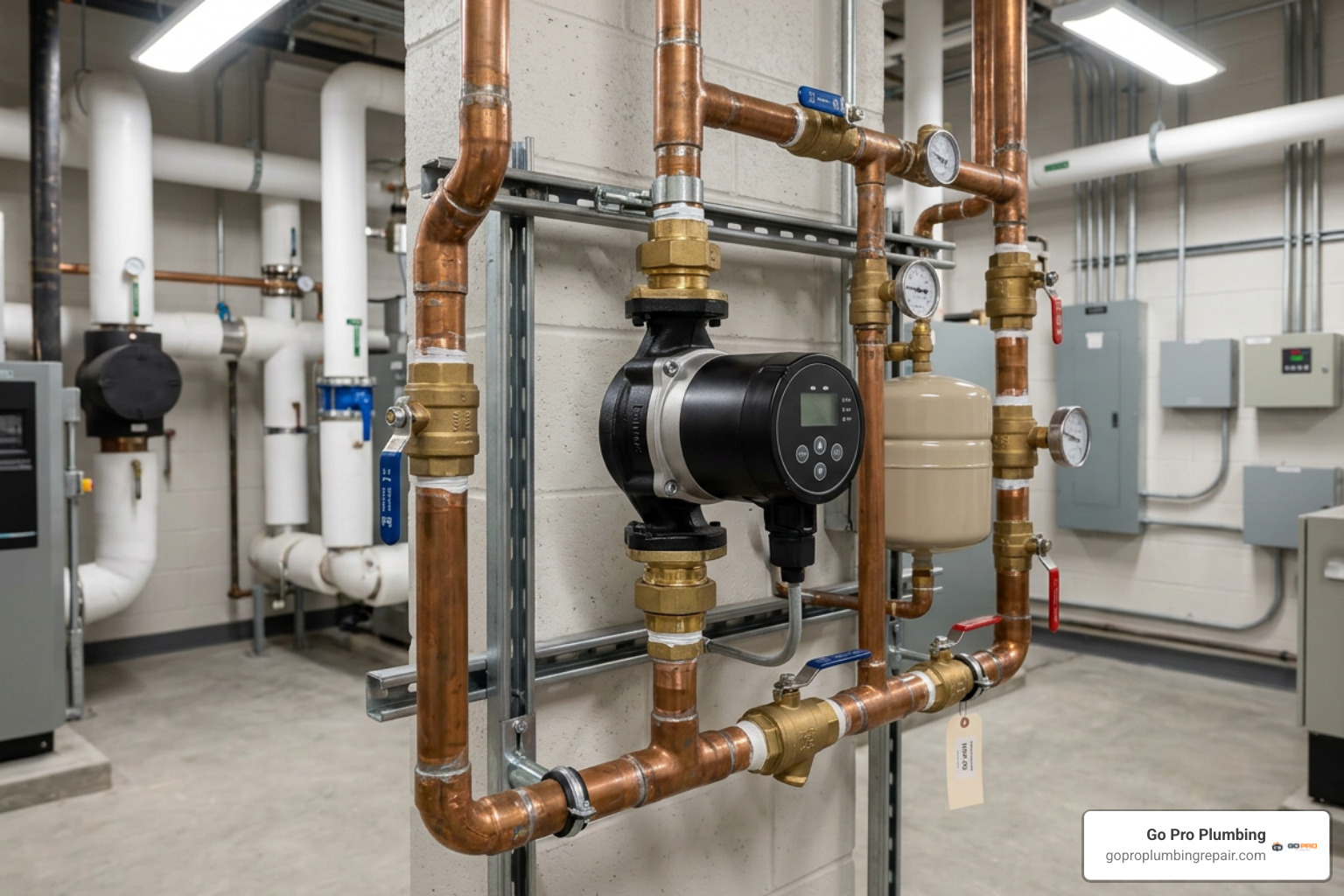
The true operational magic occurs when pairing thermostatic return valves with modern Electronically Commutated Motor (ECM) variable-speed recirculation pumps.
When you set an ECM pump to Constant Pressure Mode, it dynamically reacts to changing valve positions:
- Cool System Startup: When the system is cold, all thermostatic balancing valves open fully. Pipe resistance is low, and the ECM pump runs at full speed.
- Target Temperature Reached: As each riser hits its setpoint temperature, its thermostatic valve modulates closed toward its minimum bypass position.
- Pressure Rise Detection: As multiple valves close down, overall loop resistance increases, causing pump head pressure to rise slightly.
- Pump Speed Reduction: The smart ECM pump detects this pressure rise and automatically ramps down its motor speed.
By combining ECM pumps with dynamic thermal valves, pump electrical power consumption drops by up to 70–80%, while simultaneously maintaining perfect thermal balance across every single fixture in the building.
Frequently Asked Questions About Hot Water Return Valves
How quickly does a thermostatic balancing valve balance a multi-riser system?
Unlike manual circuit setters that require 2 to 3 plumbers working for 2 to 3 days to iteratively measure differential pressure across every floor, thermostatic balancing valves achieve automatic balance during initial startup in under 3 hours. Because the internal wax actuators react dynamically to water temperature, the entire multi-riser system balances itself seamlessly without any manual labor or balancing tools.
How do balancing valves prevent copper pipe erosion and pinhole leaks?
Manual valves locked into nearly-closed positions cause localized high-velocity water jets that strip away copper oxide protective coatings. Thermostatic balancing valves modulate dynamically based on temperature, keeping overall continuous return loop velocity capped below the plumbing industry standard limit of 2 feet per second (fps). Controlling flow velocity prevents turbulence-induced erosion, pinhole leaks, and premature pipe failures.
Do thermostatic balancing valves require electrical wiring or controllers?
No. Standard thermostatic balancing valves are completely self-actuating and mechanical. They rely exclusively on the physical thermal expansion and contraction of an internal paraffin wax actuator element. As water temperature changes, the wax changes state between solid and liquid to move an internal piston, requiring zero electrical wiring, external power sources, or electronic control systems.
Optimize Your Hot Water System with Go Pro Plumbing
Balancing a domestic hot water return loop is no longer about trial-and-error flow rate guessing or endless contractor callbacks. By transitioning to dynamic, self-actuating thermostatic balancing valves, building owners and facility managers across Northern California enjoy instant hot water delivery, lower energy costs, extended pipe longevity, and complete peace of mind.
Whether you are renovating a commercial building in Sacramento, managing a multi-family property in Rancho Cordova, or upgrading your residential water heating system, our team at Go Pro Plumbing is here to help. We bring years of expert hands-on experience in hydraulic design, recirculation pump sizing, and lead-free thermostatic balancing installations.
Ready to eliminate long hot water wait times and lower your utility bills? Contact the licensed experts at Go Pro Plumbing today to schedule your consultation or explore our Professional Water Recirculation Services.