
How Do Tankless Water Heaters Work? The Complete Breakdown
By Brian on August 20, 2026
How Do Tankless Water Heaters Work?
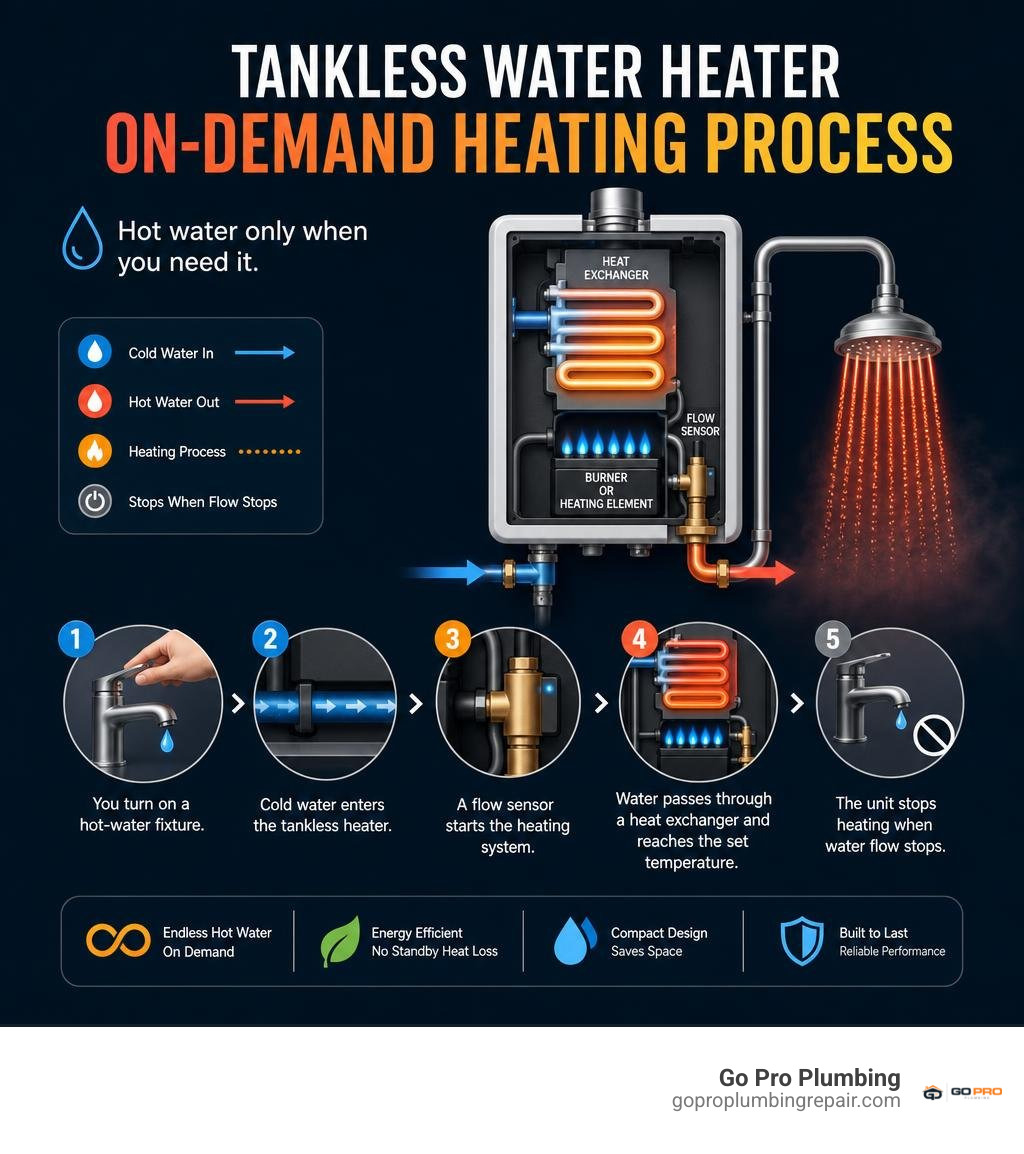
How do tankless water heaters work? They heat water only when you open a hot-water tap. Cold water flows through the unit, a sensor detects that flow, and a gas burner or electric heating element warms the water as it moves through a heat exchanger. When the tap closes, the heating stops.
Unlike a traditional water heater, there is no large tank holding 40 or 50 gallons of hot water all day. That means no standby heat loss from stored water slowly cooling between uses.
In simple terms:
- You turn on a hot-water fixture.
- Cold water enters the tankless heater.
- A flow sensor starts the heating system.
- Water passes through a heat exchanger and reaches the set temperature.
- The unit stops heating when water flow stops.
Tankless systems can provide a continuous supply of hot water, but they are not unlimited in every situation. Their real capacity depends on the unit’s flow rate, the temperature of Northern California’s incoming water, and how many showers, faucets, or appliances run at once.
This guide explains the parts inside a tankless water heater, the differences between gas and electric models, sizing, maintenance, recirculation, and the practical trade-offs to consider before installing one.
How do tankless water heaters work further reading:
- Tankless water heater reviews
- Energy efficient water heater
- Electric tankless water heater for camper
The Core Mechanism: How Do Tankless Water Heaters Work?
Understanding how do tankless water heaters work requires looking at the system as a continuous flow-through process. Water heating accounts for roughly 20 percent of the average home energy budget. Traditional tank units operate like a battery with a very slow charger—constantly burning gas or drawing electricity to keep 40 to 50 gallons of standing water hot 24 hours a day, 7 days a week.
Tankless water heaters eliminate that standby energy loss. As outlined in the Department of Energy Guide on Demand-Type Water Heaters, on-demand systems only consume energy when a hot water fixture is actively opened somewhere in the home.
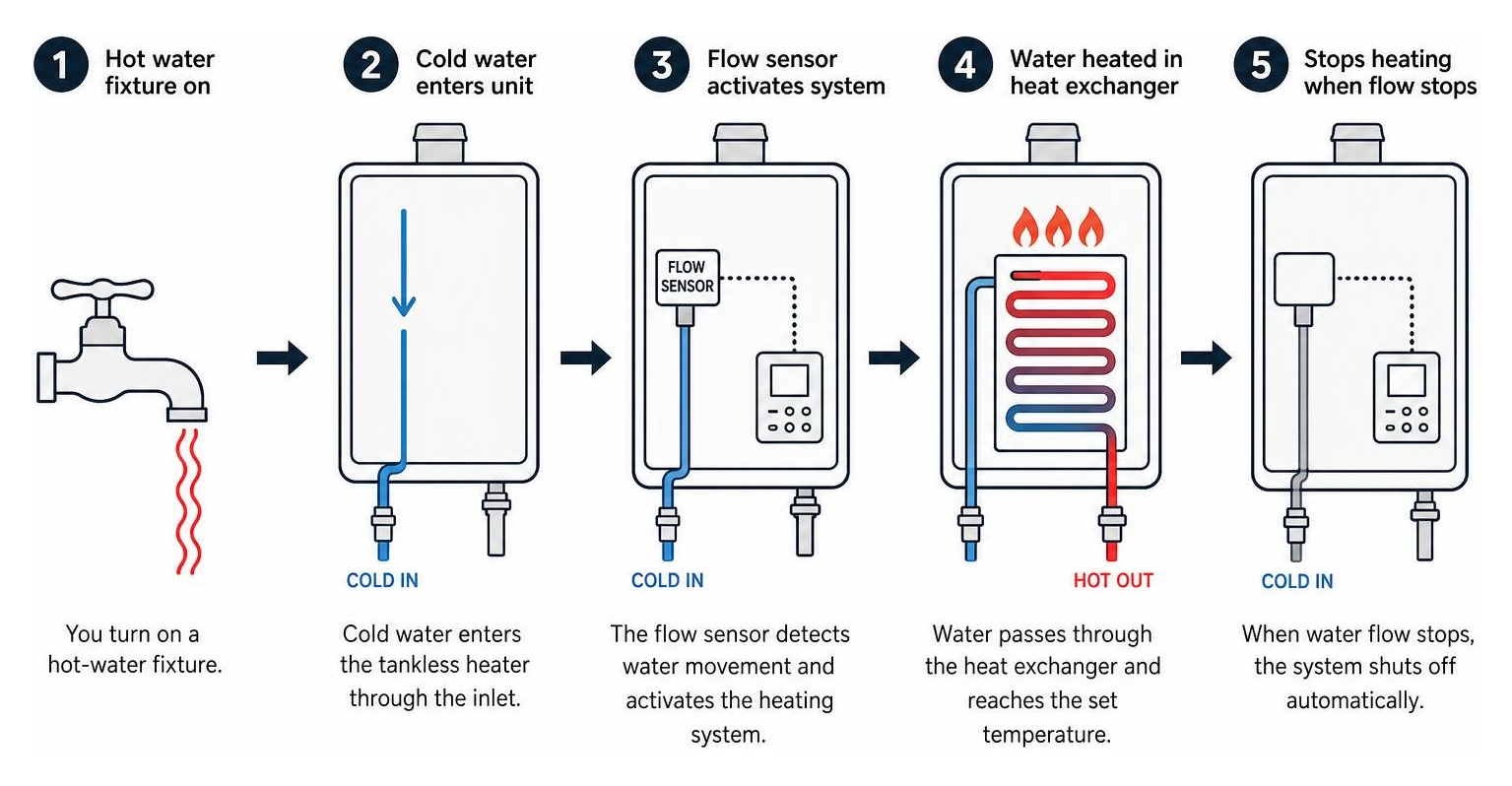
When you open a hot water tap, cold water enters the unit through an inlet pipe. An electronic flow sensor detects this movement and sends a signal to the computer control board. The system instantly activates its heating elements or ignites its gas burner. As cold water travels through the dense, tightly wound copper or stainless steel heat exchanger, rapid heat transfer occurs. By the time the water exits the outlet valve, it has reached your target set temperature (typically 120°F).
Primary Internal Components
To deliver rapid, precise temperature increases in a cabinet the size of a suitcase, several specialized components must work together within seconds:
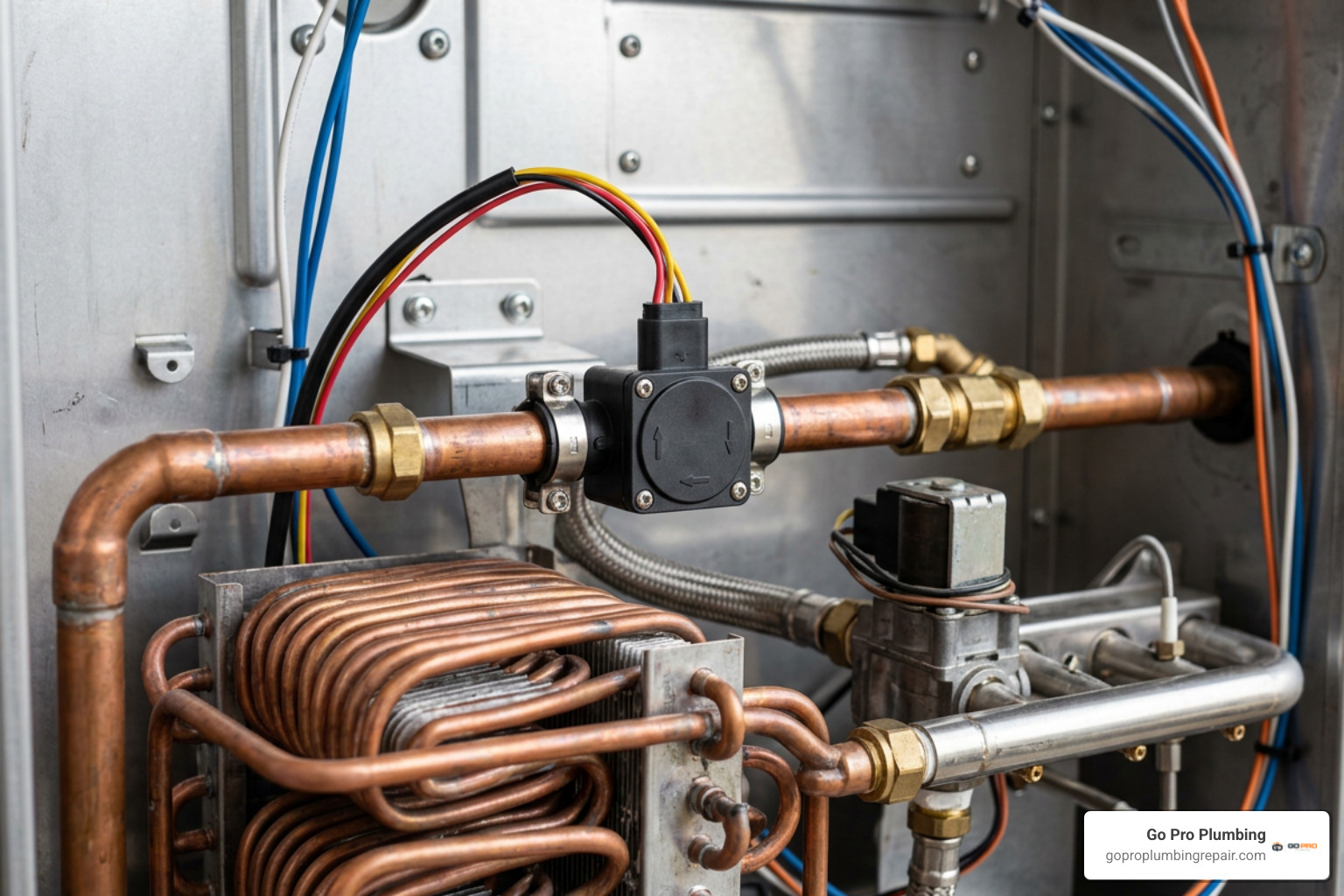
- Flow Sensor (Turbine or Impeller): Measures the flow rate of water entering the unit. Most systems require a minimum flow rate of about 0.5 gallons per minute (GPM) to activate the heater.
- Electronic Control Board (PCB): The unit’s brain. It reads inputs from temperature sensors and the flow sensor, dynamically adjusting gas valves or electric element modulation to maintain accurate output temperatures.
- Heat Exchanger: A dense network of copper or stainless steel tubing surrounded by heating fins. Copper provides high thermal conductivity, while stainless steel offers exceptional resistance to corrosion and scale accumulation.
- Gas Burner or Electric Elements: The heat source. Gas units utilize high-output modulating burners (ranging from 10,000 to nearly 200,000 BTUs), while electric units utilize powerful thick-film immersion heating elements.
- Mixing Valve: Controls water output by blending cold water directly into the heated stream if output temperatures exceed safe levels.
How Do Tankless Water Heaters Work During Intermittent Use?
If you turn off the shower faucet to lather up and turn it back on 30 seconds later, you might experience a brief drop in temperature known as a “cold water sandwich.” This occurs because the heated water already inside the pipe travels out first, followed by a small pocket of unheated water that entered the system during the few seconds it took for the flow sensor to re-trigger the burner.
Modern manufacturers address this issue in several ways. Many units utilize Hot Start Programming, which keeps the system in a ready state for five minutes after water usage ends. Other high-end systems incorporate small internal buffer tanks (1/2 gallon) that blend stored hot water into the outgoing line during burner ignition lag. You can read more about these operational variations in our detailed guide to comparing tankless water heater options.
Fuel Types: Gas Condensing vs. Non-Condensing vs. Electric
Selecting the right fuel source and operating design directly impacts installation complexity, energy performance, and utility costs.
| Feature | Gas Condensing | Gas Non-Condensing | Electric Tankless |
|---|---|---|---|
| Energy Efficiency (UEF) | 90% – 98% | 80% – 85% | 98% – 99% |
| Primary Fuel | Natural Gas / Propane | Natural Gas / Propane | Electricity |
| Venting Material | Low-cost PVC / CPVC | Category III Stainless Steel | None required |
| Max Flow Rate (GPM) | High (Up to 11.0 GPM) | Moderate to High (Up to 9.0 GPM) | Low to Moderate (2.0 – 5.0 GPM) |
| Infrastructure Needs | 3/4″ Gas line, condensate drain | 3/4″ Gas line, high-temp vent | 150 – 200+ Amp panel, multiple breakers |
Gas Tankless Heaters: Condensing vs. Non-Condensing
Gas-powered systems dominate the whole-home market due to their capacity to heat water quickly. However, gas systems fall into two distinct mechanical categories:
- Non-Condensing Gas Systems: These use a single primary heat exchanger to warm incoming water. Exhaust gases leave the unit at very high temperatures (up to 400°F). Because these exhaust gases are hot and corrosive, non-condensing units require dedicated Category III stainless steel venting pipe, which can add to installation costs.
- Condensing Gas Systems: As detailed in the ENERGY STAR Overview of Gas Tankless Mechanics, condensing models feature a secondary heat exchanger. Cold incoming water passes through this secondary heat exchanger first, capturing residual heat from outgoing exhaust gases before entering the primary heat exchanger. This secondary process cools the exhaust down to 100°F–130°F—causing moisture in the exhaust to condense into liquid. Because the exhaust is cool, these units can be vented using inexpensive schedule 40 PVC or CPVC piping.
Condensing units are up to 9 percent more energy efficient than conventional gas tankless units, but they require a condensate drain line to safely handle the mild acidic byproduct.
Electric Tankless Water Heaters
Electric tankless water heaters rely on electric resistance heating elements positioned inside internal flow chambers. When the flow sensor trips, high-voltage contactors energize the heating elements. Modulating power controls alter the electrical draw in real time based on demand.
While electric units operate at near 100% thermal efficiency right at the device, whole-house models draw vast amounts of electrical power—often requiring 24 kW to 36 kW or more. This equates to 100 to 150 amps of dedicated electrical breaker capacity, which frequently necessitates an electrical panel upgrade for older homes in Sacramento or Rancho Cordova. If you are exploring this option, check out our guide on sacramento electric tankless water heater install.
Sizing, System Types, and Hybrids
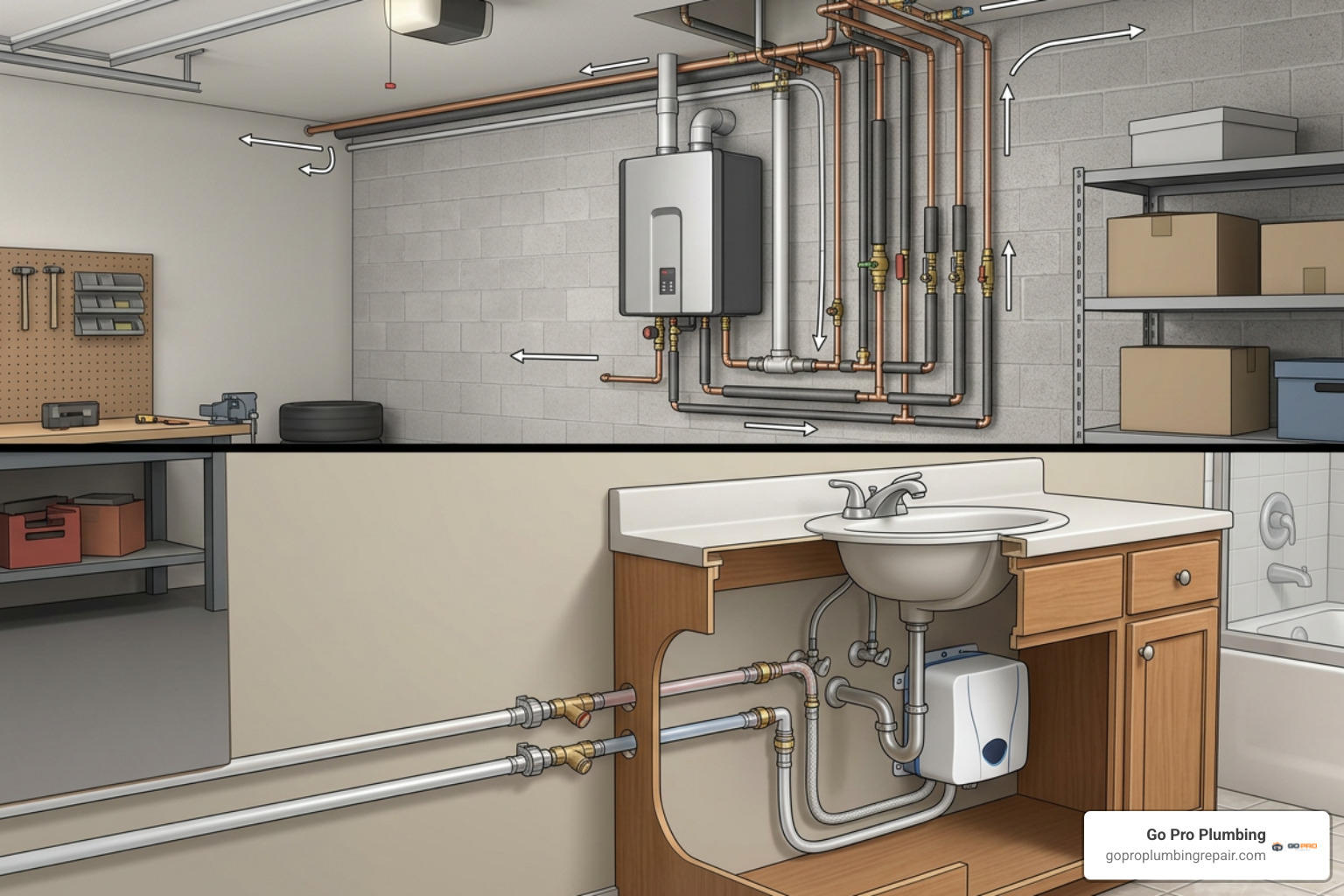
A tankless water heater must be properly sized for your household’s peak hot water demand and local incoming groundwater temperatures.
Whole-House vs. Point-of-Use (POU) Systems
Whole-House Systems: These are central units installed in a garage, utility closet, or outdoor wall (common in milder Northern California climates). They are sized to supply hot water to all fixtures throughout the residence.
Point-of-Use (POU) Systems: These compact, smaller units sit directly under a sink, near a washing machine, or inside an RV or camper. POU units eliminate the time spent waiting for hot water to travel through long plumbing runs from a central garage water heater. Learn more about specialized large home setups in our best tankless water heater large home guide.
Sizing Formula: GPM and Temperature Rise
To size a system correctly, you must calculate two key figures: Flow Rate (GPM) and Temperature Rise (°F).
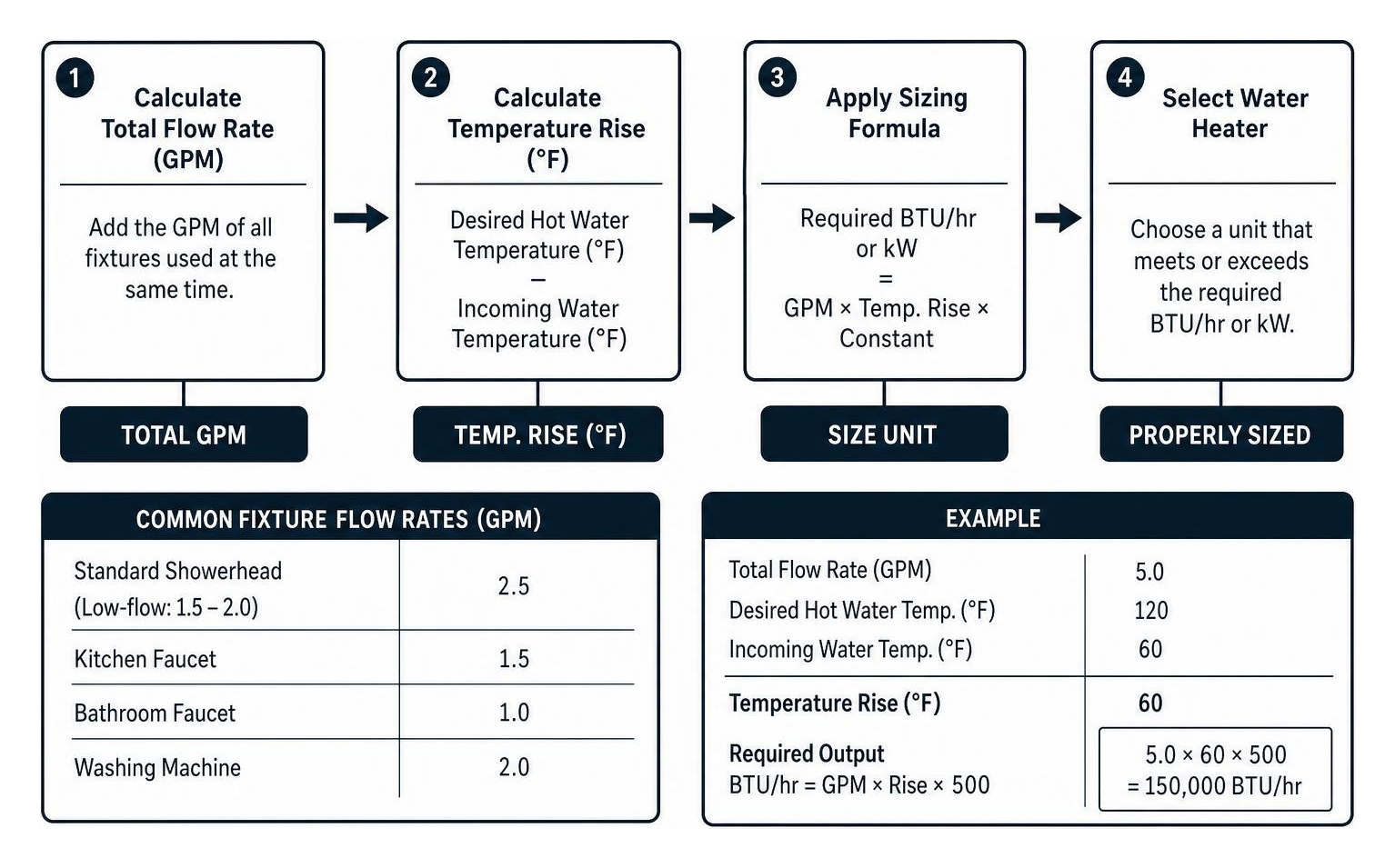
Determine Total Flow Rate (GPM): Add up the GPM of all fixtures you plan to operate at the exact same time.
- Standard Showerhead: 2.5 GPM (Low-flow: 1.5 – 2.0 GPM)
- Kitchen Faucet: 1.5 GPM
- Bathroom Faucet: 1.0 GPM
- Washing Machine: 2.0 GPM Example: Running two standard showers simultaneously requires a minimum capacity of 5.0 GPM (2.5 + 2.5).
Calculate Required Temperature Rise: Subtract incoming groundwater temperature from your desired hot water temperature (usually set to 120°F).
- In Northern California, winter groundwater temperatures average around 50°F to 55°F.
- Target Output (120°F) – Incoming Water (50°F) = 70°F Required Temperature Rise.
You can review real-world sizing scenarios in the Water System Wiki No-Nonsense Guide. Never under-size a unit to trim upfront expenses; doing so will result in reduced water pressure or lukewarm showers when multiple taps are running.
How Do Tankless Water Heaters Work with Recirculation Systems?
One common complaint with on-demand water heating is “water waste” while waiting for hot water to traverse long pipe runs. Recirculation loops solve this issue by continuously or periodically cycling hot water back to the heater.
Tankless units work with recirculation systems using built-in or externally wired recirculation pumps. Instead of running continuously (which wears out heat exchangers and wastes gas), modern systems utilize push-button activation, motion sensors, or smart schedules. The pump pulls cool water standing in the hot water line back into the unit, heats it, and pre-charges the plumbing lines. You can learn more about configuring these loops in our guide on hot water recirculation for tankless system.
Hybrid Water Heaters Explained
A hybrid water heater combines different heating principles to maximize energy performance:
- Tankless + Buffer Tank Hybrids: Combine a high-output tankless heat exchanger with a small 2 to 5-gallon storage tank to eliminate the cold water sandwich and support micro-flows (like low-flow faucets below 0.5 GPM).
- Heat Pump Hybrid Water Heaters: These rely on standard 50 to 80-gallon storage tanks equipped with an attached heat pump compressor. They pull heat from surrounding indoor air to heat stored water, achieving average thermal efficiencies around 86%—far outperforming traditional electric resistance tanks.
Key Pros, Cons, and Maintenance Requirements
Making an informed decision means balancing operating benefits against installation realities and ongoing upkeep. You can review a broader comparison in the WaterClue Tank vs Tankless Decision Guide.
Advantages vs. Traditional Tank Heaters
- Extended Lifespan: Tankless units average a lifespan exceeding 20 years, compared to just 10 to 15 years for traditional tank units.
- Superior Energy Efficiency: The Department of Energy reports tankless units are 24%–34% more efficient for homes using 41 gallons or less of hot water daily, and 8%–14% more efficient for larger households using 86 gallons daily.
- Space Conservation: Mounted on an interior or exterior wall, tankless units free up valuable basement, garage, or closet floor space.
- Lower Operating Costs: Shaving up to 20% off annual water heating bills while saving up to 1,000 gallons of water per year with water-saving settings enabled. Explore further efficiency details in our article on whether are tankless water heaters more efficient.
Limitations and Upfront Costs
- Higher Initial Cost: Unit purchase and professional installation can cost up to three times as much as a standard tank replacement.
- Infrastructure Upgrades: Gas models frequently require upgrading existing 1/2-inch gas lines to 3/4-inch lines to supply up to 199,000 BTUs. Electric units often require a 200-amp main breaker service upgrade.
- Flow Rate Limits: If demand exceeds unit GPM capacity during peak usage, output water temperature or pressure will drop.
Essential Maintenance and Descaling
Because tankless heat exchangers feature small internal water channels designed for fast heat transfer, hard water minerals (calcium and magnesium) can accumulate on internal walls over time. Scale acts as an insulator, forcing the unit to burn more fuel while increasing internal thermal stress.

- Isolate the Heater: Turn off gas/electric power and close the cold inlet and hot outlet isolation valves.
- Attach Flush Hoses: Connect washing machine hoses to the integrated service ports (purge valves).
- Submerge Pump: Place a small submersible pump into a 5-gallon bucket filled with 3 to 4 gallons of food-grade white vinegar or an approved descaling solution.
- Circulate Solution: Run the pump to circulate vinegar through the heat exchanger loop for 45 to 60 minutes.
- Clean Inlet Filter: Unscrew and rinse the cold water inlet filter screen under clear water to clear sediment.
- Flush and Re-activate: Flush the unit with clean cold water for 5 minutes, close service valves, open main isolation valves, and restore power.
Frequently Asked Questions About Tankless Water Heaters
Can a tankless water heater run out of hot water?
No, a tankless water heater will not run out of hot water in the way a traditional tank does, because it heats water continuously as long as water flows through it. However, if you exceed its GPM capacity by running too many fixtures at once (such as three showers, a dishwasher, and a washing machine), the water temperature may drop, or flow rates will be throttled.
How long do tankless water heaters typically last?
When properly maintained with regular descaling, tankless water heaters typically last more than 20 years. In contrast, standard storage tank water heaters generally last between 10 and 15 years due to bottom-tank sediment corrosion.
Is a gas line upgrade required for a gas tankless water heater?
In many retrofit installations, yes. Traditional gas tank water heaters draw around 30,000 to 40,000 BTUs and function on 1/2-inch gas supply lines. Tankless gas units require between 150,000 and 199,000 BTUs to heat cold water on demand, which usually requires upgrading to a 3/4-inch gas line. To learn more about regional plumbing code expectations, review our guide on sacramento tankless water heater installation.
Conclusion
Understanding how do tankless water heaters work boils down to a smart mechanical shift: heating water instantly on demand rather than storing and continually reheating standing water in a large tank. By utilizing flow sensors, electronic control boards, and primary or secondary heat exchangers, tankless units eliminate standby loss, conserve space, and deliver continuous hot water.
While upfront equipment and installation costs are higher than standard tank replacements—and routine maintenance like annual descaling is required—a properly sized system provides exceptional operational efficiency and a lifespan exceeding 20 years.
If you are evaluating an upgrade for your home in Sacramento, Rancho Cordova, or the surrounding Northern California region, our expert team at Go Pro Plumbing is here to help. Contact us today through our Services/Tankless Water Heaters page to schedule a professional consultation and custom sizing assessment.