
Everything You Need to Know About Lining a Sewer Pipe
By Brian on July 29, 2026
Is Epoxy Pipe Lining Right for Your Sewer Problem?
Epoxy pipe lining is a trenchless method of repairing damaged pipes from the inside — without digging up your yard or tearing out walls. A liquid epoxy resin is applied to the interior of an existing pipe, where it hardens into a smooth, durable new surface.
Here’s a quick summary of what you need to know:
- What it fixes: Corrosion, pinhole leaks, root intrusion, cracks, and restricted flow
- Compatible pipes: Cast iron, copper, PVC, clay, ductile iron, concrete, and more
- Lifespan: Estimated 35–50 years
- Downtime: Pipes are typically out of service for about 8 hours
- Best for: Pipes that are damaged but still structurally sound
- Not ideal for: Severely collapsed pipes or situations requiring full structural replacement
It’s a popular choice for homeowners and building owners who want to avoid the cost and disruption of full pipe replacement. But it’s not without its drawbacks — and understanding both sides matters before you commit.
In this guide, we’ll walk you through exactly how the process works, when it makes sense, what can go wrong, and what alternatives exist so you can make an informed decision.
Epoxy pipe lining terms to learn:
- how does trenchless sewer line replacement work
- how much does trenchless sewer line replacement cost
- sewer backup prevention
What is Epoxy Pipe Lining and How Does It Work?
If you’ve ever had a leak under your Sacramento home’s foundation, you know the dread that comes with the word “excavation.” Epoxy pipe lining is the modern antidote to that dread. At its core, it is a method of pipeline repair that uses a thermosetting polymer called polyepoxide—more commonly known as epoxy.
Think of it as building a brand-new, high-tech pipe right inside your old, crumbling one. This process is often categorized under the broader umbrella of cured-in-place-pipe (CIPP).
The Science of the Seal
The “magic” happens through a chemical reaction. Most Epoxy Pipe Lining systems use a two-part resin. You have the base resin and a hardener (or curing agent). For most applications, these are mixed just prior to installation at a strict 1:1 ratio.
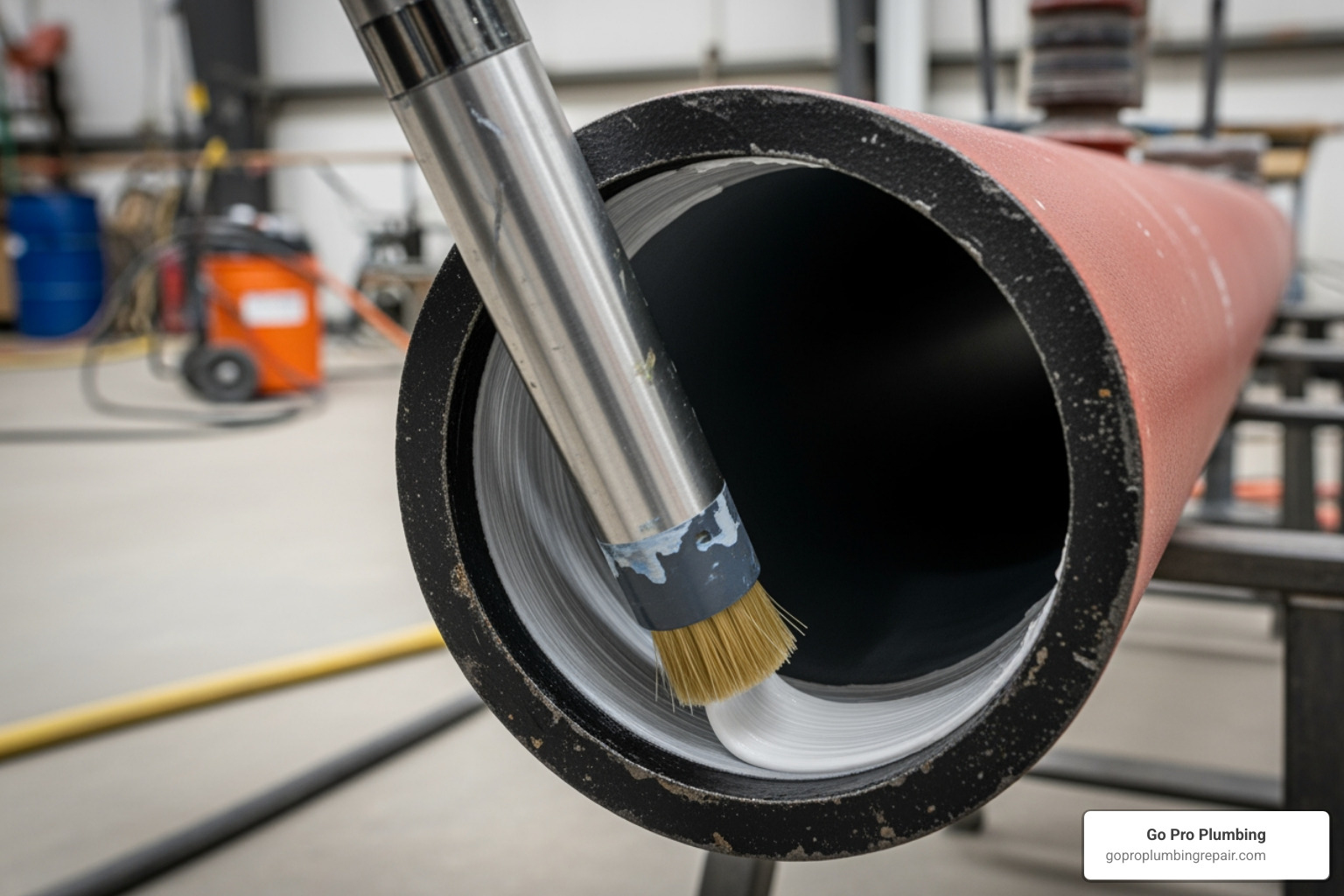
Once mixed, the epoxy begins a transition from liquid to solid. During this phase, it creates a powerful chemical bond with the host pipe. This isn’t just a “sleeve” sitting inside the pipe; it’s a structural rehabilitation that restores the pipe’s integrity. The result is a seamless, jointless “pipe-within-a-pipe” that is resistant to chemicals, heat, and mechanical stress.
Different Resins for Different Needs
Not all epoxy is created equal. Depending on whether we are fixing a sewer line in Rancho Cordova or a pressurized water line, we use different “flavors” of resin:
- Standard Epoxy: Durable, has no VOCs (volatile organic compounds), and is the gold standard for long-term repairs.
- Polymer Resins: Often more affordable and slower-curing, frequently used in large-scale municipal projects.
- Vinyl Resins: These are hybrids that offer extreme corrosion resistance but can sometimes emit noxious fumes during the curing process.
When to Use Epoxy Pipe Lining for Sewer Repairs
We often recommend epoxy pipe lining when the host pipe is still “there” but is failing. If your pipe has completely collapsed into a pile of dirt, lining won’t help—you can’t line a ghost! However, it is the perfect solution for:
- Tuberculation: This is a fancy word for those “rust barnacles” that grow inside cast iron pipes. They restrict flow and cause clogs. Once we clean them out, the epoxy prevents them from ever coming back.
- Corrosion and Pinhole Leaks: Especially common in older copper or metallic lines in Northern California. The lining seals these tiny holes and prevents further thinning of the pipe walls.
- Root Intrusion: Tree roots love sewer lines. They find tiny cracks, grow inside, and eventually destroy the pipe. A jointless epoxy liner removes the “entry points” for these thirsty roots.
- Cracked Clay Pipes: Many older homes in the Sacramento area have clay sewer tiles. These are notorious for cracking at the joints.
If you are dealing with these issues, checking out our trenchless-sewer-replacement-complete-guide can help you see if lining is the best fit for your specific property.
Is Epoxy Pipe Lining Safe for Potable Water?
This is a question we get a lot, especially from health-conscious homeowners. The short answer is: Yes, if the right materials are used.
For drinking water systems, the epoxy must be AWWA/ANSI/NSF61 approved. This certification ensures the material is safe for potable water and is “lead-free.”
However, there is a bit of a debate in the scientific community regarding older epoxy formulations. Some studies have looked into Bisphenol A (BPA) and Bisphenol F (BPF) used in some resins. For example, a 2015 study in Environmental Health Perspectives found that BPF could exhibit estrogenic activity.
Because we care about your water quality, we always prioritize high-quality, modern resins that meet the strictest safety standards. If you’re concerned about chemical leaching, it’s worth reading deeper into the health considerations of different lining materials. For sewer lines, this is less of a concern, but for the water you drink, we never cut corners.
The Benefits of Epoxy Lining vs. Full Pipe Replacement
Why choose lining over the traditional “dig and replace” method? It usually comes down to three things: your wallet, your yard, and your sanity.
| Feature | Epoxy Pipe Lining | Traditional Repiping |
|---|---|---|
| Disruption | Minimal; uses existing access | Major; requires trenches/wall removal |
| Time | 1–2 days | 1–2 weeks |
| Lifespan | 35–50 years | 20–50 years (depending on material) |
| Cost | Lower (no restoration needed) | Higher (due to landscape/wall repairs) |
| Yard Impact | None | Your rose bushes might not survive |
Saving Your Landscaping
In Northern California, we love our outdoor spaces. Traditional sewer replacement involves digging a deep trench through your lawn, driveway, or patio. By the time the plumbing is fixed, you’re left with a massive bill for landscaping or concrete repair. Epoxy pipe lining is “trenchless,” meaning we use existing cleanouts or small access points. We save the pipe, and we save your yard.
Cost-Effectiveness
While the per-foot cost of the epoxy material itself can be higher than a stick of PVC, the total project cost is often much lower. When you factor in the cost of tearing out a bathroom floor or repaving a driveway, lining wins almost every time. You can learn more about the specific price points in our trenchless-pipe-repair-cost guide.
Long-Term Protection
Did you know that new pipes can sometimes fail within 8–10 years if roots find their way into the new joints? Because epoxy lining is a single, continuous piece, it has no joints. Engineers estimate that epoxy-coated pipes can last over 50 years. It’s not just a repair; it’s an upgrade. For a deeper dive into the financial side, check our trenchless-sewer-replacement-cost-guide.
The Installation Process for Sewer Pipe Lining
We don’t just pour some glue down the drain and hope for the best. The process is highly technical and requires precision.
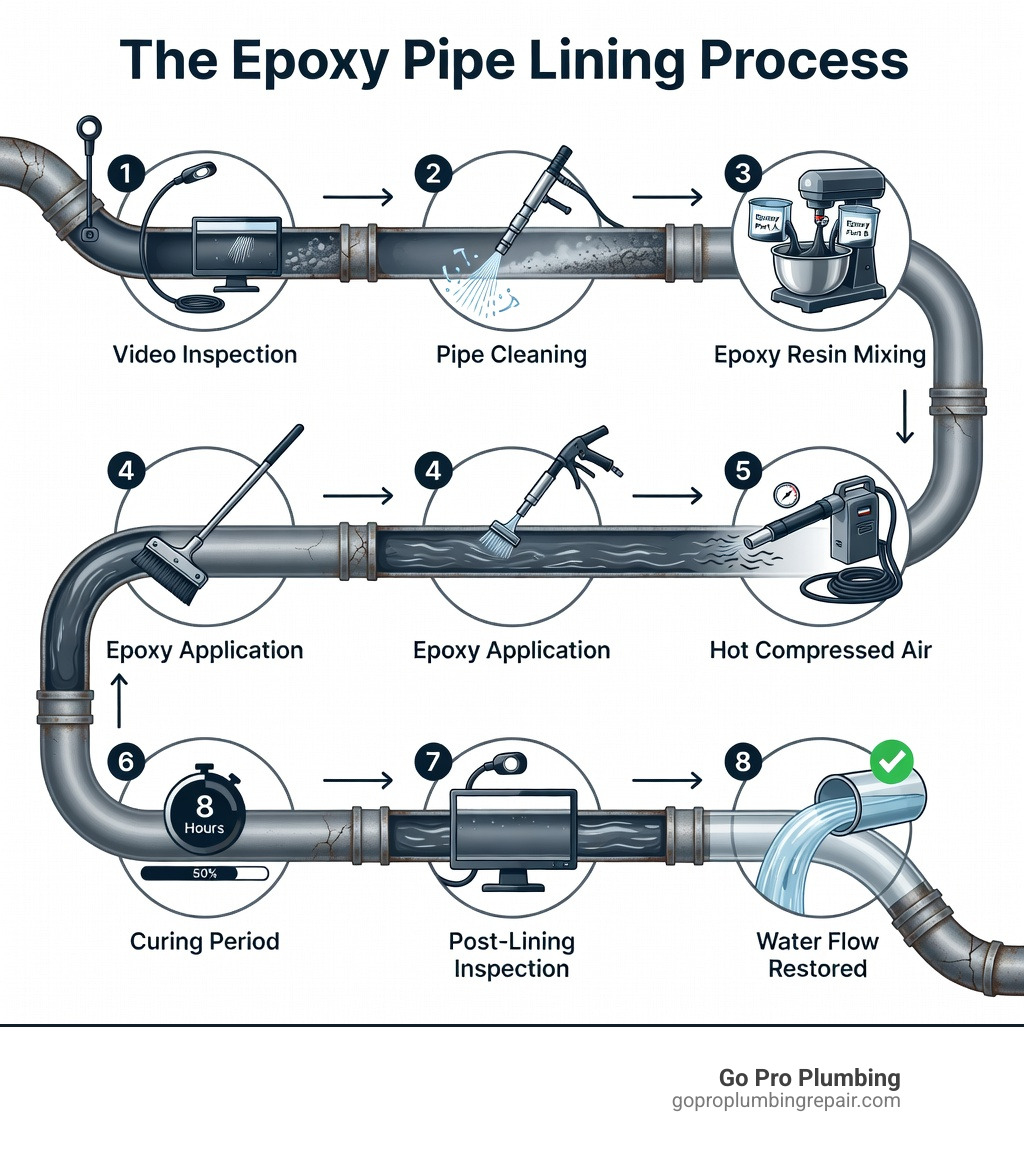
- Video Inspection: We start by sending a high-definition camera down the line. We need to see the extent of the damage and ensure the pipe is a good candidate for lining.
- Cleaning and Prep: This is the most important step. We use hydro-jetting or mechanical sandblasting to clean the pipe to NASSCO standards. If the pipe isn’t clean, the epoxy won’t stick. For PVC pipes, we even do a bit of internal “sanding” to ensure the resin bonds properly.
- Measurement: We determine the exact length of the liner needed.
- Implementation:
- For Drains/Sewers: We saturate a felt liner with the mixed epoxy resin. This liner is “inverted” or pulled into the pipe.
- The Air Bladder: We insert an air bladder inside the liner and inflate it. This presses the epoxy-soaked felt tight against the walls of the old pipe.
- Curing: The epoxy needs time to harden. This usually takes about 8 hours. We can sometimes speed this up using warm air or steam.
- Final Inspection: Once cured, we remove the bladder and send the camera back in for a “victory lap” to verify a smooth, even coating.
Flow is usually restored within 4 hours of the coating being applied, meaning your household is back to normal by dinner time. You can see a more detailed walkthrough in our trenchless-sewer-line-complete-guide.
Common Risks and Why Epoxy Linings Fail
We believe in being honest with our customers. While epoxy pipe lining is incredible, it isn’t a magic wand. If done poorly, it can fail.
Why Failures Happen
Most “horror stories” about epoxy—like those seen in some GTA condo lawsuits—stem from poor installation, not the material itself.
- Poor Adhesion: If the plumber didn’t clean the pipe properly, the epoxy can peel away (delaminate). Imagine trying to tape a dusty box; it just won’t stay.
- Uneven Thickness: If the resin isn’t mixed correctly or applied evenly, you might get “slugs” of epoxy that restrict water flow or leave thin spots that eventually crack.
- Mechanical Stress: If a pipe is under heavy shifting soil, even epoxy can’t always stop a structural break.
The “Point of No Return”
One of the biggest risks is that epoxy-lined pipes are very difficult to repair using traditional methods later. You cannot use a torch to solder a pipe that has an epoxy liner inside—the heat will ruin the resin. If a repair is needed later, we have to use specialized mechanical couplings or “push-to-connect” fittings.
Furthermore, there is no way to verify if the epoxy adhered perfectly without literally cutting the pipe open. This is why choosing a certified, experienced installer is non-negotiable. You can read more about real-world examples of lining failures to understand what to watch out for.
Alternatives to Epoxy: When to Choose Repiping
Sometimes, the best move is to walk away from the old pipe entirely.
Pipe Bursting
If your sewer line is severely damaged but you still want a trenchless solution, “pipe bursting” might be the answer. We pull a large “bursting head” through the old pipe, shattering it while simultaneously pulling a brand-new HDPE (High-Density Polyethylene) pipe into its place. This is a full structural replacement without the trench.
Repiping with PEX
For interior water lines, many homeowners are moving away from epoxy and copper in favor of PEX (cross-linked polyethylene). PEX is flexible, resistant to scale and chlorine, and doesn’t have the “BPA” concerns some people associate with epoxy. It’s often the most reliable long-term fix for a house full of pinhole leaks.
If you’re unsure which path to take, our services/trenchless-sewer-replacement page breaks down the pros and cons of each method.
Frequently Asked Questions about Pipe Lining
How long does epoxy pipe lining last?
When installed correctly, you can expect a lifespan of 35 to 50 years. Many manufacturers offer a 50-year warranty on the materials. It is designed to be a permanent fix, not a temporary patch.
Can epoxy-lined pipes be repaired later?
Yes, but it’s tricky. As mentioned, you can’t use heat. Any future modifications require mechanical fittings. If you plan on doing a major remodel in a few years that involves moving plumbing, you might want to consider a full repipe instead.
What is the maximum length for a single lining application?
Typically, we can line up to 150 linear feet from a single access point. If we have access from both ends of the pipe, we can cover up to 300 feet. This is usually more than enough for the average Sacramento residential sewer lateral.
How long will my water be turned off?
Generally, the pipe is out of service for about 8 hours. We usually start in the morning and have everything back up and running by the time you’re ready to start the dishwasher in the evening.
Conclusion
Epoxy pipe lining is a game-changer for Northern California homeowners. It offers a way to fix “unfixable” underground leaks without destroying your property or your budget. From preventing tuberculation in cast iron to sealing out invasive tree roots, it is a high-tech solution for an age-old problem.
However, the success of the project lives and dies with the preparation and the quality of the resin used. At Go Pro Plumbing, we pride ourselves on being the trenchless experts for Sacramento and Rancho Cordova. We combine the latest technology with a commitment to same-day service and outstanding customer care.
Don’t let a sewer problem become a yard-destroying nightmare. If you think your home might be a candidate for lining, or if you just want a second opinion on a plumbing issue, we are here to help.