
Instant Heat on a Schedule: A Homeowner’s Guide to Circulation Pumps with Timers
By Brian on September 24, 2026
How a Circulation Pump with Timer Operates and Saves Energy
A circulation pump maintains warmth in your domestic supply lines by continuously pushing cooled water sitting in the pipes back to the water heater. However, running a pump 24/7 creates severe thermal dissipation. Uninsulated or semi-insulated copper lines act like small radiators inside walls, floor joists, and crawlspaces, constantly leaking thermal energy into unoccupied structural cavities.
When homeowners ask us, “does a hot water recirculating pump run all the time?”, we explain that continuous operation is one of the quickest ways to inflate utility bills and cause premature pump motor wear. Introducing a dedicated timer turns an unregulated continuous loop into an intermittent, on-demand service window.
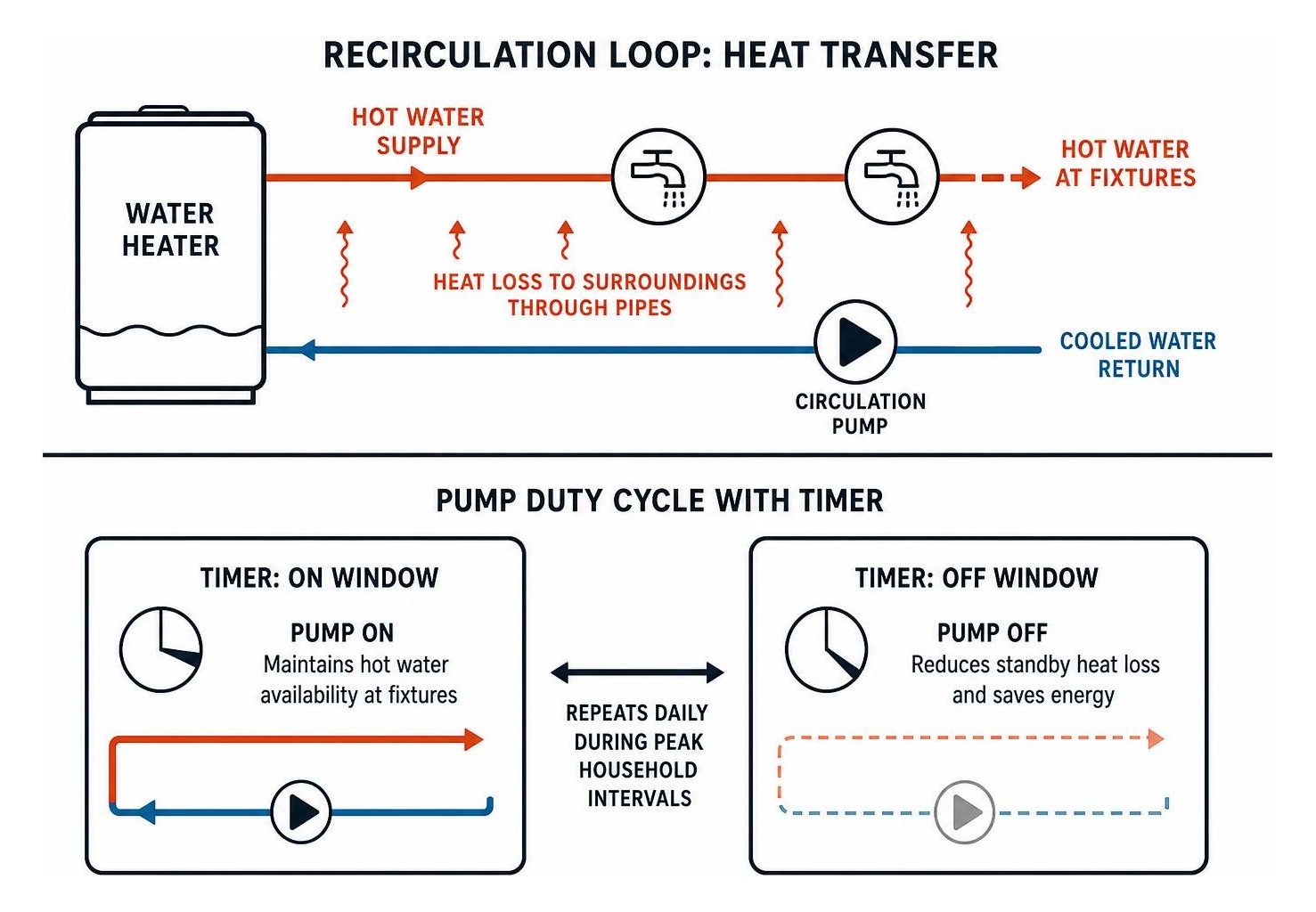
By scheduling the pump to operate exclusively during peak household intervals, you drastically curb standby heat loss. The water heater runs fewer reheating cycles because hot water isn’t sitting indefinitely in distant lines losing heat. Evaluating whether hot water recirculation systems are efficient comes down to how well runtime is managed; pairing the system with a timer ensures electrical consumption and gas or electric reheating costs remain low.
Applications Across Hydronic Heating, Potable Water, and Pools
Circulation timers serve critical roles across different residential fluid systems:
- Domestic Hot Water Systems: Recirculation ensures you don’t waste water down the drain while waiting for fixtures to warm up. If you’ve ever wondered why you are waiting for hot water and how recirculators fix it, it comes down to moving the stagnant, ambient-temperature water out of the supply run before you turn on the tap.
- Hydronic Radiant and Baseboard Heating: Timers manage zone circulators, pre-warming floor loops right before waking hours or evening family time, integrating smoothly with residential boilers.
- Swimming Pool Filtration: Pool systems use timers to push water through filtration and sanitation equipment during off-peak power hours, keeping water clear without consuming high wattage during peak daytime rates.
For maximum thermal control in potable and hydronic lines, timers can be paired with an aquastat—a temperature-sensing switch. Using a digital timer like the FFPFDT – 7 Day Timer in combination with an aquastat gives you dual-parameter automation: the timer opens the electrical circuit during your preferred hours, but the pump only spins if the pipe temperature drops below a set threshold (such as 105°F) and shuts off once it hits target temperature (such as 120°F).
Calculating Daily Run Time and Operational Efficiency
Setting up an efficient schedule requires balancing comfort with energy conservation.
For domestic hot water loops, the water volume within the pipe loop is relatively small. A standard 100-foot run of 3/4-inch copper pipe holds under 3 gallons of water. A standard circulator operating at 3 to 5 Gallons Per Minute (GPM) clears that entire line in under one minute. Thus, running the pump in 15-minute scheduled blocks during morning routines (e.g., 6:00 AM – 8:00 AM) and evening dinner/bath windows (e.g., 5:30 PM – 9:30 PM) is plenty to ensure instant hot water without running the motor for hours on end.
For pool systems, turnover volume calculations differ. A 20,000-gallon pool using a pump with a flow rate of 40 GPM requires around 500 minutes (roughly 8.3 hours) for a complete turnover. Most pools only require the pump to run for 8–10 hours each day to properly circulate and filter the water. Using a timer to split these 8 to 10 hours into early morning and late evening intervals avoids peak electricity rates, keeping pool sanitation high and operating costs low.
Comparing Timer Technologies, Enclosures, and Electrical Specs
| Feature | Mechanical Timers | Digital Programmable Timers | Smart / Wi-Fi Timers |
|---|---|---|---|
| User Interface | Physical tripper pins / rotating dial | LCD screen with push-button controls | Mobile app interface & voice control |
| Schedule Flexibility | Single repeating 24-hour cycle | 7-day custom schedules (up to 20 events) | Infinite schedules, astronomical & countdown |
| Power Outage Retention | Loses clock time (requires manual reset) | 48 hours to 6 months (battery backup) | Cloud-synced clock (auto-updates via Wi-Fi) |
| Typical Amperage Rating | 15A – 40A | 15A – 40A | 15A – 40A |
| Horsepower Capacity | Up to 2 HP – 3 HP | Up to 2 HP | Up to 3 HP |
| Best Suited For | Basic indoor potable hot water pumps | Multi-schedule domestic & light hydronics | Complex schedules, outdoor pools, automation |
When selecting a timer, matching electrical ratings is critical. Always check:
- Voltage: Ensure single-phase compatibility matches your supply—standard residential recirculation pumps run on 120V, while heavy-duty pool pumps and commercial circulators often require 240V (or multi-tap 120–277 VAC units).
- Amperage: Small under-sink or tankless recirculators draw under 2A to 5A, making a standard 15A timer suitable. High-power pool motors demand heavy-duty 40A switches.
- Horsepower Rating: Ensure the timer’s internal relay can handle the initial inrush current of the motor (e.g., matching a 1/2 HP, 2 HP, or 3 HP rating).
- Dry-Contact Relays: Many digital and smart timers utilize dry-contact output relays (COM/NO). These contacts act strictly as an automated switch—they open and close the circuit without outputting independent voltage, allowing you to switch separate circuits safely.
Choosing the Right Circulation Pump with Timer: Mechanical vs. Digital vs. Smart
Mechanical timers use rotating dials with push-in or pull-out tripper pins. Each pin represents a 15- or 30-minute block. While mechanical dials are simple and intuitive, they repeat the exact same schedule every 24 hours without weekend differentiation. Furthermore, if power drops, a mechanical timer stops turning, causing its clock to drift until manually reset.
Digital programmable timers provide 7-day scheduling flexibility. Devices such as the FFPFDT – 7 Day Timer allow you to configure separate weekday and weekend cycles, programming multiple on/off periods per day to match changing household habits.
Smart Wi-Fi controllers bring complete remote automation to your pump setup. Connecting over standard 2.4 GHz home Wi-Fi networks, units like the DEWENWILS | WiFi Pool Pump Timer let you adjust runtimes from your smartphone or trigger cycles via voice assistants like Amazon Alexa or Google Assistant. These smart controllers also support specialized modes:
- Astronomical Mode: Adjusts runtime automatically based on local sunrise and sunset data.
- Countdown Mode: Runs the pump for a set duration (e.g., 45 minutes) and then shuts down automatically.
- Random Mode: Varies start and stop times by +/- 30 minutes in 2-minute increments, helpful for security or dynamic cycling.
Housing Durability, Weatherproofing, and Battery Backups
Where you mount the timer dictates the required enclosure rating:
- Polycarbonate Plastic Casing: Lightweight, rustproof, and UV-resistant. High-grade plastic enclosures are well-suited for both indoor utility closets and standard outdoor installations protected from direct physical abuse.
- Metal Enclosures (NEMA 3R/4X): Powder-coated steel or aluminum provides impact resistance, weather tightness, and defense against harsh outdoor elements or commercial wear.
Pay close attention to ingress protection ratings. An IP44 rating protects against splashing water from any angle, which is suitable for covered outdoor settings, while an IPX5 rating ensures protection against directed water jets. For instance, the Swim & Fun Circulation Pump 550W With Timer utilizes an IPX5 design to handle wet equipment pads reliably.
Backup power retention is another critical factor. The DEWENWILS | Digital Pool Pump Timer features an internal battery capable of retaining program settings for 3 to 6 months during outages, while smaller digital units like the FFPFDT maintain clock settings for up to 48 hours without incoming AC power.
How to Install, Program, and Maintain Your Timer Setup
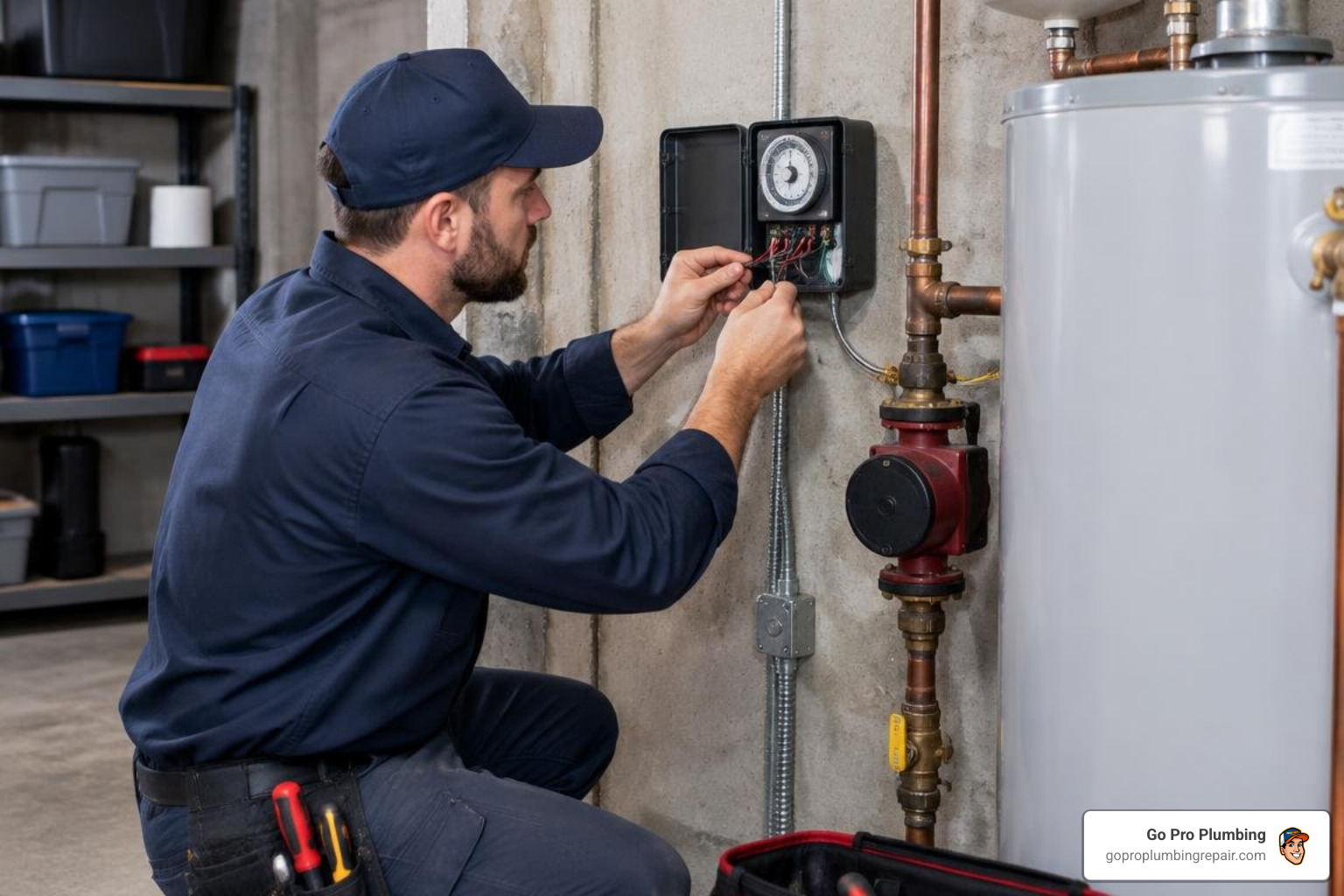
Working with electrical panels and motor wiring requires strict adherence to the National Electrical Code (NEC) and local municipal safety standards. Always work on completely de-energized circuits. If you are ever uncertain about line voltages or proper grounding, review our comprehensive hot water recirculation installation guide or consult a licensed professional.
Step-by-Step Installation of a Circulation Pump with Timer
- De-energize the Power Supply: Switch off the dedicated circuit breaker in your main electrical panel. Verify zero voltage at the installation site using a calibrated non-contact voltage tester or multimeter.
- Mount the Control Box: Secure the timer enclosure to the wall or mounting post within reach of the pump’s electrical feed. Use appropriate anchors and ensure conduit knockouts face downward to prevent moisture entry.
- Run Line and Load Wiring: Strip input wires and connect the incoming Line (Hot), Neutral, and Ground leads to the timer’s input terminals.
- Connect the Pump Load Terminals: Route the pump’s power cable through a watertight conduit fitting into the load side of the timer box. Wire the switched hot lead to the normally open (NO) load terminal, secure the common neutral, and fasten all ground wires to the grounding bus.
- Seal and Inspect: Tighten all terminal screws to manufacturer torque specifications. Ensure internal gaskets and moisture seals are seated properly before closing the enclosure faceplate.
- Energize and Test: Restore power at the main breaker. Verify that the digital display powers on, test the manual override switch to confirm the pump activates, and verify motor rotation.
Programming Schedules, Modes, and Common Troubleshooting
Setting up your timer involves a few baseline steps:
- Time & Format: Sync the system clock to your local time zone. Most digital timers default to a 12-hour format with AM/PM indicators, though some can switch to 24-hour military time.
- Define Program Events: Set your primary morning and evening on/off schedules. A unit like the 24 Hour Programmable Timer for UP Cir – GRUNDFOS PUMPS | HED allows you to dial in specific daily cycles, while advanced digital units can store up to 20 distinct daily or weekly ON/OFF schedules.
- Daylight Saving Time (DST): Enable automatic DST adjustments, or use the key combo (often holding
HOUR+MINsimultaneously) to adjust for seasonal changes.
If your system behaves unexpectedly, consult these troubleshooting steps:
- Pump Fails to Activate on Schedule: Check if the mode is set to “AUTO”. If the timer is left in “OFF” or “MANUAL ON”, it will ignore programmed schedules. Also, ensure the manual override lever isn’t physically jammed.
- Time Drift or Blank Display: If a digital timer drifts by several minutes or loses its display during power blips, the internal backup battery may be fully drained. Leave the unit connected to AC power for several hours to recharge its internal cell.
- Smart Timer Offline: Wi-Fi smart timers require a dedicated 2.4 GHz network band. If the timer loses cloud connectivity, check your Wi-Fi signal strength at the outdoor pad; while offline, smart timers maintain their basic internal schedule but cannot receive real-time app commands. For broader system diagnostics, review our guide to diagnosing hot water recirculation system problems.
Frequently Asked Questions About Circulation Pump Timers
What happens to the timer settings during a sudden power outage?
Digital and smart timers feature built-in battery backups or non-volatile EEPROM memory chips. Digital units such as the DEWENWILS digital timer maintain schedules and keep internal clock time running for 3 to 6 months without external AC power, while standard indoor models retain memory for roughly 48 hours. When main power returns, the timer resumes its active cycle immediately without requiring reprogramming.
What is the difference between a 24-hour timer and a 7-day programmable timer?
A 24-hour timer repeats the exact same programmed on/off sequence every single day of the week. A 7-day programmable timer allows you to assign unique operational schedules to individual days. This enables you to run the pump early on weekday mornings for work routines, while delaying pump activation on weekend mornings to fit your household’s schedule.
Can a timer be used alongside an aquastat on the same circulation pump?
Yes, combining a timer with an aquastat is an industry best practice for hydronic and potable circulation loops. When wired in series, the timer acts as the master schedule gatekeeper, while the aquastat acts as a thermal regulator. The pump will only draw power if the timer schedule is active and the pipe temperature has cooled below the aquastat’s setpoint, maximizing energy efficiency.
Optimize Your Hot Water with Go Pro Plumbing
Adding a timer to your circulation pump delivers the perfect balance of immediate comfort, reduced plumbing wear, and lower monthly utility bills. Eliminating continuous pump operation prevents unnecessary heat loss, extends the lifespan of your water heater, and protects your copper plumbing lines from premature erosion.
At Go Pro Plumbing, we provide expert plumbing solutions across Northern California, including Sacramento and Rancho Cordova. Whether you need a brand-new timer installed, a circulator diagnosed, or a high-efficiency system upgrade, our licensed team is committed to outstanding customer service and fast, same-day service. Schedule your professional water recirculation pump installation with our trusted local specialists today.