
Pressure’s On: Simple Solutions for Low Water Flow
By Brian on July 22, 2026
When the Water Barely Flows: What You Need to Know
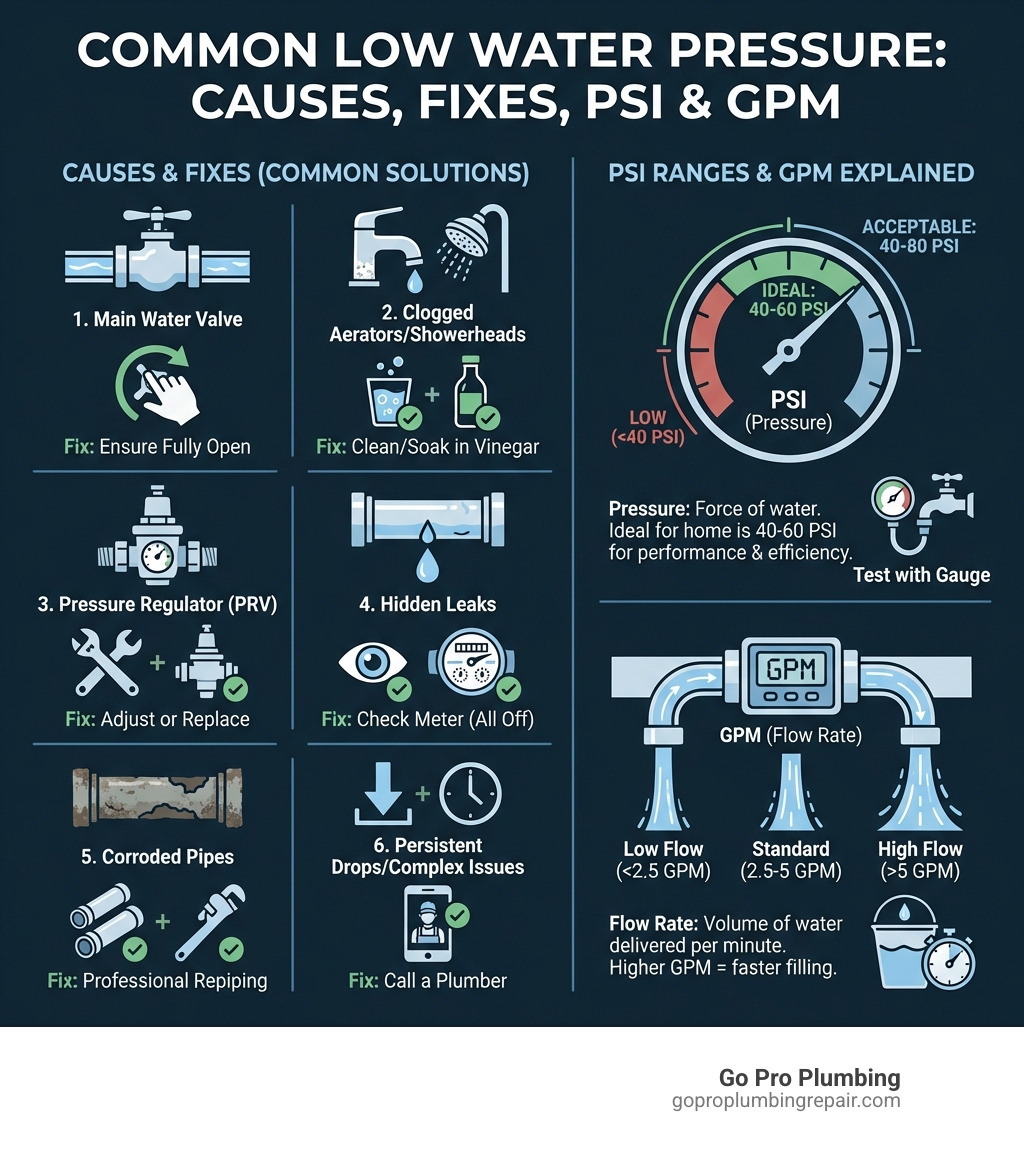
Low water pressure fix options range from simple DIY adjustments to professional repairs. Here’s a quick overview of the most common solutions:
- Check your main water valve – Make sure it’s fully open
- Clean clogged aerators and showerheads – Soak in vinegar to dissolve mineral buildup
- Test your PSI – Attach a pressure gauge to an outdoor faucet (ideal range: 40-60 PSI)
- Inspect your pressure regulator (PRV) – Adjust or replace if faulty
- Check for leaks – Monitor your water meter with all fixtures off
- Call a plumber – For corroded pipes, persistent drops, or complex issues
There’s nothing quite like stepping into the shower after a long day, only to be met with a sad, weak trickle. Sound familiar?
Low water pressure is one of the most frustrating home plumbing problems. It slows down everything — from rinsing dishes to filling a pot to simply washing your hair.
The good news? Many causes of low water pressure are fixable without a major overhaul. Some you can handle yourself in minutes. Others need a professional’s eye. This guide walks you through both.
Most homes should deliver water at 40 to 80 PSI (pounds per square inch). Anything consistently below 40 PSI means something is restricting your flow — and it’s worth finding out what.
Low water pressure fix vocabulary:
According to the Government of Canada, the average person uses about 220 litres of water per day. When your pressure drops, that daily routine becomes a struggle. Whether you’re in Sacramento or Rancho Cordova, understanding how your water system works is the first step to getting that “raging river” feeling back in your shower.
Diagnosing Your Home’s Water Flow
Before we start pulling apart pipes, we need to play detective. Is the problem everywhere, or is it just your kitchen sink giving you attitude?
If the low pressure is affecting every single faucet, the issue is likely “systemic”—meaning it’s coming from your main supply line, a valve, or the city itself. If it’s just one showerhead, you’re likely looking at a localized clog.
One of the smartest things you can do is talk to your neighbors. If everyone on your street in Northern California is complaining about weak flow, the problem is likely with the municipal water main or a local water tower. If it’s just you, the call is coming from inside the house!
Testing Your Home’s PSI
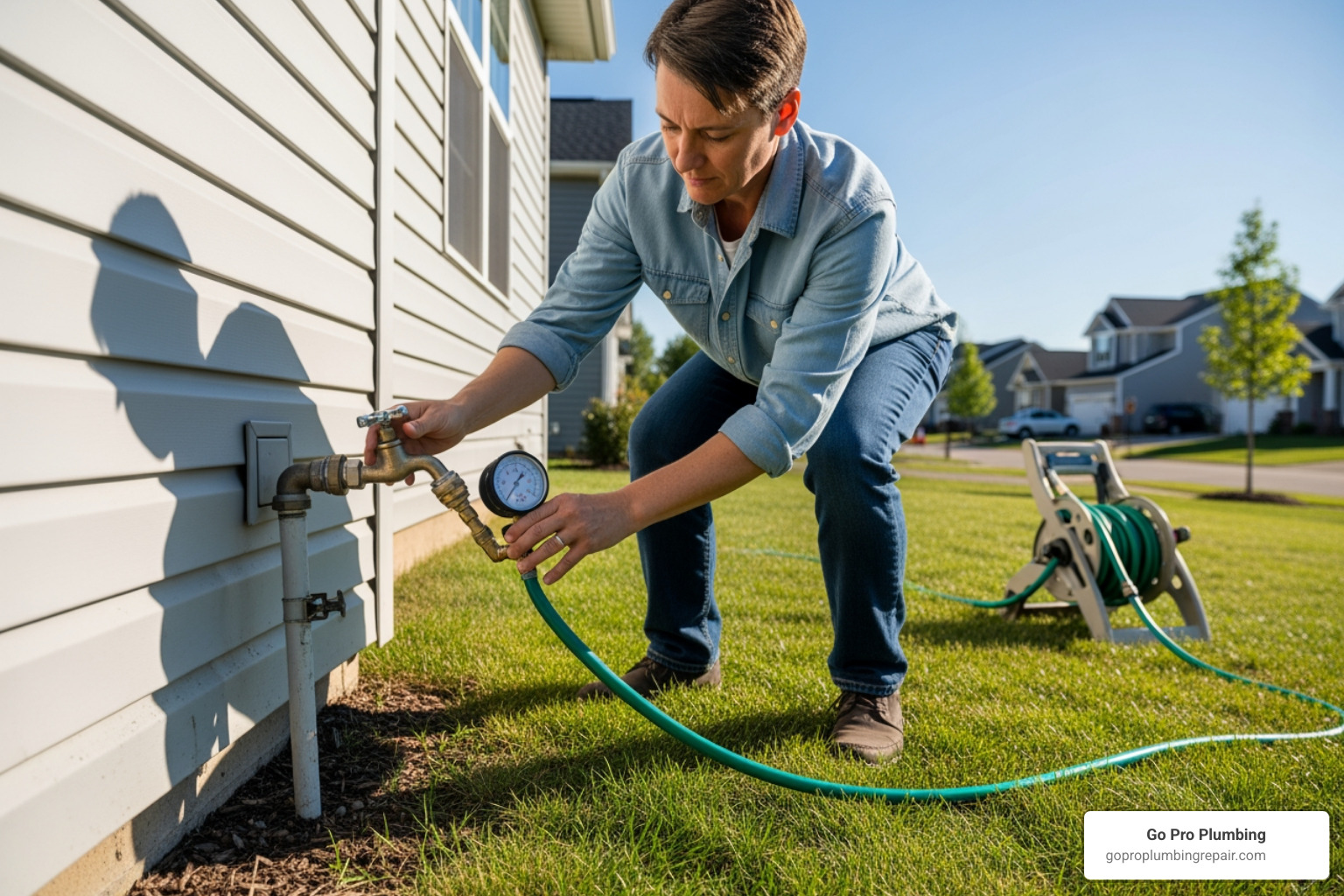
To get a definitive answer, you need to measure your “static pressure.” This is the pressure in your pipes when no water is running. You can do this yourself by purchasing a water pressure test gauge.
Here is how we recommend doing it:
- Ensure all faucets and water-using appliances (like the dishwasher or laundry) are turned off.
- Hook the gauge onto an outdoor hose spigot.
- Turn the tap on all the way.
- Read the dial.
A healthy reading is usually between 40 and 60 PSI. If you see a reading below 30 PSI, you definitely have a problem that requires a low water pressure fix. Conversely, if it’s over 80 PSI, you actually have too much pressure, which can damage your appliances and pipes over time.
Identifying the right low water pressure fix for your fixtures
If your gauge shows a healthy 50 PSI but your bathroom faucet is still just a sad dribble, the problem is localized. This is actually good news! It usually means you don’t have to worry about the main lines. Instead, you can focus on low-water-pressure-solutions specifically for that fixture, such as cleaning the aerator or replacing a worn-out cartridge.
Simple DIY Adjustments for Immediate Relief
Sometimes the solution is so simple it’s almost embarrassing. We’ve seen many cases where a homeowner spent days worrying about their plumbing, only to find out a valve was halfway closed.
Checking the Main Water and Meter Valves
Your home actually has two main shut-off valves. One is the “main” valve located inside your home (usually in the garage or near the water heater), and the other is the “meter” valve located out by the street in a concrete box.
- Gate Valves: These look like round wheel handles. To be fully open, they must be turned counter-clockwise as far as they will go.
- Ball Valves: These have a straight lever handle. When the handle is parallel to the pipe, it’s fully open.
If you’ve recently had a contractor over for repairs, they might have turned the water off and forgotten to open the valve all the way when they finished. Even a valve that is 90% open can significantly throttle your flow.
Cleaning Aerators and Showerheads
In areas like Sacramento, mineral sediment is a common culprit. Over time, calcium and magnesium build up in the tiny screens (aerators) at the end of your faucets.
To fix this:
- Unscrew the aerator from the tip of the faucet.
- Soak it in a bowl of white vinegar overnight.
- Use an old toothbrush to scrub away any remaining gunk.
- Rinse and reinstall.
If your shower is the problem, we often suggest a high-pressure showerhead recommendation like the Speakman Anystream. These are specifically designed to optimize flow even when the incoming pressure is less than ideal.
Addressing the low water pressure fix for Systemic Issues
If your valves are open and your aerators are clean but the pressure is still low across the whole house, we need to look at the “brain” of your plumbing system: the Pressure Reducing Valve (PRV).
Adjusting the Pressure Regulator
Most modern homes have a pressure reducer valve (PRV). This bell-shaped device is usually located right after the main shut-off valve. Its job is to take the high-pressure water from the city (which can be over 100 PSI) and slow it down to a safe level for your home.
If the PRV is failing, it can “stick” in a position that chokes off the water flow. You can try to adjust it by loosening the locknut and turning the adjustment bolt clockwise. Do this in small increments and re-test your pressure with your gauge. If the pressure doesn’t change when you turn the bolt, the internal diaphragm is likely broken, and the whole unit needs to be replaced.
Detecting Hidden Leaks and Pipe Corrosion
A sudden drop in pressure is a major red flag for a leak. If water is escaping through a hole in a pipe under your house, there’s less “push” to get the water to your faucet.
The Meter Test: Turn off every faucet in the house. Go out to your water meter box and look at the “leak indicator” (usually a small red or silver triangle). If that triangle is spinning while all your water is off, you have a leak.
Furthermore, the material of your pipes matters. Here is a quick look at how long different pipes last before they start causing trouble:
| Pipe Material | Average Lifespan | Common Issues |
|---|---|---|
| Galvanized Steel | 20–50 Years | Internal corrosion, rust flakes, major clogs |
| Copper | 50+ Years | Pinhole leaks, high material cost |
| Brass | 40–70 Years | Generally very durable, but expensive |
| PEX / Plastic | 40+ Years | Scaling resistant, but can be damaged by rodents |
If you have an older home in Northern California with galvanized pipes, they may be corroded from the inside out. This narrows the “pipe diameter,” meaning less water can physically fit through the pipe, leading to a permanent drop in flow.
Advanced Solutions for Persistent Problems
Sometimes, the low pressure isn’t “broken”—it’s just a result of where you live. If your home is at the end of a long municipal line or sits at a higher elevation than the water tower, gravity is working against you.
Implementing a low water pressure fix with a booster pump
If the city simply isn’t providing enough “oomph,” you might need a water pressure booster pump. This is a powerful electric pump that connects to your main water line. It “grabs” the incoming water and pushes it through your home at a higher PSI. These systems usually include a pressure tank to ensure the pump doesn’t have to kick on every time you wash your hands. While the installation can range from $300 to several thousand dollars depending on the complexity, it is the ultimate low water pressure fix for elevation-related issues.
Troubleshooting Well Water Systems
If you aren’t on city water, your pressure depends entirely on your well pump and pressure tank.
- The Pressure Switch: This tells the pump when to turn on. If it’s set too low (e.g., 20/40), your pressure will feel weak. Adjusting this to a 40/60 setting can make a huge difference.
- The Bladder Tank: If your pump is “short-cycling” (turning on and off every few seconds), the air bladder in your tank might have failed.
- Pump Wear: Submersible pumps eventually wear out. If you notice sand in your water along with low pressure, your pump might be nearing the end of its life.
When to Call a Professional Plumber
We love a good DIY project, but plumbing can get complicated—and messy—very quickly. There are certain times when “doing it yourself” might lead to a flooded basement or a broken main line.
Signs You Need Expert Intervention
You should reach out for a professional plumbing consultation if:
- The pressure drop was sudden: This often indicates a burst pipe or a major main line break.
- You smell sewage or see wet spots: These are signs of a leak that could be damaging your home’s foundation.
- You have galvanized pipes: Replacing these requires specialized tools and permits.
- The PRV adjustment didn’t work: Replacing a regulator involves cutting into the main line, which is best left to the pros.
At Go Pro Plumbing, we provide same-day service for these exact types of headaches. We know that in a busy household, you can’t afford to wait a week just to be able to do a load of laundry.
Frequently Asked Questions about Low Water Pressure
Why is my hot water pressure lower than my cold water?
This is almost always a water heater issue. Over time, sediment (minerals) settles at the bottom of the tank. This sediment can get sucked into the hot water outlet pipe, partially blocking it. Also, check the shut-off valves on top of the water heater to ensure they are fully open.
Can a clogged water filter cause low pressure?
Absolutely. If you have a whole-house water filtration system or a water softener, the internal cartridges or resin beds can become clogged with debris. If you haven’t changed your filter in six months, that’s likely your culprit. Most systems have a “bypass” valve—flip it to bypass the filter and see if your pressure returns. If it does, you just need a new filter!
Is 40 PSI too low for a standard home?
While 40 PSI is technically within the “functional” range, most modern appliances (like high-efficiency dishwashers) and many people’s comfort levels prefer something closer to 60 PSI. If you are at 40 and it feels weak, there is definitely room for improvement.
Conclusion
Dealing with low water pressure doesn’t have to be a permanent part of your life. From simple vinegar soaks of your faucet aerators to checking your main valves, many fixes are well within your reach. However, when the problem is buried deep in your walls or involves the main “brain” of your plumbing system, it’s time to call in the experts.
Maintaining optimal pressure not only makes your showers better but also protects your appliances and prevents long-term pipe damage. If you’ve tried the basics and the water is still just a trickle, we’re here to help. For a permanent low water pressure fix and outstanding customer service, contact our team for Rancho Cordova Plumbing or service throughout the Sacramento area. We’ll get your water flowing exactly the way it should be!