
Everything You Need to Know About Recirculation Line Pumps
By Brian on July 3, 2026
Why an In Line Circulating Pump Belongs in Every Efficient Plumbing System
An in line circulating pump is a small but powerful device that keeps water — or another fluid — moving continuously through a pipe loop, so hot water arrives at your tap almost instantly instead of after a frustrating wait.
Quick answer — what you need to know at a glance:
| Question | Answer |
|---|---|
| What does it do? | Moves fluid in a continuous loop through your plumbing or HVAC system |
| Where does it install? | Directly in-line on a pipe — no separate pump chamber needed |
| Common uses | Hot water recirculation, hydronic heating, radiant floors, cooling systems |
| Common materials | Cast iron, lead-free bronze, stainless steel |
| Key specs to know | Flow rate (GPM), head (feet), motor HP, voltage |
| Who needs one? | Homeowners, commercial buildings, and industrial facilities |
If you’ve ever turned on your shower and waited 30, 60, or even 90 seconds for hot water to arrive, a circulating pump is the fix. Beyond comfort, these pumps are the backbone of hydronic heating systems, solar thermal loops, radiant floor systems, and large commercial HVAC setups.
The range is wide. Small residential models from brands like Bell & Gossett handle up to 40 GPM for home heating. Large commercial pumps from Wilo’s CronoLine-IL series can move up to 1,450 GPM at 440 feet of head. There is a pump for almost every application and budget.
In this guide, we’ll walk you through everything — from how these pumps work, to how to size and select one, to what to look for in installation and maintenance.
Quick in line circulating pump definitions:
- hot water heater recirculation pump
- hot water recirculating pump installation diagram
- recirculation pump sizing
What is an In Line Circulating Pump?
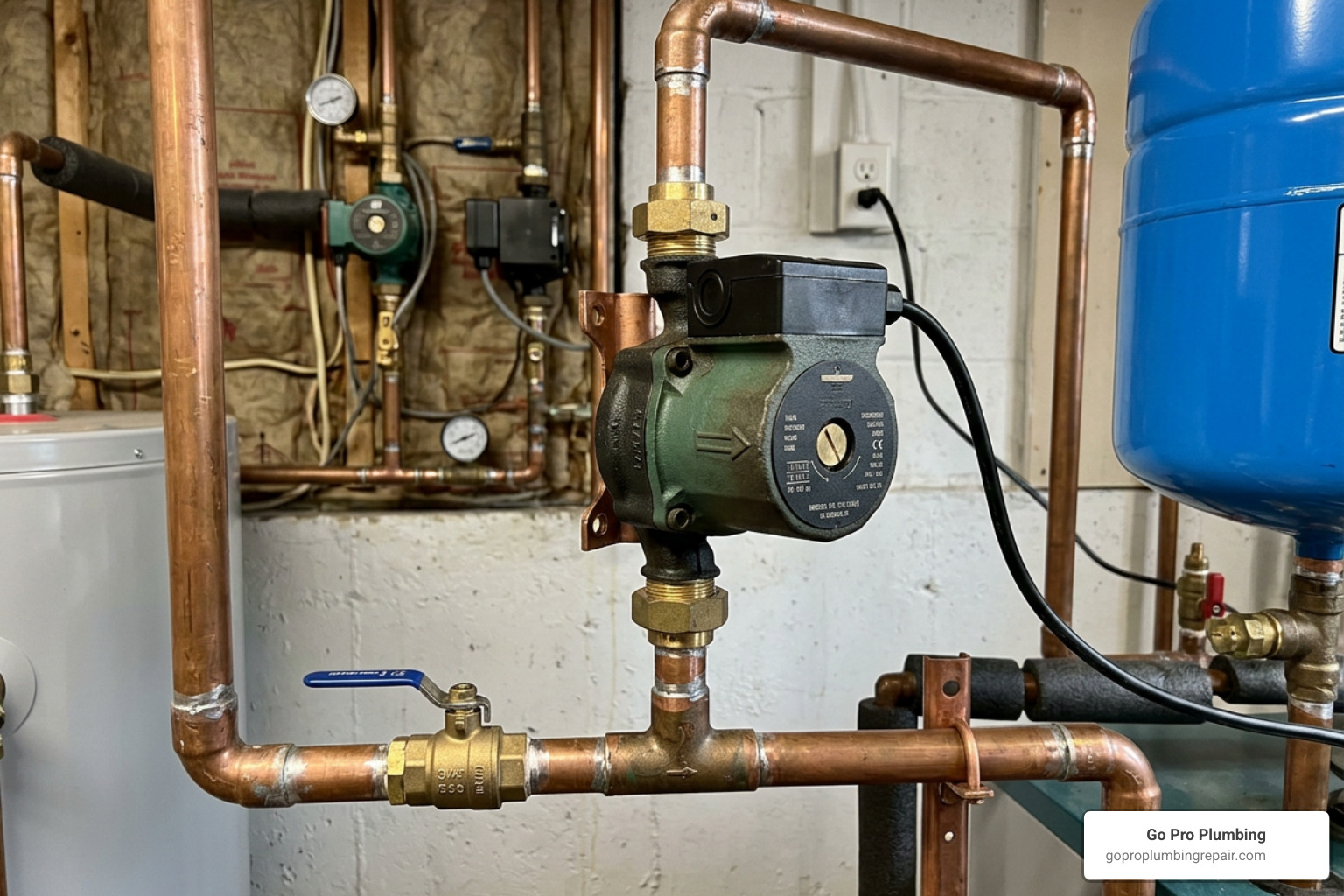
To understand what an in line circulating pump is, let’s start with how it sits in your plumbing system. Unlike massive sump pumps or well pumps that push water from deep underground or lift it from a pit, an in-line pump is designed to be spliced directly into your existing pipe run.
At its core, a circulator is a specialized type of centrifugal pump. It features an inlet and an outlet that align perfectly with your pipeline, allowing the fluid to flow straight through. When you turn on the pump, an internal impeller spins, using centrifugal force to accelerate the water and push it forward.
Because the system is a closed loop (or a pressurized open loop), the pump doesn’t need to fight gravity to lift the water from scratch; it simply needs to overcome the friction created by the inside of the pipes. This makes the Hot Water Recirculating Pump incredibly energy-efficient, often running on less electricity than a standard household light bulb.
When shopping for these pumps, you will quickly run into two primary designs:
- Wet Rotor Pumps (Glandless): In these models, the rotor of the motor is completely submerged in the fluid being pumped. The water acts as both a lubricant and a coolant for the bearings. These are incredibly quiet, virtually maintenance-free, and are the standard choice for residential applications.
- Dry Rotor Pumps (Glanded): In a dry rotor design, the motor is sealed off from the fluid by a mechanical shaft seal (often referred to as a gland). The motor shaft connects to the impeller, but the motor itself remains dry. These are louder and require occasional maintenance, but they are far more powerful, making them the go-to choice for heavy-duty commercial and industrial applications.
How In-Line Pumps Differ from Other Circulators
When looking at the broader world of centrifugal pumps, in-line circulators stand out because of their highly compact footprint. Traditional end-suction centrifugal pumps require a heavy concrete pad, concrete anchors, and complex alignment between the motor and the pump volute.
In-line pumps, on the other hand, support direct pipe mounting. This means the pipes themselves support the weight of the pump (though larger commercial models may feature tapped pump feet for auxiliary support brackets). This inline design saves an immense amount of floor space in mechanical rooms and residential utility closets alike.
For example, specialized drinking water circulators like the Wilo-VeroLine-IP-Z | Wilo utilize this space-saving, glanded design with threaded connections to deliver high reliability in compact domestic hot water systems without taking up valuable floor space.
Key Applications and Use Cases

In-line circulating pumps are the unsung heroes of thermal comfort and fluid dynamics. They are deployed anywhere water or glycol needs to be kept in motion to maintain a consistent temperature or chemical balance.
- Hydronic Heating & Radiant Floors: If your home or business uses boiler-based heating, an in-line pump is responsible for pushing hot water from the boiler through the baseboards or radiant floor tubing embedded in your concrete slabs, ensuring even heat distribution throughout the building.
- Chilled Water & Cooling Systems: In larger buildings, these pumps circulate chilled water or water-glycol mixtures from cooling towers and chillers to air handlers to keep indoor spaces comfortable during hot Sacramento summers.
- Solar Thermal Loops: For eco-conscious homes, solar collectors on the roof absorb heat from the sun. An in-line pump circulates water or heat-transfer fluid up to the collectors and down to a heat exchanger in your storage tank. If you want to dive deeper into this green technology, check out The Ultimate Guide to Solar Hot Water Recirculating Pumps for Eco-Friendly Homes.
Residential and Commercial Uses for an In Line Circulating Pump
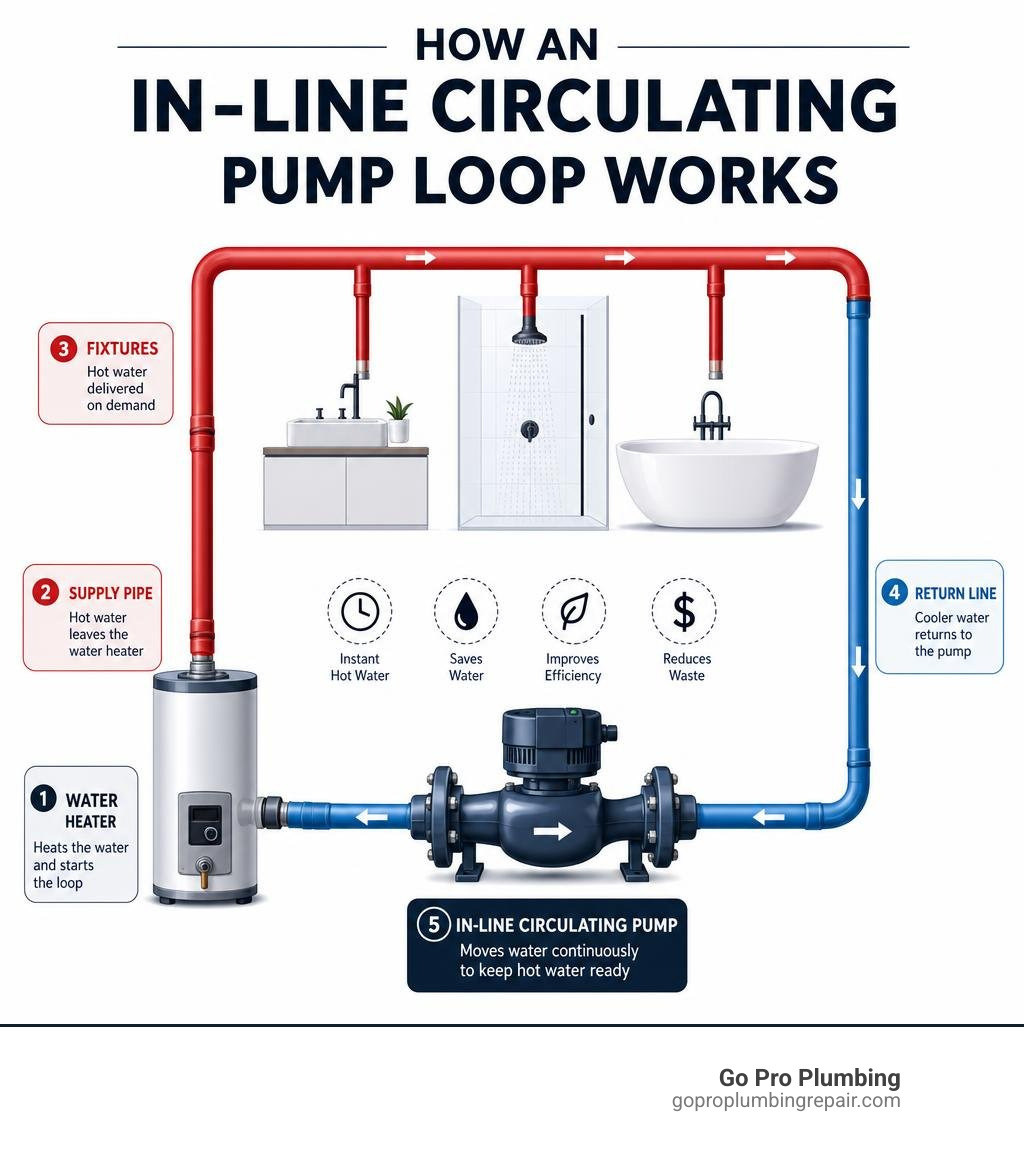
In residential and commercial plumbing, the most popular application is domestic hot water recirculation. In standard plumbing layouts, when you turn off the hot water tap, the water remaining in the pipes cools down. The next time you turn on the tap, you have to dump all that cold water down the drain while waiting for hot water to travel from the water heater.
By installing an in line circulating pump on a dedicated return line, the system continuously pulls the cooled water back to the water heater to be reheated, keeping a steady supply of hot water right behind your fixtures. You can learn more about how this system works in our guide on the Hot Water Recirculating System with Dedicated Return Line.
In commercial properties like hotels, apartment complexes, and office buildings, these systems are scaled up. They ensure that guests on the 5th floor get hot water just as quickly as those on the ground floor, saving thousands of gallons of municipal water every single year.
Industrial and Transportation Applications
Beyond buildings, highly specialized in-line circulators are used in industrial processes and transportation systems. For instance, heavy-duty machinery, agricultural equipment, and marine vessels require constant coolant circulation to prevent engines and hydraulic systems from overheating.
A prime example is the 1″ x 1″ Centrifugal Transportation Circulator , which uses a 12V DC brushed motor to circulate coolant in mobile or marine environments, handling fluid temperatures up to 220°F (104°C) while maintaining a compact, vibration-resistant footprint.
Selecting the Right Pump: Materials and Specifications
Choosing the right pump is about matching the fluid in your pipes with the correct pump materials and performance specifications. If you get this wrong, you could end up with a pump that burns out prematurely, or worse, contaminates your drinking water.
When it comes to construction materials, three options dominate the market:
- Cast Iron: Cast iron is highly durable and cost-effective, but it is highly susceptible to rust when exposed to oxygenated water. Therefore, cast iron pumps are strictly used in closed-loop systems (like hydronic heating and closed cooling circuits) where the same water is recycled indefinitely and oxygen levels are near zero.
- Lead-Free Bronze & Stainless Steel: In open-loop systems (like domestic potable water systems), fresh, oxygen-rich water is constantly introduced. This oxygen would quickly corrode a cast iron pump. For these applications, federal regulations require corrosion-resistant, lead-free bronze or stainless steel bodies to protect public health. To understand why this is non-negotiable, check out The Bronze Standard Unpacking Recirculation and Secondary Circulation Pumps.
Sizing and Specifying Your In Line Circulating Pump
To select the perfect pump, you must understand its technical specifications. Sizing a pump incorrectly can lead to noisy pipes, high energy bills, or a system that simply fails to deliver hot water.
Here are the key metrics you need to evaluate:
- Flow Rate (GPM): Gallons Per Minute measures the volume of water the pump can move. For a standard residential hot water loop, you usually only need 1 to 5 GPM.
- Head (Feet of Head): This measures the pump’s ability to overcome resistance (friction loss) within the piping system. It has nothing to do with the physical height of the building in a closed loop, but rather how hard the pump has to push to get water through all the elbows, valves, and straight pipe runs.
- Motor Horsepower (HP) & RPM: This indicates the power of the motor and how fast the impeller spins. Residential models are often 1/25 to 1/6 HP, while massive commercial models can exceed 10 or 20 HP.
- Voltage: Residential pumps typically run on standard 115V single-phase power, whereas commercial and industrial facilities may require 208V, 230V, or 460V three-phase systems.
For a step-by-step breakdown of how to calculate these numbers for your home, take a look at our Recirculation Pump Sizing Complete Guide.
Variable-Speed vs. Single-Speed Efficiency
Historically, circulator pumps were single-speed devices. They ran at 100% capacity regardless of whether your home needed it or not. Today, variable-speed and smart-recirculation pumps have completely changed the game.
By utilizing integrated microprocessors and differential pressure sensors, variable-speed pumps can automatically adjust their speed to match the real-time demand of the system. For example, the Wilo-CronoLine-IL-E | Wilo features integrated electronic power adjustment, allowing commercial systems to save up to 70% in energy consumption compared to standard fixed-speed pumps.
| Feature | Single-Speed Pumps | Variable-Speed (Smart) Pumps |
|---|---|---|
| Energy Consumption | High (runs at max speed constantly) | Extremely Low (adjusts to actual demand) |
| System Wear & Tear | Higher pressure leads to pipe erosion | Lowers pressure when demand is low, extending pipe life |
| Control Options | Simple On/Off or Timer | Integrated sensors, Δp-c, Δp-v, and PID-control |
| Upfront Cost | Budget-friendly | Higher initial investment, but fast payback |
Installation, Maintenance, and Brand Comparisons
Installing an in line circulating pump is a straightforward process for a licensed professional, but it requires precision. If you are ready to tackle the physical setup, our comprehensive guide on How to Install Hot Water Recirculating System provides an excellent roadmap.
During the installation process, we always recommend incorporating two vital accessories:
- Isolation Flanges: These are special valves installed directly on both sides of the pump. They allow us to isolate the pump and shut off the water locally, so if the pump ever needs to be serviced or replaced, we don’t have to drain the entire building’s plumbing system.
- Spring-Loaded Check Valves: A check valve ensures that water can only flow in one direction. This prevents cold water from back-flowing into your hot water lines when multiple faucets are turned on simultaneously.
Leading Manufacturers and Reliability
When investing in a pump, sticking to trusted industry brands pays dividends in long-term reliability and parts availability.
- Bell & Gossett (B&G): An industry titan, B&G pumps are legendary for their durability. Their residential series, like the NRF and Series 100, are highly serviceable, often featuring three-piece oil-lubricated designs that allow you to swap out bearings and seals without replacing the entire pump.
- Wilo: Known for cutting-edge German engineering, Wilo excels in high-efficiency smart pumps. Their Wilo-CronoLine-IL | In-line pump | Wilo is a masterclass in commercial design, handling up to 1,450 GPM with cast iron cataphoresis-coated volutes and trimmable bronze impellers.
- Armstrong: A leader in hydronic heating, their Astro series offers fantastic 3-speed versatility for residential systems, allowing installers to fine-tune the pump’s performance with the flick of a switch.
- SPX Flow (CombiLine): Highly regarded in industrial sectors, their CombiLine series features a back-pull-out design, meaning the motor and rotating assembly can be removed for service without disconnecting the pump casing from the piping.
Maintenance and Durability Features
To ensure your pump lasts for decades, you should understand its maintenance needs. Wet rotor pumps are generally maintenance-free because the system fluid lubricates the bearings. However, dry rotor (glanded) pumps require a bit of attention.
Key durability features to watch for include:
- Mechanical Seals: These seals prevent water from leaking along the rotating shaft into the motor. Over time, mineral buildup can score the seal, leading to leaks. Keeping your water hardness in check can significantly extend seal life.
- Oil-Lubricated Bearings: Some high-end commercial pumps require periodic oiling. Failing to lubricate them on schedule will cause the bearings to overheat and seize.
- Dry Shafts: Modern designs keep the motor shaft completely dry, protecting the motor’s electrical components from moisture-related failures.
If you ever run into issues like strange noises, weak flow, or leaks, head over to our troubleshooting guide on Hot Water Recirculation System Problems to diagnose the issue quickly.
Frequently Asked Questions About Recirculation Pumps
Does an in line circulating pump need to run 24/7?
No, and in most cases, it shouldn’t! Running a pump 24/7 wastes electricity and accelerates wear on your plumbing pipes (potentially causing pinhole leaks due to erosion).
Instead, you can use timers, aquastats (which shut the pump off once the water in the loop reaches a set temperature), or smart motion sensors. For a full breakdown of your options, read Does a Hot Water Recirculating Pump Run All the Time.
Can I install a recirculation pump on a tankless water heater?
Yes, but you must ensure compatibility. Tankless water heaters require a minimum flow rate to activate their burners. If your pump’s flow rate is too low, the heater won’t turn on, and you’ll get a loop of lukewarm water.
Many modern tankless water heaters come with built-in recirculation pumps, but if yours doesn’t, we can install a compatible external pump designed specifically to work with tankless flow requirements. Learn more in our guide on Hot Water Recirculation for Tankless System.
What are the signs that my circulating pump is failing?
The most common signs of a failing pump are:
- Loud humming, clicking, or screeching noises: This usually indicates worn-out bearings.
- Cold water at your fixtures: The pump may have seized or lost electrical power.
- Visible water leaks: This points to a blown mechanical seal or a failed flange gasket.
If you suspect your pump is on its last legs, read Never Wait Again Understanding Your Recirculation System for tips on how to verify its performance.
Conclusion
An in line circulating pump is a game-changer for any property. Whether you want to eliminate the morning wait for hot water in your Rancho Cordova home, maintain a massive hydronic heating loop in a Sacramento commercial facility, or optimize an industrial cooling line, selecting and installing the right pump is key to efficiency and comfort.
While choosing and sizing a pump can feel overwhelming, you don’t have to navigate it alone. At Go Pro Plumbing, we serve Sacramento, Rancho Cordova, and the surrounding Northern California communities with pride.
We are committed to outstanding customer service and offer same-day service to get your hot water flowing perfectly without delay. If you’re ready to upgrade your home or business with a highly efficient recirculation system, check out our Services Water Recirculation Pumps page and contact us today to schedule your consultation!